Decodable Books vs. Leveled Readers in Early Literacy
Research shows decodable texts build decoding skills better than leveled readers alone.
Beginning readers need decoding practice before they need book variety. That's the finding underneath decades of argument over decodable books versus leveled readers, and once you look at how children's brains actually learn to read, the debate stops being a matter of taste. Leveled reading has run American classrooms for thirty years on the strength of intuition, and the evidence increasingly contradicts that intuition. State the position plainly: leveled reading, used as the main tool for beginning readers, optimizes for the wrong thing at the wrong stage, and the field has spent three decades treating a comprehension tool like a decoding tool.
Skilled reading is several skills running at once: phonological awareness, decoding, orthographic mapping, fluency, vocabulary, oral language, background knowledge, comprehension. Scarborough's "rope" model, published in 2001, gives the clearest picture: strands that start separate and braid together as a reader develops. Phonics is one strand in that rope, but everything else gets tied to it first, because a child has to hear and manipulate sounds before those sounds mean anything on a page.
Here's the mechanism that makes this concrete. Every time a child sounds out a word successfully, something changes in how that word gets stored. Linnea Ehri and David Share call this orthographic mapping, and Share's "self-teaching hypothesis" describes it well: each successful decode builds a connection between the letters and the sound, until the word stops requiring effort and becomes instantly recognizable. Do this enough times, with enough words, and decoding turns automatic; once it's automatic, the brain has room left over for understanding what the words mean. Fluency is the bridge between phonics and comprehension, and skipping that bridge leaves comprehension with nowhere to land.
The Science of Reading organizes all of this into five pillars: phonological awareness, phonics, fluency, vocabulary, comprehension. That framework turns "decodables versus leveled readers" from a philosophical fight into a testable question. Ask which text type serves which pillar, and at what stage of a child's development, and the evidence points hard in one direction.
The reading crisis that makes this question urgent
The 2024 Nation's Report Card landed hard. Fourth and eighth grade reading scores dropped significantly, and more than a third of eighth graders now read below the NAEP Basic level, the highest proportion ever recorded on that test.
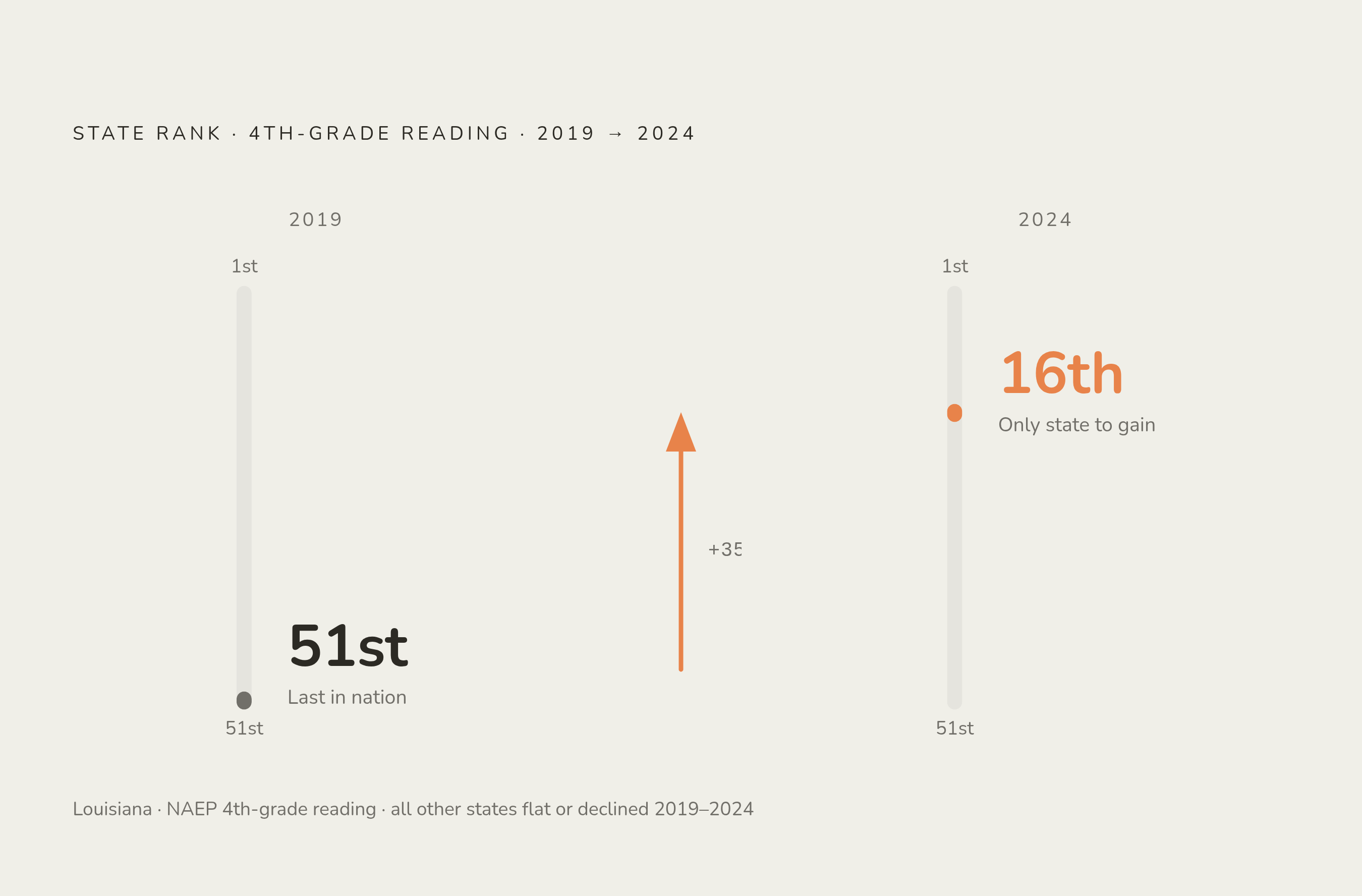
One state moved the other direction. Louisiana ranked last in the nation for fourth-grade reading in 2019, and by 2024 it ranked 16th, the only state to post a gain over that stretch. That jump lines up directly with a statewide pivot to Science of Reading-aligned instruction: phonics-first, systematic, sequenced. It functions as a natural experiment, and the results match exactly what the research on decoding and orthographic mapping would predict.
Policy is catching up faster than classrooms are. As of late 2024, most states have passed legislation or adopted policy requiring evidence-based reading instruction. Laws don't rewire a classroom overnight, though, and plenty of teachers are still handing out leveled readers and running leveled reading groups while their state's own mandate points toward phonics-first, decodable-based instruction. That gap, between what the law now requires and what's actually happening at the classroom table, is exactly where this question lives.
What decodable books are and why their design is intentional
Decodable texts are built against a systematic phonics scope and sequence, so a child only meets letter-sound patterns they've already been taught. If a first grader hasn't learned the "igh" pattern yet, a well-built decodable won't put "night" or "light" in front of them, and there's no picture on the page to bail the kid out instead.
That constraint does real work. Every successful decode reinforces orthographic mapping, the exact mechanism that turns effortful sounding-out into instant word recognition. The controlled vocabulary serves that mapping process directly: it removes the temptation to guess a word from its first letter or the picture next to it, and guessing works against building a durable reading brain. The scope-and-sequence structure also makes progress visible. A parent or teacher can point to a decodable and know exactly which skills it's testing and what comes next.
Decodables are the practice field for one skill, decoding, during the specific window when that skill is under construction. Worth being honest about their limits, too. Vocabulary restrictions rule out entire topics; most dinosaur names, for instance, aren't decodable at early reading levels, since the letter patterns are too advanced. The prose can come out sounding stiff, since natural phrasing sometimes loses out to decodability. Decodables, by design, also won't build rich vocabulary, deep comprehension, or a love of story on their own. Those come from somewhere else, usually a parent or teacher reading aloud.
What the research actually shows about decodable texts
A 2023 meta-analysis by Pugh, Kearns, and Hiebert, later summarized by Timothy Shanahan in 2024, compared reading interventions across four conditions: no texts at all, decodable texts only, non-decodable texts only, and a combination of both. The combination condition, decodables plus other texts, significantly outpaced every other group in decoding ability.
Worth sitting with what that actually says. The winning condition combined both text types, and a clear finding emerges anyway: pulling decodables out of the mix costs something measurable in decoding outcomes. Removing them isn't a neutral choice, and any program that skips them entirely is leaving a known gain on the table.
A separate 2024 meta-analysis by Murphy Odo found decodable texts significantly improve phonics knowledge and decoding skill, with the strongest effect on pseudoword reading. That detail matters more than it sounds like it should. Pseudowords, made-up strings like "vope" or "glimt," can only be read correctly by applying letter-sound rules; there's no whole-word memory to fall back on, no picture to guess from. Pseudoword reading is one of the most reliable predictors of later reading success precisely because it strips away every shortcut and leaves decoding standing alone.
Repeated reading of decodable text is also what builds the automaticity behind fluency, the same orthographic mapping mechanism at work again, just reinforced through repetition. What the research doesn't settle is duration. Consensus is missing on exactly how long a given child needs heavily controlled decodable texts; some kids move through the stage fast, others need more mileage. Mesmer's 2020 work and Shanahan's 2024 analysis agree on the shape of the answer even without agreeing on the number: decodables earn their keep at a specific developmental stage, not as a permanent diet.
What leveled readers are and the instructional bet they place
Leveled readers sort books by overall difficulty: sentence length, vocabulary complexity, how much the illustrations carry the story. A child gets assessed, assigned a level, usually something on a letter-based A-Z scale, and handed a "just-right" book that matches it.
The logic underneath that system is straightforward: reading at your current level, repeatedly, is how you get better. Early leveled texts lean on rich illustrations and predictable, repetitive language specifically to support comprehension and engagement before decoding is solid. That's the bet leveled readers place: meaning and engagement come first, decoding follows behind it. The Science of Reading places the emphasis in the reverse order, and it does so on solid mechanistic ground: decoding comes first, meaning follows once decoding stops eating up all the cognitive effort.
Leveled readers usually travel with a companion strategy called three-cueing. Children get taught to use context, pictures, and sentence structure to guess an unfamiliar word, rather than sound it out. That's efficient in the moment; a kid stuck on a word can glance at the illustration and keep the sentence moving. Yet it teaches the brain to route around decoding instead of building it, and that habit has a ceiling: once texts get harder and the pictures thin out or disappear, a child who learned to guess well runs out of runway, while a child who learned to decode doesn't. This is the failure mode worth naming directly: three-cueing produces kids who look like strong readers in kindergarten and stall out around third grade, right when texts stop carrying pictures on every page.
Leveled readers still earn a place in the conversation. The language reads more naturally, the subject matter is wider, and they're genuinely better at hooking a kid's interest in something they already care about: dinosaurs, space, horses, whatever it is. Those are real strengths, but strength at engagement isn't the same as strength at building the skill that makes independent reading possible in the first place. The field has spent thirty years mixing up the two.
The evidence against leveled reading as the primary early literacy tool
Timothy Shanahan's 2025 book, Leveled Reading, Leveled Lives (Harvard Education Press), is the sharpest recent critique of the system. His central claim: matching a student to a "just-right" book at their individually assessed level has never had strong experimental backing. Achievement doesn't reliably rise just because a child is reading at the level a test says they're at, and treating that match as the engine of progress is the part everyone got backwards.
A 2024 analysis backs this up from another angle. It found the most effective schools keep instruction anchored at grade level rather than splintering it by individual reading level, a direct challenge to the entire premise leveled reading is built on.
Leveled reading groups make the problem worse, not better. Reporting from Education Week found these groups, still the dominant classroom practice across a large majority of K-5 classrooms, widen achievement gaps over time rather than closing them. Below-benchmark readers did worse inside leveled groups than they did when left ungrouped entirely. Sit with that for a second: the intervention built to help struggling readers is, in practice, one of the things keeping them stuck.
Shanahan also takes aim at the measurement itself. Reading level benchmarks, he notes, are often inconsistent and imprecisely applied, yet teachers treat them as authoritative when deciding how to differentiate instruction. That's a shaky foundation for a system this widespread. An equity cost sits buried in it, too: ability grouping in early grades calcifies fast. Kids sorted into the "low" group rarely climb out of it, and the gap between groups tends to widen instead of narrow over the years that follow.
One qualification matters here. Shanahan's target is narrower than eliminating leveled texts altogether. He's after leveled reading groups and the "just-right book" doctrine as the primary instructional strategy, and he treats leveled texts themselves as one tool sitting among several.
How the two text types fit together across a child's development
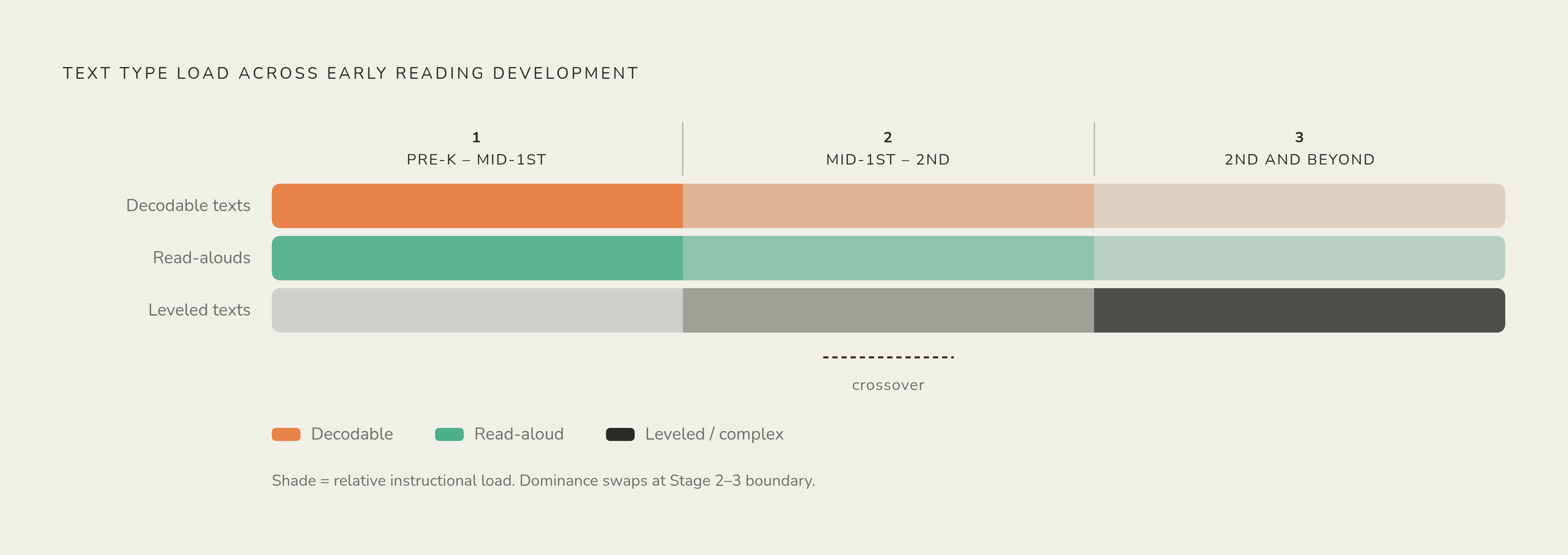
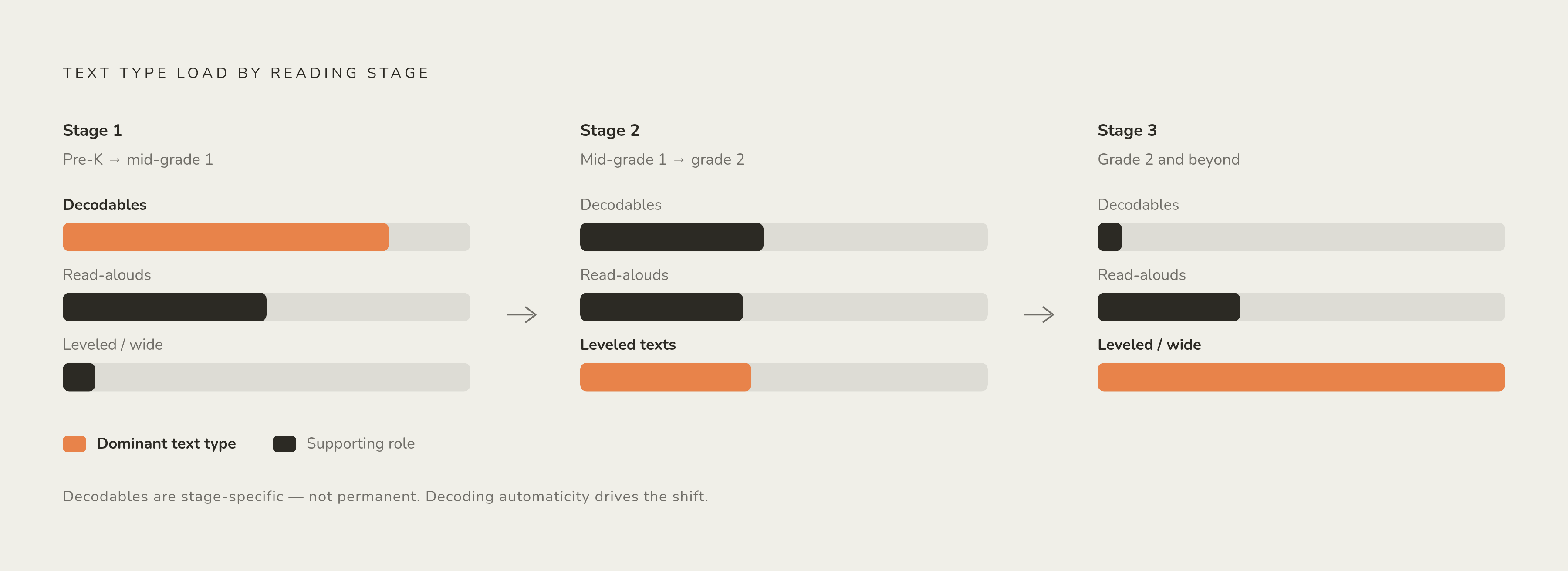
The role each text type plays shifts as the child's skills shift. Many classrooms still treat one format as a fixed, permanent tool rather than a stage-appropriate one, and that habit is worth correcting.
Early on, roughly Pre-K through the middle of first grade for a typically developing reader, decodable texts should carry the load for independent reading practice. Every word the child meets on their own should sit within reach of what they've already been taught. Meanwhile, rich read-alouds from a parent or teacher fill the gap decodables can't touch: vocabulary, comprehension, the sense that stories are worth caring about. The adult carries the meaning-making burden while the child's brain builds the decoding machinery underneath it.
The middle stretch, roughly mid-first grade through second grade, is transitional. Orthographic mapping keeps deepening, and the child needs less controlled text to practice on independently. More complex leveled texts can start entering the rotation now, but the difference is that the child applies real decoding skill to them, rather than falling back on guesswork from pictures and context.
By second grade and beyond, leveled texts come into their own. Decoding is mostly automatic by this point, so the frontier has moved to comprehension: complex grammar, richer vocabulary, denser content. As Shanahan puts it, a wide reading diet exposes kids to a broader range of language than a narrow one ever could. Eventually, for a skilled reader, every book becomes decodable; that's the whole destination.
The Pugh, Kearns, and Hiebert meta-analysis is the empirical anchor for this staged approach. Decodables plus other texts beat every single-text condition tested, and the research already points toward exactly this kind of layered integration, not a lifetime commitment to one format.
What parents should look for when choosing reading tools and apps for early readers
The research boils down to a short set of concrete questions worth asking about any reading app or tool before handing it to a kid.
Does it follow a systematic phonics scope and sequence, or does it mix skill levels without a clear order behind them? Does the practice text actually match what the child has been taught, instead of quietly requiring them to guess unfamiliar patterns? Does it adjust as the child's skills develop, or does it treat every seven-year-old the same regardless of where they actually are? Can a parent see what's been practiced and what's still missing, or is progress a black box? Does it build fluency through repeated, successful decoding, or does it reward speed and lucky guesses the same way?
A few things deserve real skepticism, and one deserves outright rejection: any app that levels its books without a phonics scope and sequence underneath amounts to three-cueing on a screen, and putting a tablet in front of a kid doesn't fix a bad instructional model on its own. A passive content library or a quiz format also falls short of real instruction. A child learning to decode needs something that listens and responds in the moment, catching the exact sound they stumbled on, rather than a system that scores a multiple-choice answer after the fact. Bright colors and high engagement aren't proof of instructional quality, either; a kid can be having a great time getting better at guessing instead of decoding. The real question is always whether the child is building decoding skill or just getting better at working around the need for it.
Parents deserve to see that distinction laid out plainly, with progress reporting that shows which phonics skills a child has actually practiced, not just how many minutes they spent tapping a screen. Access to instruction built on this evidence shouldn't sit behind a premium tier that only some families can afford, either; a free option with an optional paid upgrade keeps a Science of Reading-aligned approach within reach of more households.
The bigger point stands past any single app or book. The Science of Reading hands parents a framework: what does a child need right now, at this exact stage of learning to read, and does the tool in front of them actually supply it. Judge everything, print or digital, against that question, and "decodables or leveled readers" stops being a debate. It becomes a schedule instead.