IEP Accommodations for Early Readers With Language-Based Learning Disabilities
IEPs teach missing skills while 504 plans just remove barriers—and the difference is crucial.
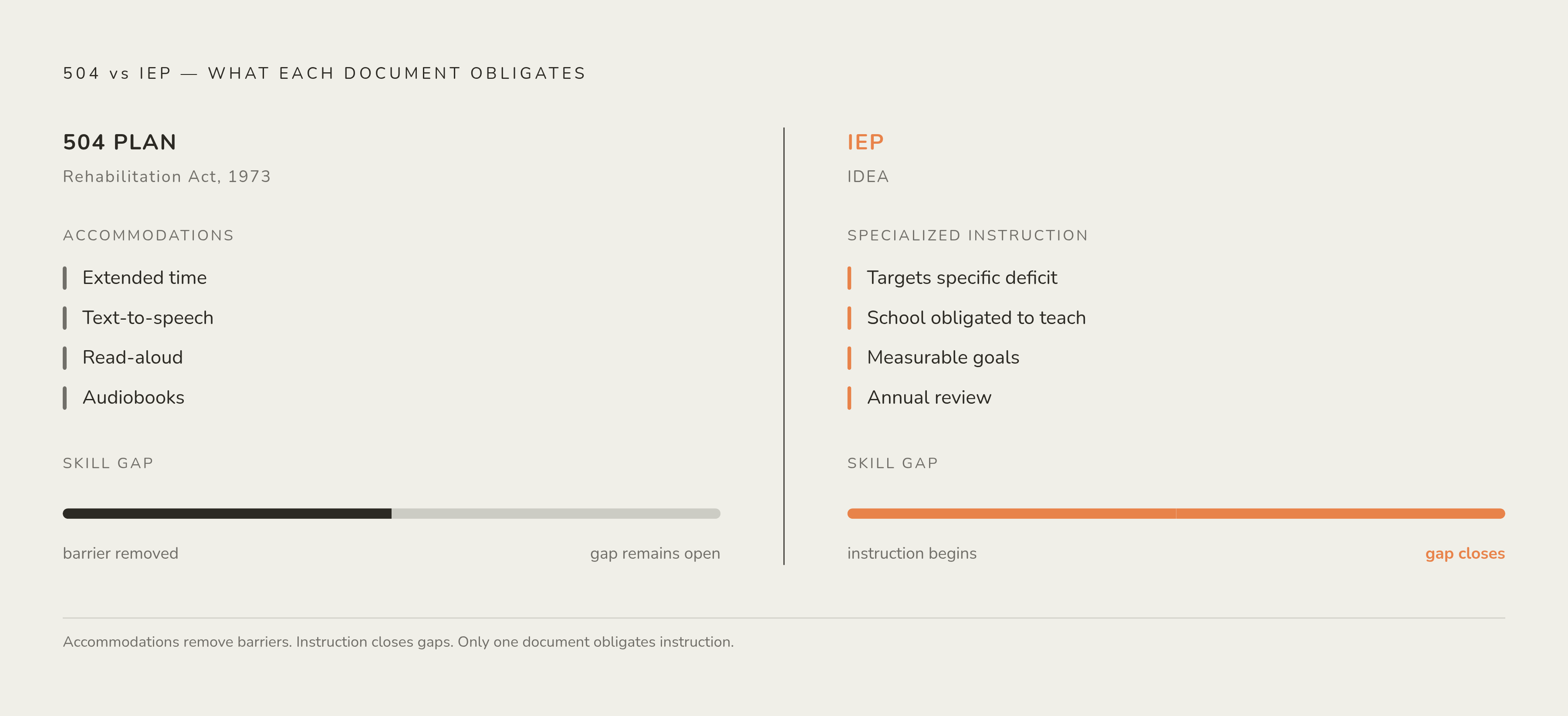
That confusion sits at the center of a lot of bad advocacy, because an IEP and a 504 plan are not two flavors of the same support. An IEP provides specialized instruction under IDEA, while a 504 plan provides accommodations under the Rehabilitation Act of 1973: one teaches differently, the other removes barriers. Both are legal documents the school must follow, but only the IEP obligates the school to deliver instruction aimed at the child's specific deficit. A child who receives only accommodations, extended time, read-aloud support, text-to-speech, may well keep up with the class content, but none of that teaches the reading skill that's actually missing. This isn't a technicality to skim past. A parent who treats a non-IEP plan as equivalent to an IEP may accept a plan that never addresses the root cause of their child's struggle.
IEP eligibility conditions
Getting an IEP requires clearing two separate legal hurdles, and missing either one, even with a strong clinical diagnosis in hand, means no IEP. The first hurdle: the child must have a disability that falls under one of 13 federal categories. For reading struggles specifically, the categories that usually apply are Specific Learning Disability (the category dyslexia typically falls under), Speech or Language Impairment, and Other Health Impairment. The second hurdle is separate and just as important: the disability has to adversely affect educational performance, and the child has to require specialized instruction to make progress. A diagnosis by itself doesn't satisfy this. The school has to independently find that the disability is affecting the child's education. This is where things get frustrating for families who assume a diagnosis settles the matter. A child with dyslexia or a language processing disorder can have a documented, clear clinical profile and still be denied an IEP if the school decides accommodations alone will get the child through. That's exactly the scenario where knowing the difference between access and instruction protects a family from accepting a weaker plan than the child needs.
504 eligibility, by contrast, sets a lower bar. A child needs only a physical or mental impairment that substantially limits a major life activity, and reading, learning, concentrating, and thinking all count. A child who doesn't need specialized instruction but does need certain barriers removed may be correctly placed on a 504 rather than an IEP, since some children's evaluations point to IEP eligibility, some point to 504 eligibility, and some qualify for both. Students learning English as an additional language present a genuinely harder case to untangle, because language acquisition and dyslexia can look similar on the surface, and the evaluation has to separate the two before eligibility can be determined.
What language-based learning disabilities do to a young reader's brain
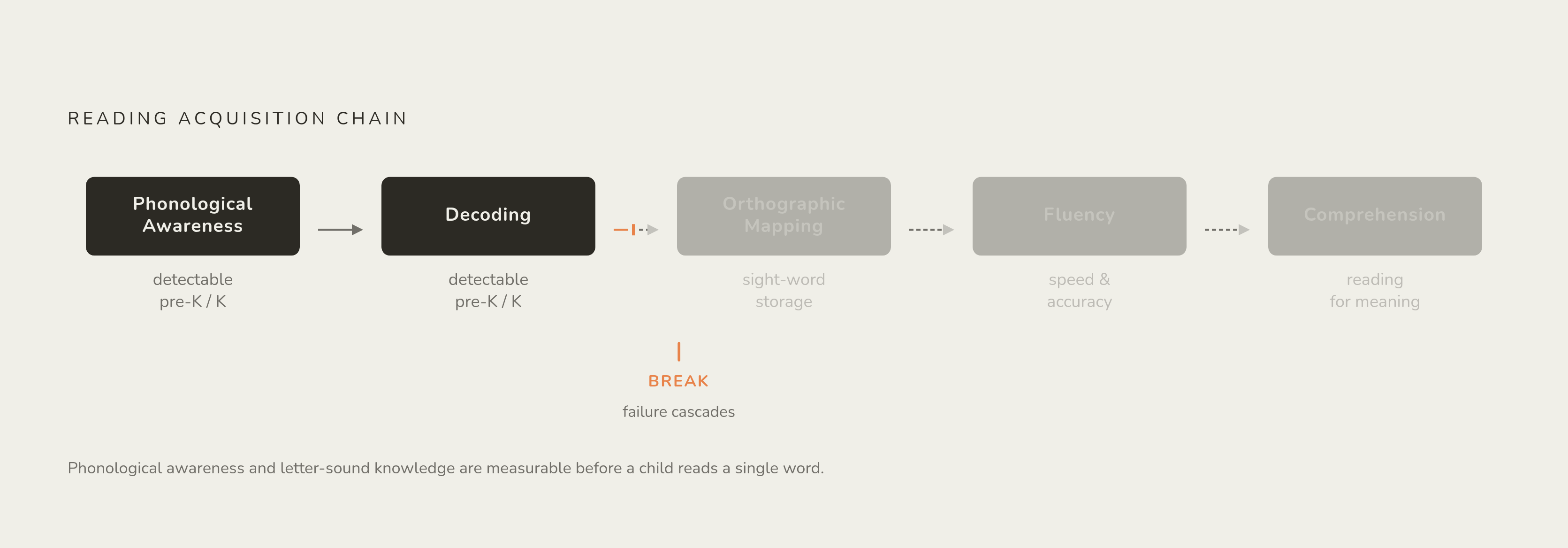
Dyslexia and related language-based learning disabilities produce a range of symptoms rather than a single one. They disrupt a chain of processing: phonological awareness, decoding, orthographic mapping, fluency, and finally comprehension, and a break anywhere in that chain can't be patched over by removing a barrier. A parent watching this up close sees a child confusing letter sounds, reading aloud slowly and with visible effort, or failing to recognize a word today that the child read correctly yesterday. None of that reflects the child's intelligence. Dyslexia is a neurobiological learning difference, and it affects reading fluency, decoding, and phonological processing specifically, not general cognitive ability.
The chain matters because each link depends on the one before it. Decoding supports fluency, and fluency is what makes deeper comprehension possible, so a child who can't decode accurately can't build the fluency that comprehension depends on. Phonics instruction plays a central role here, but it doesn't work alone. Phonemic awareness lays the groundwork and is usually introduced first, though it's taught alongside phonics rather than strictly before it, and the two together build toward orthographic mapping, the process by which a word stops requiring sounding-out and becomes an instantly recognized unit.
Phonological awareness and letter-sound knowledge problems are visible before a child can read a single word. Phonological awareness and letter-sound knowledge can be screened in pre-K and kindergarten, which gives schools a chance to flag children at risk for decoding difficulty before years of failure accumulate. And the picture is rarely isolated to reading alone. ADHD, dysgraphia, and dyscalculia frequently appear alongside dyslexia, so a child's IEP may need to address more than one processing deficit at once.
What access accommodations do
Access accommodations exist to solve a real and immediate problem: a child reading below grade level cannot absorb grade-level science or social studies content by reading grade-level text on their own. Tools that read text aloud or convert speech to text let that child keep learning content while decoding skills are still developing, and in a content-area class, that tradeoff makes sense, because the point of the lesson is the content, not the reading test. Common accommodations built around this goal include text-to-speech, audiobooks, a human reader, easier-level alternative texts, speech-to-text for writing, removing spelling-error penalties, breaking reading into smaller chunks, extended time on assessments, graphic organizers and sentence starters, dyslexia-friendly fonts, masking non-essential content on a page, and preferential seating. None of this lowers the bar for what the child is expected to know. It separates reading ability from content mastery, and that's a legitimate, useful distinction for a child whose decoding lags behind their thinking.
But there's a limit baked into the design of these tools: a child who relies on them exclusively never builds the underlying skill those tools are standing in for. A child who relies on text-to-speech for everything never practices the sequence that actually builds a skilled reader: sounding out letters, blending them, checking the result, and storing it as a recognized unit. The tool removes the barrier in that moment, but it also removes the practice that would have closed the gap permanently. Many parents ask directly: if a child can hear the text and understand it, why does decoding still matter? Listening comprehension and reading comprehension track together early on, but they diverge as texts grow longer and more complex, and a child who never learns to decode independently stays dependent on someone else being present to read for them, indefinitely.
Modern assistive technology has made these access tools considerably more capable, and naming them helps parents recognize what to look for in a classroom. Microsoft's Immersive Reader delivers text-to-speech support directly inside content-area lessons. Co-Writer's topic-aware word prediction can interpret phonetically distorted spelling in a way ordinary autocorrect cannot. A student typing "fotosintheesis" in a biology assignment gets "photosynthesis" suggested back, because the tool understands the subject matter. Kurzweil goes further still, combining text-to-speech, word prediction, graphic organizers, brainstorming support, and study-skills tools into one platform built specifically for students with learning disabilities.
Even these more sophisticated tools share the same ceiling. They remove friction in the moment, but they don't teach phonological processing, and that's precisely why an IEP needs to fund both the access tools and the intervention that targets the underlying deficit. One without the other leaves half the job undone.
What structured literacy intervention is
Structured literacy is explicit, systematic, multisensory instruction in phonological awareness, phonics, and decoding, taught in a specific sequence where each skill builds on the one before it. It's the intervention that actually closes a reading gap, and a parent who understands what it looks like can tell, fairly quickly, whether an IEP's services column is actually delivering it or just gesturing at it. Students with or at risk for reading difficulties benefit most from explicit, code-based instruction delivered one-on-one or in small groups, rather than folded into whole-class teaching where it gets diluted.
An older assumption held that phonics instruction mattered less for older struggling readers, once they'd missed the early window. Recent research has pushed back hard on that idea. A study by Dr. Timothy Mills, and a separate study by the ETS Research Institute working with Reading Reimagined, both identified something called a "decoding threshold," a specific foundational decoding level a student needs to reach before comprehension can keep improving. Below that threshold, the deficit doesn't resolve on its own with age or exposure, which is the clearest evidence that instruction closes the gap.
This is where the distinction from earlier sections becomes a practical test a parent can actually run. An IEP that lists only accommodations in its services column, with no specialized reading instruction from a qualified specialist, is an access plan, not a reading intervention. It's an access plan wearing an IEP's paperwork. Parents sitting across the table from a school team can ask direct, specific questions without it feeling adversarial: who delivers the reading instruction, how many minutes per week, which curriculum or approach is used, what evidence supports it, and whether the instruction is explicit and systematic or just embedded incidentally into other lessons. Those questions confirm the services column matches what the child's evaluation says they need, without challenging the school's competence.
The MTSS framework gives a useful structure for sorting out what "enough" intervention looks like. Tier 1 is core classroom instruction that every student receives. Tier 2 adds small-group intervention for students who need more. Tier 3 is intensive, individualized instruction, and a child who has qualified for an IEP typically needs Tier 3 support. If a child's plan tops out at Tier 1 or Tier 2 support despite an IEP on file, that's a sign the intervention doesn't yet match the eligibility finding.
How IEP goals should be written
A goal that can't be measured can't be challenged, and vague language is how a reading gap quietly continues without anyone being accountable for it. Compare two goals side by side. "The student will improve reading skills" commits the school to nothing specific and can't be checked against any real data. Contrast that with a goal built the way the research recommends: "the child will enhance reading fluency by reading 80 words per minute with accuracy across 3 consecutive sessions, as measured by curriculum-based reading assessment." That single sentence names the skill, sets a number, defines an accuracy threshold, and specifies how long the child has to sustain it. A parent can walk into the next meeting and ask whether the number was hit.
Getting there depends on tracking the right data, and global reading-level labels don't cut it. A score like "reading at a second-grade level" tells a parent their child is behind, but it hides which specific skill is the actual bottleneck and whether the current intervention is even aimed at it. The subtests that reveal that detail include letter naming fluency, phonemic segmentation fluency, nonsense word fluency, word reading fluency, oral reading fluency, and a comprehension measure called Maze. These are the granular markers that show decoding development in progress compared to a general sense of where a child lands compared to peers. Tools like DIBELS, the Dynamic Indicators of Basic Early Literacy Skills, are built to measure exactly these subtests, and schools running structured literacy screening and progress monitoring commonly use them.
None of this requires a parent to become a data analyst. Parents can request progress data at any IEP meeting and should ask which subtests are being tracked, how often, and what the target trajectory is. If the school cannot answer those questions, the monitoring plan is not adequate, regardless of how confident anyone at the table sounds. Specificity here isn't about catching a school in a failure. It protects everyone at the table, including the school, by giving both sides a shared, checkable standard for what progress is supposed to look like.
How assessment accommodations differ from instructional accommodations
The accommodations a child uses during daily classroom instruction and the accommodations a child is entitled to during formal testing are not automatically the same list, and that gap catches families off guard more often than it should. A read-aloud support or extended time that a teacher provides informally during a weekly quiz doesn't necessarily transfer to a standardized state assessment unless it's documented as a testing accommodation specifically, with its own approval process behind it. A child who has grown reliant on text-to-speech for daily work can sit down for a formal exam and discover, mid-test, that the support isn't available in that setting unless a parent confirmed ahead of time that it was written in as an assessment accommodation, not just an instructional one.
This is why the IEP document itself needs to spell out both categories separately rather than treating "accommodations" as one undifferentiated bucket. Instructional accommodations govern how a child accesses daily lessons and coursework. Assessment accommodations govern what supports carry over into formal, often high-stakes testing environments, and the rules for what's allowed can be stricter, more specific, and tied to the particular test being given. A parent reviewing an IEP before a testing season starts should confirm, line by line, that whatever support the child depends on day to day (extended time, a reader, text-to-speech, reduced answer choices) is explicitly listed under the assessment section too. Skipping that check is how a child ends up facing a test without a tool they've used successfully for months, on the one day accuracy matters most to the school's own record of the child's progress.