How to Evaluate a Children's Reading App Using Science of Reading Criteria
Most phonics apps fail to meet basic educational standards based on science.
Fewer than a third of phonics apps on the market today meet basic educational quality standards. That is the finding of Furlong, Serry, Erickson et al. (2025), a peer-reviewed systematic appraisal published in the Early Childhood Education Journal (Springer Nature), which evaluated a large sample of phonics apps using validated quality criteria. Nearly one in five was rated poor. The gap between what reading science says works and what shows up on the app store shelf runs wide, and parents are the ones left to close it. More than 40 U.S. states now mandate or strongly recommend systematic phonics through Science of Reading legislation, so parents hear, correctly, that method matters, then get handed a market where the signal is buried under a pile of noise.
How Children's Brains Learn to Read
Reading is not something the human brain comes built to do. Unlike spoken language, which children pick up just by being around it, written language has to be taught, deliberately and in order, because the brain has no built-in wiring for turning letters into sounds. Stanislas Dehaene's neuroscience research, laid out in Reading in the Brain (2009), used brain imaging to show that phonics instruction is not simply one teaching option among several. It lines up with how the brain is actually built to process text.
That finding carries a chain of consequences that every reading app either respects or ignores. Phonics instruction builds what researchers call the alphabetic principle, the understanding that letters correspond to sounds in a systematic way. That understanding gives a child the tools to decode an unfamiliar word. Decoding, done enough times, turns into fluency. Fluency frees up mental effort that would otherwise go toward sounding out words, so that effort can go toward understanding what the words mean instead.
One detail from the neuroscience matters a great deal for how an app should be built: sound and letter need to be taught together, not as two separate lessons. A child can hear that "cat" has three sounds in it, but that skill only becomes reading when those three sounds get tied to the three letters on the page. Separating the two leaves a child with two disconnected skills rather than one working system that connects sound to print.
Guessing does real damage here, too. David Kilpatrick, in Equipped for Reading Success (2016), explains that every time a child looks at a picture or uses context to guess a word instead of decoding it, that child reinforces a habit that fights against how words actually get stored in memory. The process is called orthographic mapping, and it depends on the brain connecting the sounds in a word to its specific sequence of letters repeatedly until the whole word gets filed away for instant recognition. Guess instead of decode, and that filing never happens correctly. A fluent reader recognizes words and understands the sentence at the same time, while a reader who has not built that skill has to spend so much attention sounding out each word that little is left over for grasping what the page actually says, which is what the NICHD's framing captures.
Whether reading apps can genuinely work
Parents reading the Furlong et al. numbers might reasonably wonder whether the entire category of reading apps is worth trying. The research says the opposite: well-built apps produce real literacy gains, and that finding holds up across a wide body of research. The real question is which apps help, and why.
The fairness angle holds up under direct examination. Schiele et al. (2025) studied a large group of preschoolers and found that structured, app-based practice improved literacy regardless of family background, income, gender, or starting ability. A modest amount of quality practice each week was enough to produce gains that could be measured.
What separated those apps from the pile that failed Furlong's quality review was not polish or production value. The apps that worked taught letter-sound relationships in a logical order, demanded active practice instead of passive watching, and adjusted to what each child needed to learn next. None of that happened by accident, and none of it is unique to any one product. It comes down to design choices that can be checked directly, which the next section lays out.
The five non-negotiable features that separate a genuine phonics app from a game
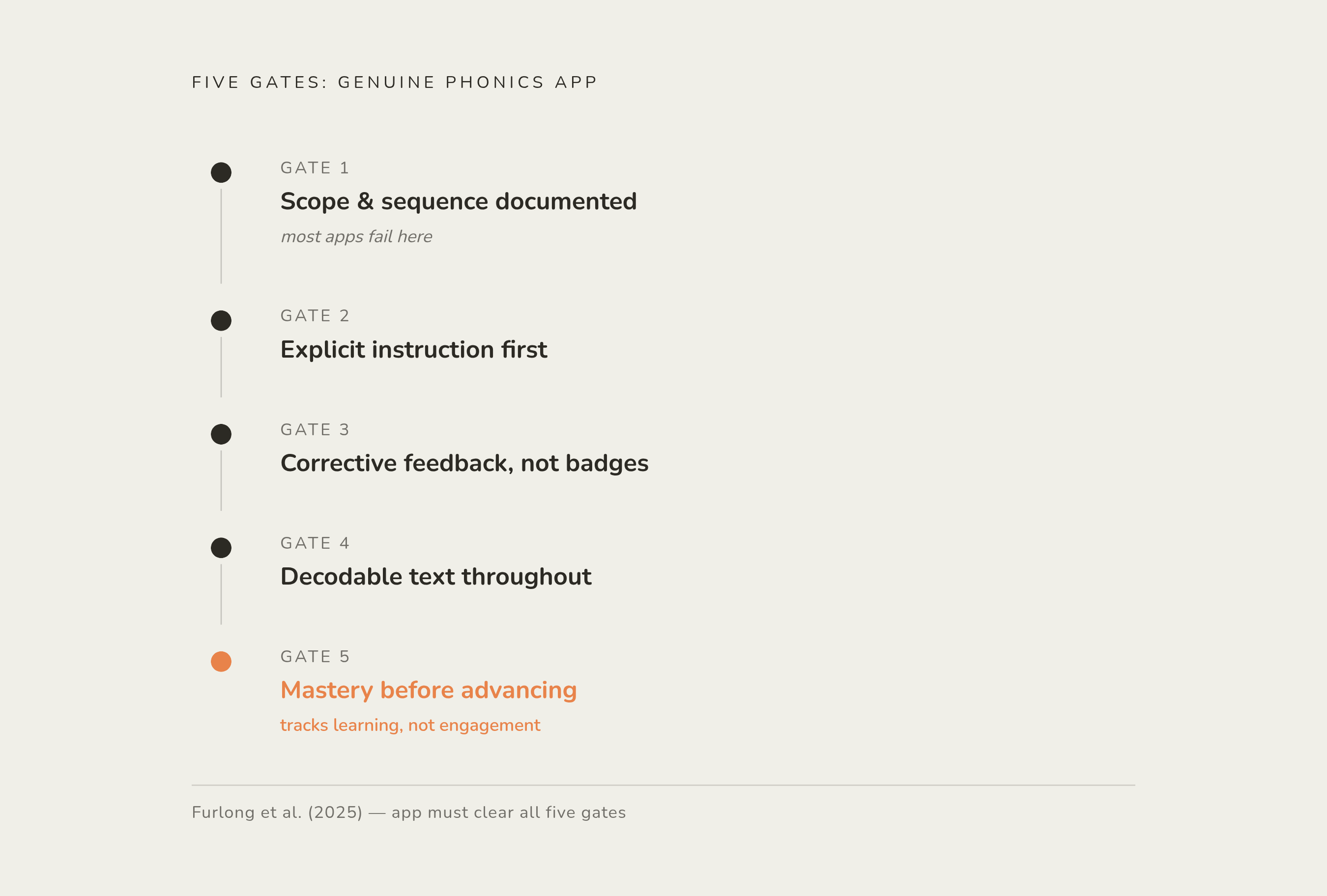
A genuine phonics app can be told apart from entertainment software dressed up with letters by five specific, observable features. An app that cannot show all five is phonics branding, not phonics instruction.
The first is a documented, systematic phoneme scope and sequence. Furlong et al. (2025) found that most apps in their review had no real scope and sequence at all, often defaulting to teaching letters in alphabetical order rather than any sequence grounded in how reading skills actually build on each other. An app that teaches sight words before decoding is established, or that jumps around with no visible order, is showing a red flag parents can spot in the first few minutes of use.
The second is explicit instruction before any quiz or practice task. The higher-quality apps in the Furlong et al. study taught the sound first, modeling it clearly, before ever asking the child to answer a question about it. An app that opens straight into multiple-choice questions without teaching the sound first is testing a child on something it never taught.
The third is immediate corrective feedback, and that is a different thing from a reward. Furlong et al. identified immediate corrective feedback as one of the traits that separated passing apps from the rest. A badge for finishing a level tells a child nothing about what they got wrong. Being told which sound was incorrect, and shown the right one on the spot, is feedback, and a surprising number of apps never go beyond the badge.
The fourth is decodable text, not leveled readers and not sentences a child can only get through by studying the picture. Decodable text means nearly every word on the page follows a phonics pattern the child has already learned, so the only way through the sentence is to sound it out. Cover the picture and ask the child to read the sentence anyway. Cover the picture, and if a child cannot read the sentence without it, the app never built the decoding skill it claims to teach.
The fifth is mastery gating. If a child can tap forward into content they have not yet learned, the app is tracking engagement, not learning. Real mastery gating means a child has to show they have learned the current skill before the app lets them move on, and that is a different thing entirely from simply making levels harder as a child progresses while letting them through regardless of whether they got anything right.
Reading a Child's Progress Data
Whether a parent can see what a child has mastered, where they are stuck, and what comes next shows whether the app's makers understood what they were building. A star count or a completion percentage tells a parent nothing useful. A parent cannot reinforce a skill at home, or flag a concern to a teacher, without knowing which specific sounds or decoding skills are still shaky.
A few benchmark numbers give a general sense of what real progress looks like. By the end of first grade, a child reading around 47 correct words per minute on oral reading fluency is roughly on pace on DIBELS benchmarks, though the exact figure shifts somewhat depending on which DIBELS edition and testing window is used. By the end of second grade, that number rises to around 87 correct words per minute, alongside a growing ability to decode multisyllabic words, vowel teams, r-controlled vowels, and common word endings. Earlier on, around the midpoint of kindergarten, a measure called Nonsense Word Fluency, roughly 28 or more correct letter sounds per minute, gives a useful early read on whether foundational sound-letter skills are taking hold. An app with no visibility into a skill at this level cannot tell a parent whether a child is on track or falling behind.
Some parents will skim past a progress dashboard entirely, or find it overwhelming to read. That is fine. The value of the dashboard does not depend on whether every report gets read line by line. An app that has built real assessment into its instruction will have that data ready to show. An app that has not built real assessment in has nothing to show, no matter how the dashboard is designed.
What AI-Powered Reading Apps Can Do
AI shows up in nearly every reading app's marketing now, and it genuinely contributes personalization that adjusts in the moment and availability whenever a child wants to practice. The question that actually matters is whether an app's AI is teaching the child something or simply handing over answers to clear the friction out of the way.
An app that makes a child decode, blend sounds, and attempt a word before offering help is doing more teaching than one that surfaces the answer the moment a child hesitates. One piece of research speaks directly to this. Elmaadaway et al. (2025) tested an AI voice tool with 90 primary school students and found that children who practiced reading aloud with the AI improved their oral reading fluency significantly more than a control group did. Tapping and swiping on a screen in silence does not build the same skill as actually producing the sounds out loud.
AI brings real risks alongside its real benefits, and those risks call for active attention from parents rather than a hands-off assumption that the technology is handling everything. Overreliance is the first: an app that does too much of the cognitive work for a child undermines the exact orthographic mapping process that Kilpatrick's research identifies as essential to becoming a reader. Algorithmic bias and uneven access are documented concerns in the broader research literature on AI in education, and they apply to reading apps as much as any other category. Screen exposure for very young children, ages one to four, has been linked to lower vocabulary and fewer back-and-forth exchanges with adults, a reminder that even the best-designed app supplements time with a responsive adult.
The word "adaptive" gets thrown around loosely in edtech marketing, but an app can make its reward animations more elaborate as a child progresses without ever adjusting its actual phonics instruction. The test that matters is whether the phonics sequence itself responds to what a child has demonstrated, not whether the game simply gets harder to look at.
An app that satisfies all five checklist criteria produces a recognizable pattern in daily use. The child reads decodable text out loud rather than tapping matching pairs or watching an animation play out. When the child makes a mistake, the app responds to that specific error with instruction, not a generic prompt to try again. By the end of a session, a parent can see which sounds were practiced, which ones the child has mastered, and what comes next. And the following session does not start from zero. It builds on what came before, with earlier material woven back in for review.
Short-session habits and home practices that make any quality app more effective
The same app, used well, produces very different results than that same app used passively or in a scattered way. How the app gets used at home matters nearly as much as how the app was built.
Short, consistent sessions beat occasional long ones. Research shows that a modest amount of structured practice spread across a week produces measurable gains in reading skill. Ten focused minutes a day does more for a child's reading than an hour of screen time where attention keeps drifting.
Starting with the right level of text matters just as much. Research on what are sometimes called "just-right texts", books where a child can read nearly all the words independently and still follow what is happening, shows that text pitched at the right difficulty builds both confidence and fluency. Series like Bob Books, I Can Read Levels 1 through 2, and Step into Reading Steps 1 through 2 work well alongside decodable app practice for exactly this reason.
None of this should happen in isolation from a parent. Research on parent-child media use finds that active involvement, sitting with a child, asking questions, talking through what was just read, produces better comprehension and fewer downsides than letting a child use an app alone. The app's job is to extend phonics practice into the moments a parent cannot sit down and read together, not to take the place of that shared reading time. For a child who resists reading, start with text they can already decode successfully, let the confidence build from there, and bring the app in as a way to strengthen specific skills, not as a signal that something is wrong.
A parent who knows what a genuine phonics app looks like, and who backs it up with a few minutes of steady practice and real reading time together each day, has given a child something no app-store rating can replace.