AI Reading Coaches That Deliver Real-Time Corrective Feedback for Early Readers
AI coaches catch reading errors in the half-second that matters most for building automaticity.
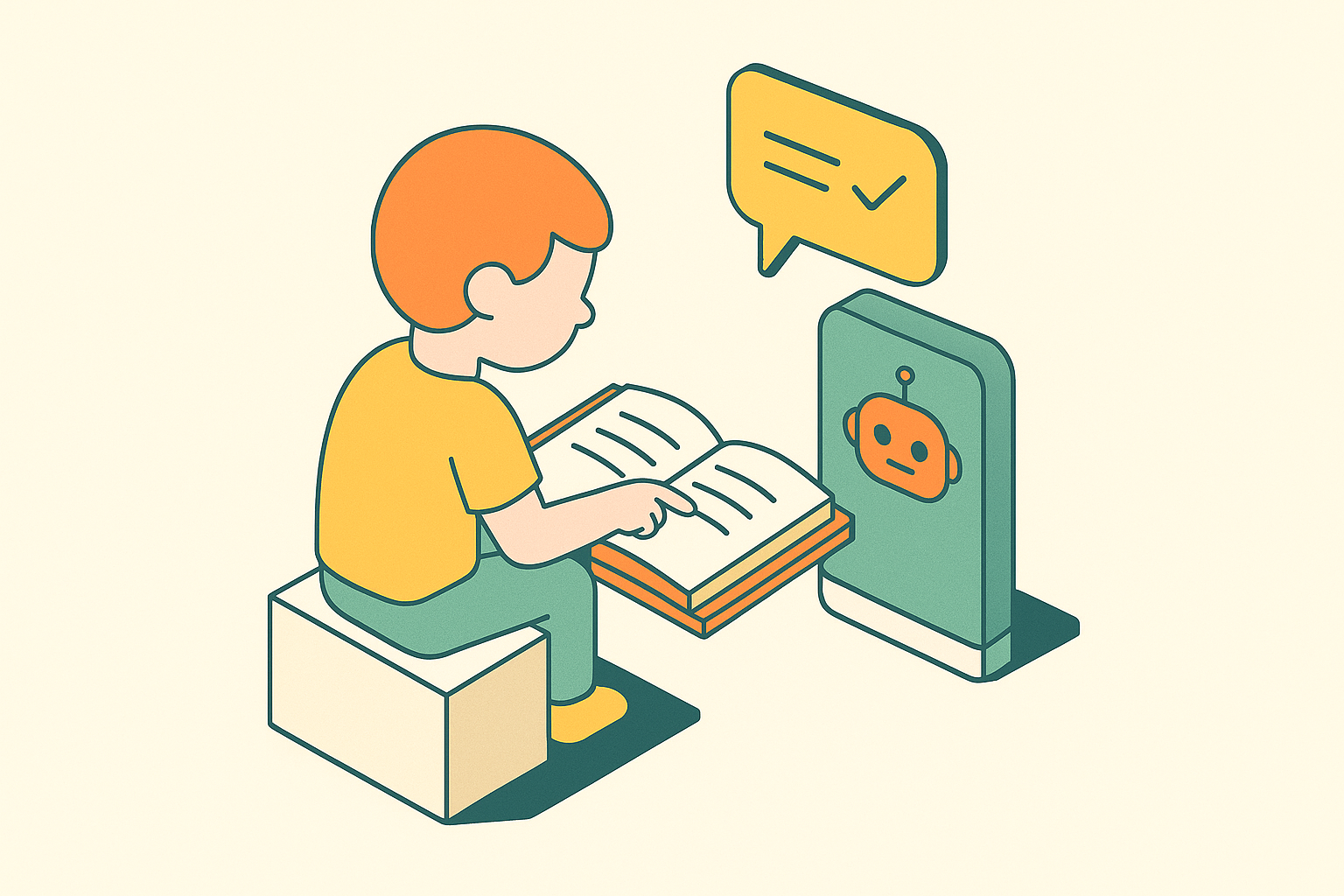
A seven-year-old hits the word "though" for the third time this week and guesses. She says "thuff." Nobody corrects her in the next half second, so she moves to the next word, and the next, and the guess she just made gets a little more cemented in her head as an acceptable answer. That half second is the whole problem this article is about, and it's also the whole opportunity.
Reading comprehension in early learners follows what researchers call the Simple View of Reading: comprehension is the product of decoding and language comprehension. When decoding is slow or shaky, the brain's attention gets pulled away from meaning and spent on sounding out words instead. A child who's working hard to figure out what "though" says has no mental room left to track what the sentence is actually about. Decoding has to become automatic, both accurate and instant, before fluency and comprehension can develop, and that automaticity only comes from repeated practice that gets corrected on the spot.
Silent reading time doesn't do much for early readers. What actually builds skill is immediate feedback while a child is in the middle of reading, not a review afterward. The trouble is scale. One teacher with twenty-five kids reading aloud at once cannot be in twenty-five places in the same second a mispronunciation happens. That gap between what a struggling reader needs and what one adult can physically deliver is the opening AI reading coaches were built to fill.
What real-time corrective feedback means, technically
Real-time corrective feedback sounds like a buzzword until it's broken into what the AI is actually doing while a child reads out loud. The system has to listen at the level of individual sounds, called phonemes, catch exactly which one went wrong, and respond before the child moves on to the next word. That's a different job from scoring a comprehension quiz or logging how many minutes a student spent on an app.
Listening at the phoneme level means the tool can tell a child who swapped out an entire word for a different guess from a child who read the right word but botched one vowel sound inside it. Those are two different problems, and they call for two different corrections. NWEA's Maya shows one version of what this looks like in practice: a student reads aloud, and Maya coaches in real time in ways aligned with the science of reading, including showing how the lips should move to form a sound. That's feedback that goes past flagging an error and into showing a child how to physically produce the right sound. Microsoft's Reading Coach works along similar lines, giving real-time feedback on pronunciation and syllabification as a student reads, then logging mispronunciations in a dashboard the student can see alongside accuracy rate, reading time, and progress toward a goal.
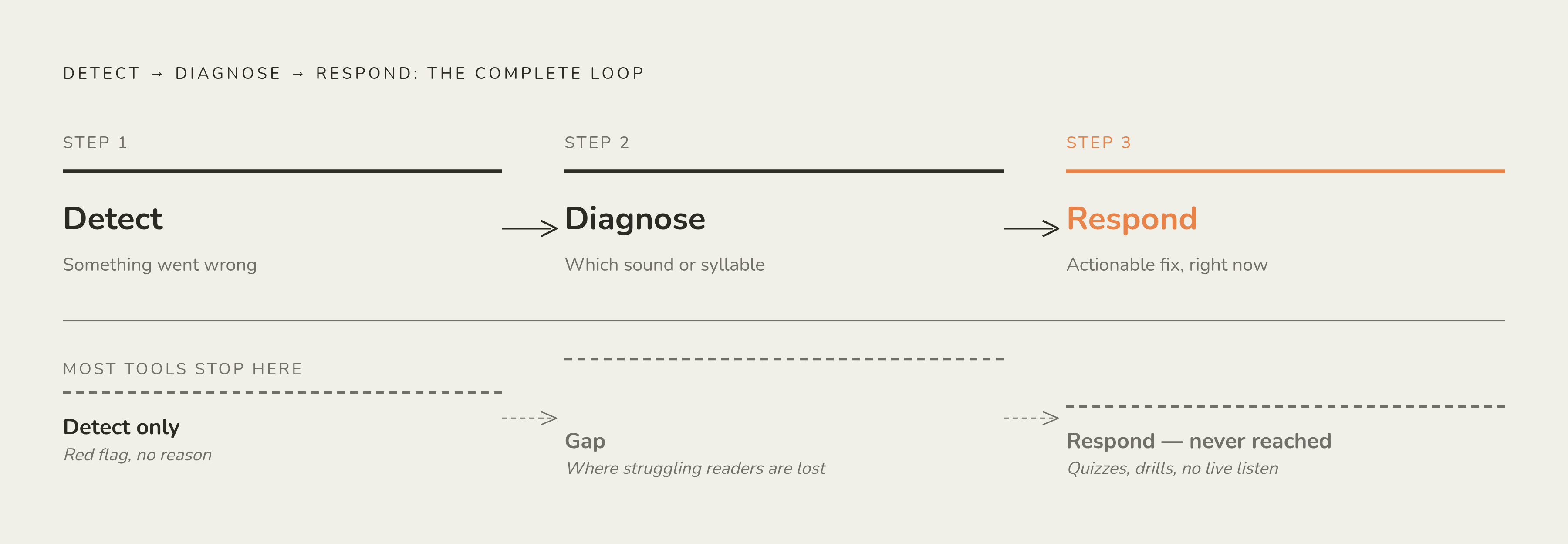
A three-step loop sits beneath all of this: detect, diagnose, respond. Detect means the system notices something went wrong. Diagnose means it figures out precisely what went wrong, down to the sound or syllable pattern. Respond means it gives the child something useful to do about it, right then. A tool that only detects, flashing a red mark on a missed word without saying why it was missed, is doing a fraction of the instructional work. Comprehension quizzes given after the fact, libraries of books with no listening component, and gamified drill apps that never actually hear a child read aloud, all skip this loop. None of them close the gap in the moment it opens. That three-step loop is the test every tool in this article gets measured against.
Building tools around the Science of Reading
Speed alone doesn't make feedback useful. A coach that responds instantly but reinforces the wrong instructional content can still leave a struggling reader stuck, because the Science of Reading has established that systematic phonics, teaching sound-letter connections in a deliberate, built-up sequence, is what makes decoding instruction work. Feedback is only as good as the curriculum behind it.
Project Read's Tutor ties its feedback directly to the UFLI scope and sequence. A teacher can assign the UFLI lesson a student needs, or let the student move forward adaptively as they show mastery. That matters because it means the correction a child gets is tied to the specific phonics concept they're working on that day, not a generic "try again." NWEA's MAP Reading Fluency with Coach, the Maya tool, is built the same way: it's aligned with the science of reading and measures oral reading fluency, literal comprehension, and foundational reading skills, while also screening for students at risk of reading difficulty, including characteristics of dyslexia.
For parents comparing tools, the practical question is simple: does this product name the specific phonics framework or scope and sequence it follows? A label like "phonics-based" with nothing behind it doesn't tell a parent whether skills are being taught in the order that makes each new skill learnable. Phonics instruction builds in a specific order for a reason: short vowels before vowel teams, single consonants before blends, and so on. A tool that skips that order, even while giving fast and accurate feedback, risks teaching a skill before the foundation under it is ready.
Adaptive progression after an error pattern is detected
Fixing one mispronunciation in the moment is valuable. What makes a tool instructional rather than just reactive is whether it remembers that error, builds a picture of what a child has and hasn't mastered, and changes what comes next based on that picture.
Project Read's Tutor gives teachers granular data on error patterns and supports automatic progression tied to mastery. The system tracks which specific grapheme-phoneme correspondences, the connections between a letter pattern and its sound, keep getting missed across multiple sessions. NWEA's approach with Maya starts from a whole-class assessment through MAP Reading Fluency, and the results from that assessment place each student into coaching sessions built around where they actually are. Adaptive progression here starts from a measured baseline. Microsoft's Reading Coach tracks growth over time and shows it in a dashboard with accuracy rate, mispronunciations, and goals for what comes next, giving both the student and the parent a picture that extends past a single session.
Research on the Storiza platform, built by a University of Florida team and presented at the International Conference of the Learning Sciences, confirms that this kind of generative-AI system for oral reading fluency is being actively studied in academic research, not just marketed by companies. Adaptive oral reading feedback is moving from a commercial claim into something being tested and published on.
For a parent, the way to evaluate this is concrete: does the app remember what a child struggled with last Tuesday, and did it change what it offered today because of that? A tool worth trusting should be able to answer that question. One caution applies here too: progression that moves too fast, pushing a child forward before a skill is solid, can create new gaps. The strongest systems use a mastery threshold as the trigger to advance, not simply time spent in the app.
What neurodiverse learners need from corrective feedback
More feedback and richer scaffolding don't automatically add up to better outcomes for every child. For neurodiverse learners, the type and intensity of support has to be matched to the individual child and the specific moment, not applied uniformly.
Research by Jhilal, Pasqua, Marchesi, and colleagues at Sony Computer Sciences Laboratories and Centro Ricerca e Cura di Roma studied primary-school children with special educational needs and disabilities and found responses to reading scaffolds that varied widely from child to child. Some children showed patterns consistent with real benefit from segmented text and pictograms. Others showed patterns consistent with those same visual scaffolds adding extra coordination costs, making the task harder. A support that helps one child can overload another. The researchers ground this in the Construction-Integration model and the idea of contingent scaffolding: the challenge isn't piling on more support, it's calibrating the right type and amount to the learner in front of the system at that moment.
NWEA's MAP Reading Fluency screens for students at risk of reading difficulty, including characteristics of dyslexia, connecting assessment directly to coaching so children who need a different instructional approach get flagged before they fall further behind. A second-grade teacher using Project Read's Tutor reported that an English language learner who hadn't been speaking in class started talking, because working one-on-one with the AI lowered her inhibitions and built her confidence in English.
For parents of neurodiverse children, the question to ask is whether a tool can adjust the intensity and the form of feedback it gives, since the same corrective response doesn't work equally well for every child.
The real limits of AI reading coaches
The most defensible way to use any AI reading coach, however well built, is as a supplement sitting alongside human instruction. No tool available today has been validated to carry the full teaching job on its own, and naming that limit clearly is what makes everything claimed above it trustworthy.
General-purpose AI tools carry a specific risk for early readers: they can let a child avoid the effortful thinking that builds the skill. The line between a tool doing work a student should be doing themselves, sometimes called cognitive debt, and a tool genuinely building a child's capability, is the central design problem nobody in this space has fully solved. This is part of why purpose-built tools aimed specifically at phonics diagnosis show more promise for this age group than general-purpose AI chatbots adapted from broader systems. A tool designed from the ground up to detect a missed grapheme-phoneme correspondence is doing a narrower, better-understood job than a general assistant repurposed for reading practice.
There's also a gap between efficiency and effectiveness that parents should hold onto. A tool that saves a teacher time isn't automatically the tool producing the best outcome for a struggling child. Saving fifteen minutes of a teacher's day and improving a child's decoding accuracy are two different claims, and a product succeeding at one doesn't guarantee it's succeeding at the other<sup>4</sup><sup>6</sup><sup>1</sup><sup>2</sup><sup>3</sup><sup>5</sup>. General-purpose AI tools show a related weakness: when asked to generate reading passages at a specific grade level, their output tends to land higher than the target, sometimes by several grade levels even when the request was for an easier passage. For any tool generating reading material on the fly for an early reader, that's a real risk, since a passage pitched above a child's level undermines the exact decoding practice the tool is supposed to support.
None of this makes the technology unproven or risky to use. It means a parent should expect an AI reading coach to extend what a teacher or parent is already doing, catching the moments a single adult physically cannot catch across a room of struggling readers, as a supplement to the adult, not a replacement for them.
The biometric voice data question for parents choosing a tool
An AI reading coach has to listen to a child's actual voice to do any of what's been described above, and that requirement turns voice data collection into a central feature of the product, not a footnote buried in a privacy policy. Parents are now treating it as a real selection criterion, and school districts are starting to act on it at scale.
In August 2026, five New Mexico school districts and one charter school declined to use a state-mandated AI-powered reading assessment specifically over concerns about collecting children's biometric voice data. The state's Public Education Department responded by allowing schools to skip the voice-recording feature entirely or substitute their own assessment instead. A state mandate got overridden by district and parent pushback once trust in the data handling wasn't established first.
The practical question for any parent evaluating a tool is direct: is the child's voice processed locally on the device, or sent off to a third party and retained there? What does the tool's consent process actually say about a child's biometric data specifically? Tools that are upfront about minimizing what they collect and retain, and that spell out voice data handling in plain terms in a dedicated disclosure, are giving parents and districts something concrete to evaluate. For a tool used at home, the same standard applies: look for a privacy policy that names voice data directly, not a general statement that mentions children's data in passing. That specificity is what tells a parent whether a product is built with this question in mind or treating it as an afterthought.
Sources
- NWEA Adds an AI-powered Reading Coach to its Innovative Early Literacy Assessment - NWEA
- Tailoring AI-Driven Reading Scaffolds to the Distinct Needs of Neurodiverse Learners
- Supporting fluency and comprehension using practices grounded in the science of reading - Teach. Learn. Grow.
- The Effortless Trap: Productive Struggle, AI, and the Illusion of Learning
- Tailoring AI-Driven Reading Scaffolds to the Distinct Needs of Neurodiverse Learners
- How AI tutors can lower the stakes for emerging and multilingual readers - Teach. Learn. Grow.
- Children's English Reading Story Generation via Supervised Fine-Tuning of Compact LLMs with Controllable Difficulty and Safety