Simple View of Reading Applied to Curriculum Selection
A multiplication formula shows why reading programs must teach both decoding and comprehension.

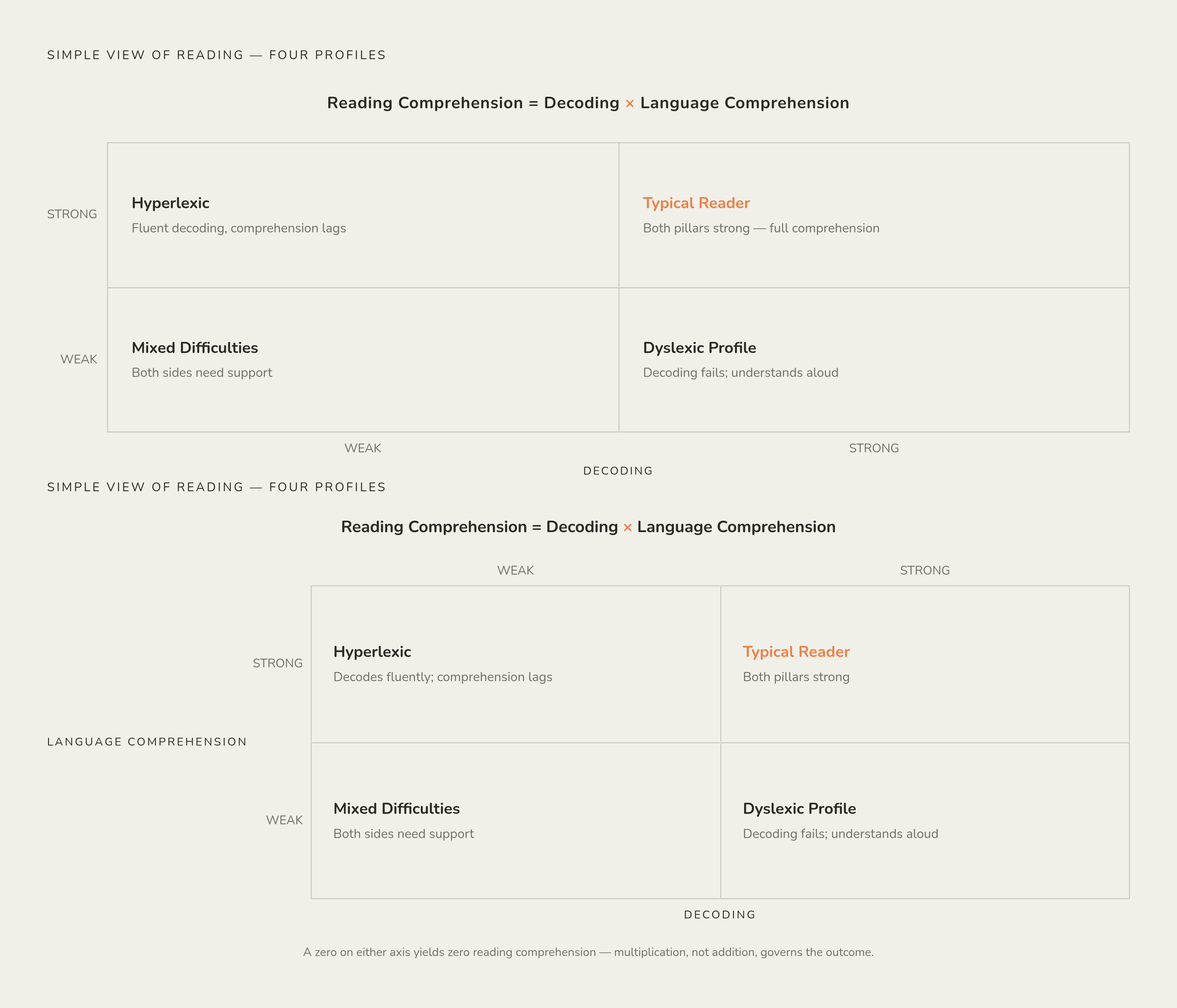
Reading comprehension is the product of two things multiplied together, not added. That's the core claim of the Simple View of Reading, a formula psychologists Philip Gough and William Tunmer proposed in 1986: Decoding × Language Comprehension = Reading Comprehension. Because it's multiplication and not addition, the model gives parents and educators a precise way to check whether any curriculum, no matter how well it's marketed, is actually teaching what a child needs to become a reader.
The formula itself is a diagnostic lens. It's a diagnostic lens. SVR won't tell you which program to buy, but it will tell you, with real specificity, what any program has to cover if it wants to produce readers rather than just decoders or just talkers. The two pillars are important to keep in mind for the rest of this piece:
Decoding is word recognition, the mechanical work of turning print into speech. It runs through phonological awareness, phonics, and eventually fluent, automatic word reading. Language comprehension is understanding spoken language once it's been decoded, built from vocabulary, background knowledge, and a feel for how sentences are put together. Neither one, alone, produces a reader.
Why the multiplicative relationship changes how you read a curriculum's claims
Multiplication makes this model useful, and it's also the detail most people skip past. If either side of the equation is zero, the product is zero. Not diminished, not partial. Zero.
That has a blunt consequence. A child with a rich vocabulary and deep background knowledge, the kind of kid who can hold a conversation about volcanoes or a major historical conflict, still cannot read a single sentence if decoding hasn't developed. Language comprehension doesn't compensate for a broken decoding system; it just sits there, unused, while the child stares at print that won't resolve into words.
The reverse breaks down too, and it's less intuitive. A child who decodes fluently, who can sound out or instantly recognize almost any word on a page, is not automatically comprehending what they've read. This is the hyperlexic profile: accurate word reading paired with weak understanding of what those words mean once they're strung together. The mouth is reading. The mind isn't catching up.
SVR sorts readers into four rough profiles, and they function less like a theory and more like a map:
- Typical reader: solid decoding, solid language comprehension.
- Dyslexic profile: decoding is the struggle; the child understands everything read aloud to them but can't get there independently on the page.
- Hyperlexic profile: decoding is fluent; comprehension lags behind.
- Mixed difficulties: both sides need support, and neither one masks the other.
A curriculum that's excellent at one pillar cannot backfill the other. The math forbids it. Which sets up a real problem in how curricula have actually evolved over the past few years, because a lot of the current shift has overcorrected toward exactly one side of this equation.
How the Science of Reading movement has changed curriculum, and where the gaps still show up
More than 40 states have now passed legislation requiring evidence-based reading instruction, and the Science of Reading movement behind that legislation has reshaped curriculum and teacher training at a scale few education reforms manage.
A survey by an education research nonprofit and a policy research organization of more than 1,200 K-3 teachers shows how deep that reshaping has gone, and where it's stalled. Eighty-two percent of teachers had completed at least one Science of Reading-aligned training in the prior two to three years. Of those, 84% said phonics got "a lot" or "some" focus in that training, and 83% said the same about phonemic and phonological awareness.
Reading comprehension, vocabulary, oral language, and content knowledge all scored lower, areas that extend beyond the phonics and phonemic awareness that dominated training time. And about a third of teachers said they were still blending phonics instruction with cueing, an approach the research base has already discredited.
Curriculum adoption tells a similar story. Fountas & Pinnell materials dropped from 43% of teachers using them to 16%, while UFLI Foundations, a researcher-developed phonics program, was used by 38% of respondents. But more than 90% of teachers reported using more than one curriculum at once, and 44% used four or more. That's patchwork, not coherence: individual programs' blind spots get stitched over informally, classroom by classroom, with no guarantee the stitching is consistent from one teacher to the next.
One of the report's co-authors said there's still a lot of work to do. Change is happening at the margins, not everywhere at once. Plenty of curricula now market themselves as "Science of Reading-aligned" without actually covering both halves of what SVR demands. The label describes a marketing decision.
The movement has done real, measurable good for phonics instruction. It has not done the same, yet, for language comprehension, which is precisely the gap SVR predicts will cap outcomes down the line.
What decoding instruction requires, and how phonics differs from fluent word reading
Decoding gets used as a stand-in for phonics, but that's an oversimplification. The Massachusetts literacy framework, among others, has shifted to calling this skill "fluent word reading" specifically because accuracy alone isn't the goal. Automaticity is.
Three sub-skills have to work together for decoding instruction to be complete:
Phonological and phonemic awareness comes first, before print even enters the picture. This is the ability to hear and manipulate the sounds inside spoken words, isolating them, blending them, swapping them out.
Phonics is the systematic, explicit mapping of letters to sounds. The National Reading Panel's findings on this are about as settled as reading research gets: systematic phonics instruction works, and "systematic" is doing real work in that sentence. It means a planned sequence, taught in order, not incidental exposure that hopes a child picks up the pattern from context.
Fluency is the bridge from decoding into comprehension, and it's often underweighted. Reading accurately, quickly, and with natural expression matters on its own terms: research has found that fluency contributes to comprehension in ways that go beyond word reading accuracy alone.
Decodable texts matter here too. Beginning readers benefit from practicing on decodable text, material built from the phonics patterns they've actually been taught, because that's what supports automatic word reading and builds fluency. A program that skips decodables in favor of predictable, pattern-based books (the kind a child can guess from pictures rather than sound out) is quietly working against this pathway.
When evaluating a curriculum's decoding strand, ask direct questions. Is phonics taught explicitly, in a defined sequence, rather than as scattered mini-lessons? Is phonemic awareness taught as its own skill, separate from phonics instruction? Are decodable texts actually provided for early readers? And is fluency practice built into connected text reading, alongside isolated speed drills on word lists?
What language comprehension instruction requires: the pillar that most curricula underinvest in
Language comprehension gets confused, constantly, with reading comprehension strategies. They are not the same thing. Language comprehension is the oral language capacity a child brings to a text before they ever decode a word of it; comprehension strategies (summarizing, predicting, finding the main idea) are techniques applied on top of that capacity, and they're only useful once the underlying language ability exists.
A curriculum has to build three things on this side of the equation:
Vocabulary, meaning explicit knowledge of what words mean, including the domain-specific words a child won't pick up casually (photosynthesis, tributary, monarchy).
Background knowledge, the accumulated understanding of how the world works that lets a child make sense of a text's context. This can't come from decoding instruction. It has to be built separately, deliberately, usually through content itself: history, science, stories about how things work.
Syntax, the sense of how sentence structure and word order create meaning, especially as sentences get longer and more layered.
Decoding plays a central role in reading comprehension in the earliest grades, but language comprehension becomes increasingly important as texts get harder and more complex later on, a developmental pattern that makes this urgent rather than academic. A curriculum that only shores up decoding is setting a child up to hit a ceiling, just a few years down the road, when the words get harder to sound out but the real barrier becomes understanding them once they're on the page.
This is happening in classrooms right now. It's happening in classrooms right now: the Fordham survey found that current Science of Reading-aligned training reported lower emphasis on vocabulary, oral language, and content knowledge. The gap on this side of the equation is being built into instruction today, inside programs that carry the evidence-based label. It's being built into instruction today, inside programs that carry the evidence-based label.
When evaluating a curriculum's language comprehension strand, look for whether vocabulary is taught explicitly, in addition to being encountered incidentally while reading a story. Look for a content-knowledge strand, built around science, history, or narrative, that deliberately grows a child's background knowledge. And look for oral language work: discussion, listening activities, retelling, the kind of talk that builds the muscle comprehension actually depends on.
Using SVR as a practical checklist when evaluating any reading curriculum
SVR reduces to two questions a parent can ask of any program, print or digital, expensive or free.
Does the curriculum systematically build decoding, through explicit phonics, phonemic awareness, and fluency practice grounded in decodable text? And separately, does it build language comprehension, through explicit vocabulary instruction, background knowledge, and oral language development?
If the answer to either question is no, or unclear, the formula already tells you what happens next. The child plateaus on whichever side got shortchanged, regardless of how strong the other side is.
The four-profile framework runs in reverse too, as a selection tool rather than just a diagnostic one. A child showing the dyslexic profile, decoding is the struggle but listening comprehension is intact, needs an intensive, structured decoding strand, not another round of comprehension strategy work. A child showing the hyperlexic profile, fluent decoding but thin comprehension, needs explicit vocabulary and background knowledge instruction, not more phonics drills. A child with difficulties on both sides needs full coverage of the equation at once, from a program that covers every lane.
Watch for a handful of red flags in how programs describe themselves. "Science of reading-aligned" language with no visible evidence both pillars are covered. Marketing that treats phonics as the whole of reading instruction rather than half of it. Programs heavy on comprehension strategies but thin on foundational decoding work. Pacing that's fixed and uniform, refusing to adjust once a child's actual profile becomes obvious.
The positive signals are just as concrete: a published, sequential phonics scope and sequence; decodable texts for early readers; vocabulary instruction embedded in content-rich topics rather than bolted on; fluency practice built into connected text; and assessments that measure decoding and comprehension separately, rather than folding them into one vague score.
For parents of children with learning differences, this matters even more directly. A child with dyslexia doesn't need less instruction. They need instruction matched precisely to the decoding side of the equation, delivered with more structure and more intensity than a general program assumes.
What SVR-informed instruction looks like in practice, including where adaptive technology fits
The National Center on Improving Literacy states this without hedging: both accurate word reading and text comprehension require careful, systematic instruction, and once formal reading instruction starts, both sides of the equation need daily attention. Not one this month and the other next month. Both, every day.
One-on-one instruction has always been the gold standard for delivering on that, for a simple mechanical reason: a skilled teacher, sitting beside one child, can tell in real time which side of the equation is weak, adjust the lesson on the spot, and move to whatever challenge comes next. A static, one-size program, no matter how well designed, can't do that. It can only guess at the average child in the room.
The patchwork reality the Fordham survey turned up, teachers stitching together four or more curricula, is really a symptom of this same limitation. Static programs can't adapt to what one particular child's SVR profile demands at nine in the morning on a Tuesday.
This is where adaptive technology, when it's actually built around this problem rather than around gamified drilling, does something a printed workbook structurally cannot. It listens to a child read aloud, distinguishes a decoding error from a comprehension failure, and shifts what comes next accordingly. That real-time listening and response marks a genuine reading tool, distinct from a quiz app with a reading theme; the quiz app can only tell you a child got an answer wrong, not why.
Parents evaluating an app should ask the same two SVR questions they'd ask of a workbook: does it address both pillars explicitly, and does it know, right now, for this child, which one needs more attention?
What parents should take away from SVR when making a curriculum decision
SVR's real value is as a question, and a stubborn one. It's as a question, and a stubborn one: not "which curriculum is best," but "does this curriculum fully address both of what reading actually requires?"
Any curriculum, no matter how polished, how popular, or how aggressively it's marketed, that only builds one side of the equation will leave a gap. That's not a criticism of any particular program. It's what the multiplication structure guarantees, mathematically, regardless of intention.
The shift documented in the Fordham and RAND survey is genuine progress: phonics instruction is finally being taken seriously at scale, in a way it wasn't a decade ago. But the same data shows language comprehension instruction hasn't kept pace, which means a parent who only asks "does it teach phonics well?" is asking half the question and accepting half an answer.
The four reader profiles are a reminder, too, that no two children need the identical program. The right fit for a child who struggles to decode looks nothing like the right fit for a child who decodes fluently but doesn't grasp what the words mean once they're strung together. A program, a teacher, or a tool that helps identify which profile fits, rather than assuming one-size instruction covers every case, is one worth trusting.
A few concrete questions to ask any curriculum or app provider before committing: How does the program assess decoding separately from comprehension, rather than lumping them into one score? What happens when results show a weakness on one side specifically, does the program actually adjust, or does it keep moving at the same pace regardless? And can a parent see, clearly, what a child is working on and how they're progressing on each dimension separately?
The Simple View of Reading has held up since 1986, backed now by more than 150 empirical studies, and that kind of durability isn't an accident of academic fashion. It maps the actual structure of what reading is. That structure doesn't shift based on what a curriculum's marketing copy claims about itself.