When an AI Reading Tutor Actually Listens Versus Just Checking Answers
Real-time listening to a child decode—not just scoring answers—is where AI tutoring actually works.
For parents choosing a personalized AI tutor for reading and math, the reading test is whether it hears the child decode words, identifies specific errors, and changes instruction in response. A correct-answer score is not enough to assess a reading tutor. The evidence here supports that standard for reading.
Why the moment of decoding is where early reading instruction succeeds or fails
Children do not learn to read naturally just by seeing print. Most children need explicit instruction in how letters stand for sounds and how those sounds join to make words. The Simple View of Reading describes comprehension as the product of decoding and language comprehension. Both parts have to do their work. A child who understands spoken language can still struggle to understand a sentence because recognizing its written words consumes too much attention.
When a word is not yet automatic, the child must identify the sounds associated with its letters and blend them. That work competes with attention to meaning. Phonics builds decoding through systematic instruction in spelling-sound regularities, introduced in a planned sequence from simple to complex. Pairing sounds with visible letters helps children learn those connections. The goal is automatic word recognition, which takes more than just reading faster.
Fluency provides the bridge from decoding to comprehension. A 2026 scoping review in Frontiers in Education examined 25 empirical studies and identified several roles for fluency, including as a mediator and direct contributor to comprehension. Fluency includes accuracy, rate, and prosody (phrasing and expression). A words-per-minute score cannot capture all of that. Instruction therefore needs to attend to how a child reaches a word, because the effortful decoding moment is where the teaching happens.
What "checking answers" actually means in AI reading tools, and what it misses
An answer-checking tool reduces that process to an outcome. It can report whether a response was correct, assign a score, or move a child to another level without identifying the difficulty that preceded the answer. A child may pause for a long time before giving a correct response. An incorrect one may come from a wrong sound, a failed blend, or trouble with an exception word. Those differences point toward different teaching needs, but a right-or-wrong record leaves them unresolved.
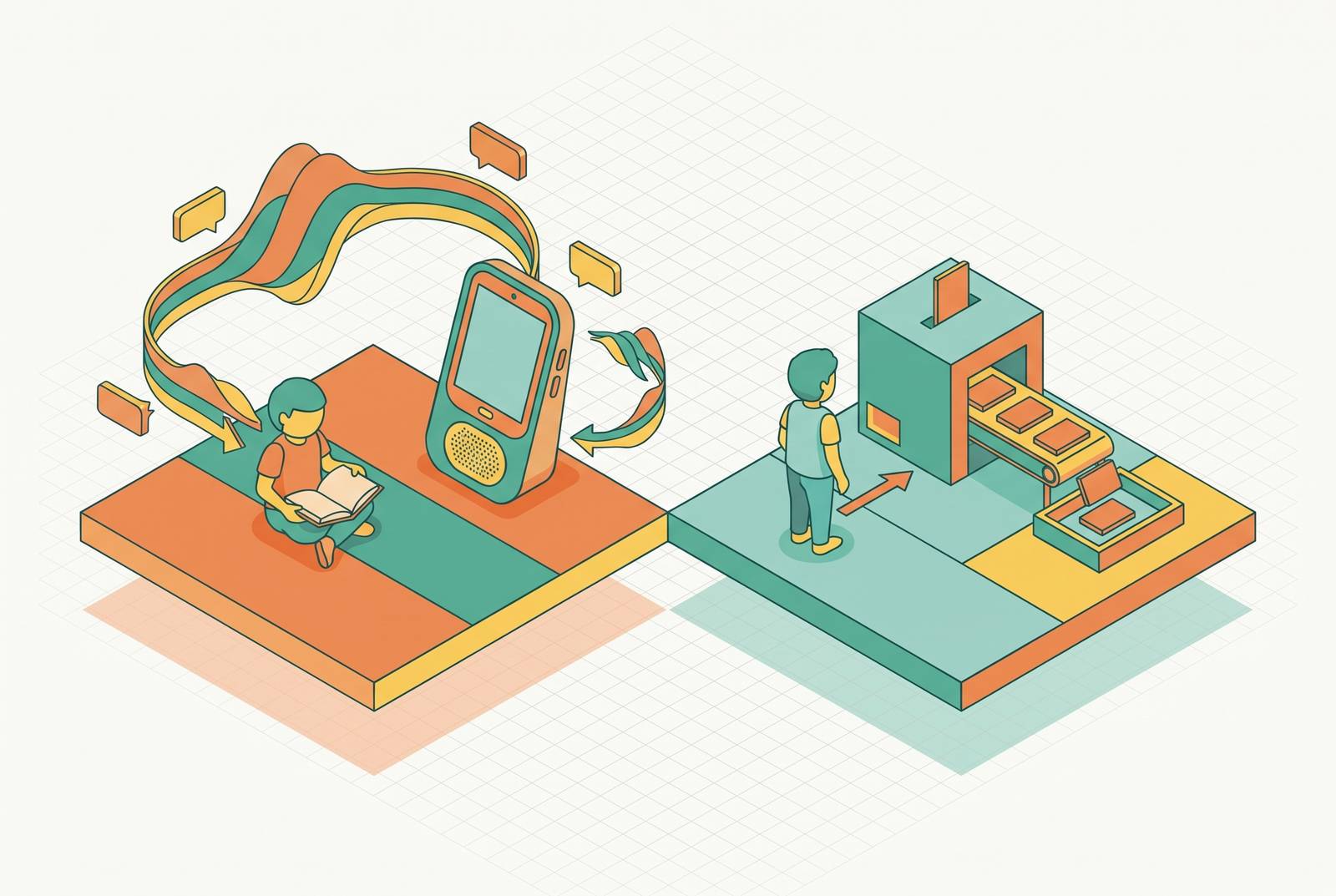
Read-along mode makes the distinction easy to see. A child can listen to a book without actively reading a single word, while a platform without oral-reading assessment logs the session as completed. The record shows participation. Listening to a story and decoding its words are different activities, even when the same text appears on screen. A tool that cannot distinguish them has no basis for treating completion as evidence of independent reading.
The strongest case for adaptive difficulty is that it still beats a workbook that stays the same. That is a fair distinction, but a limited one. Moving a child to easier or harder text changes the challenge without necessarily identifying the source of the struggle. Adapting difficulty is not the same as adapting teaching. Without decoding-level information, a tool may repeat or advance an activity while leaving unanswered the question that should guide the next lesson.
What real-time listening requires from an AI reading tutor
A reading tutor needs to hear the child’s voice, spot the error as the child tries to decode, track patterns across attempts, and use what it learns to choose what to teach. Voice recognition is only the starting point. The useful output includes a transcript or a judgment that a word was wrong within a picture of what the child can do and where the process breaks down.
A substitution of one phoneme, or speech sound, for another may call for practice with that sound, while a hesitation may call for repeated oral reading to build automaticity. An omission is different from a blend breakdown. A broader collapse in fluency may mean the child needs to step back to a decodable text. Treating all these events as “try again” discards the information that makes instruction specific.
The established teacher practice is the running record, which uses a child’s oral reading to assess reading level and identify errors. A listening AI must come close to that assessment and use it in a teaching loop that includes guided repeated oral reading and feedback. It must hear phrasing and expression too. Getting the words right without the right phrasing can show that text-level fluency still needs work. Deciding what to teach, how to teach it, and when to move on is what a skilled human reading teacher does, and it is the bar AI must meet.
How the gap plays out in practice: what schools have found when AI actually listens
Continuous assessment of oral reading makes the child’s reading available for teachers to examine. That changes the information teachers can work with. Instead of seeing only that practice happened, they can have running records and recordings that reveal how the child read. This lets more children be heard one at a time than a single teacher could manage alone.
EPS Learning’s Reading Assistant is described as an AI-powered reading tutor that provides personalized practice and in-the-moment intervention grounded in the Science of Reading. Its design includes continuous assessment of mastery whenever a child reads, as well as running records and recordings. Those features address the listening requirement directly. They aim to replicate part of what a teacher does while hearing a child read aloud, rather than treating a finished activity as the main evidence of progress.
That description supports a comparison of designs. No specific school results are supplied here. A recording alone also cannot show that every choice about what to teach based on it is sound. The concrete distinction is that oral-reading records give teachers evidence of the reading process, while a passive completion log does not. Whether an AI uses that evidence well depends on the teaching decisions that follow.
Why phonics sequencing — not just feedback speed — is the harder problem for AI to solve
Fast feedback can catch a mistake before the child moves on with practice. It does not, by itself, determine the next lesson. An AI may recognize a blend error immediately and still need to decide which spelling-sound pattern to revisit, which example words to use, and when to introduce harder material. Those decisions determine the instructional sequence. Solving them requires both evidence about the child and a sound account of how decoding develops.
Tobias Ungerer, Kathleen Rastle, and Blair C. Armstrong’s 2026 paper in Perspectives on Psychological Science examines these choices in phonics instruction. The paper finds that programs now in use differ in what they say about which regularities to teach, in what order, and which example words and exception words to use. Some effects on learning remain poorly understood. Decisions about exception words depend on their linguistic properties and the target skills being emphasized, and robust decoding skills may benefit from delaying their introduction. There is no simple rule that a child should move to the next harder item after every correct answer.
This is where the claim of personalization faces its hardest test. Most adaptive tools change difficulty rather than revising the phonics sequence in response to observed errors. They treat that sequence as something settled in advance. A more responsive tutor needs an accumulated picture of mastery across encounters. Yet listening supplies necessary evidence without guaranteeing that the tutor can choose what to teach next.
For parents, the distinction becomes concrete in what happens after an error. A move to harder text after a correct answer is a difficulty decision. Identifying a consistent blend-level error and targeting that pattern is a teaching decision. The latter connects the child’s observed need to the next instructional move. That connection is the harder standard, because it requires the system to change more than the level label.
How do you choose an AI reading tutor that adapts to your child?
Parents should ask whether the app requires the child to read aloud, rather than accepting “adaptive” as a sufficient description. This is the first practical filter. If a session can be completed entirely by tapping, selecting, or listening, completion supplies interaction data. Those activities may have a place in a reading app, but they cannot take the place of listening to the child read. Real-time voice processing is the minimum requirement for the kind of reading tutor described here.
Parents should next ask whether the app identifies the type of error. A report that distinguishes a substituted vowel sound, a skipped blend, and a hesitation at a multisyllabic word gives a more useful account of the difficulty. Parents should then ask whether that distinction changes the teaching. Specific error labels are useful only if the system can connect them to a suitable instructional response.
A third question is what the parent can see about the child’s actual reading. Scores and stars do not explain a struggle. Reporting that shows error patterns and skill gaps provides evidence that the system is examining more than final answers. The key comparison is between a report that says the child reached a level and one that shows which decoding skills still need attention. That kind of report helps parents see the claimed personalization for themselves, beyond what the marketing promises.
Children who are behind, struggling, or learning differently especially need specific errors caught during repeated practice. An undetected blend error can keep recurring. For children at or ahead of grade level, the same listening design can respond to mastery signals before progress stalls. In both cases, the relevant feature is an instructional response to the individual child.
For a family seeking support in both reading and math, these criteria answer the reading part of the purchase decision. They do not establish a combined best app. The material here provides neither a comparison of math instruction nor the evidence needed to rank alternatives by age or use case. A reading tutor’s ability to hear decoding should therefore be judged on its own terms. Offering many subjects does not show that it can do this.
The broader risk of settling for answer-checking: what children miss when the AI isn't really listening
An answer-checking app can be fun and still leave a decoding gap untouched. Finishing sessions may feel like progress even as the effort of word recognition keeps taking attention away from comprehension. Engagement is necessary, but it is not proof of instruction. Screening for phonemic awareness and alphabet knowledge can show who is at risk before children fall behind in reading, but logs of final answers alone cannot do that screening.
The positive case for AI is more individual than a score increase. A child hesitates, the tutor recognizes the pattern, and the next instruction addresses the skill that needs work. That is a meaningful form of personalization. When genuine listening guides those decisions, AI can make something approaching responsive, one-on-one instruction more accessible. The goal is for a child to spend less effort working out the words and have more attention left to understand them.