What Preschoolers Actually Need From an AI App Before Phonics and Math Instruction Can Stick
Strong foundations in language and self-regulation must come before phonics and math.
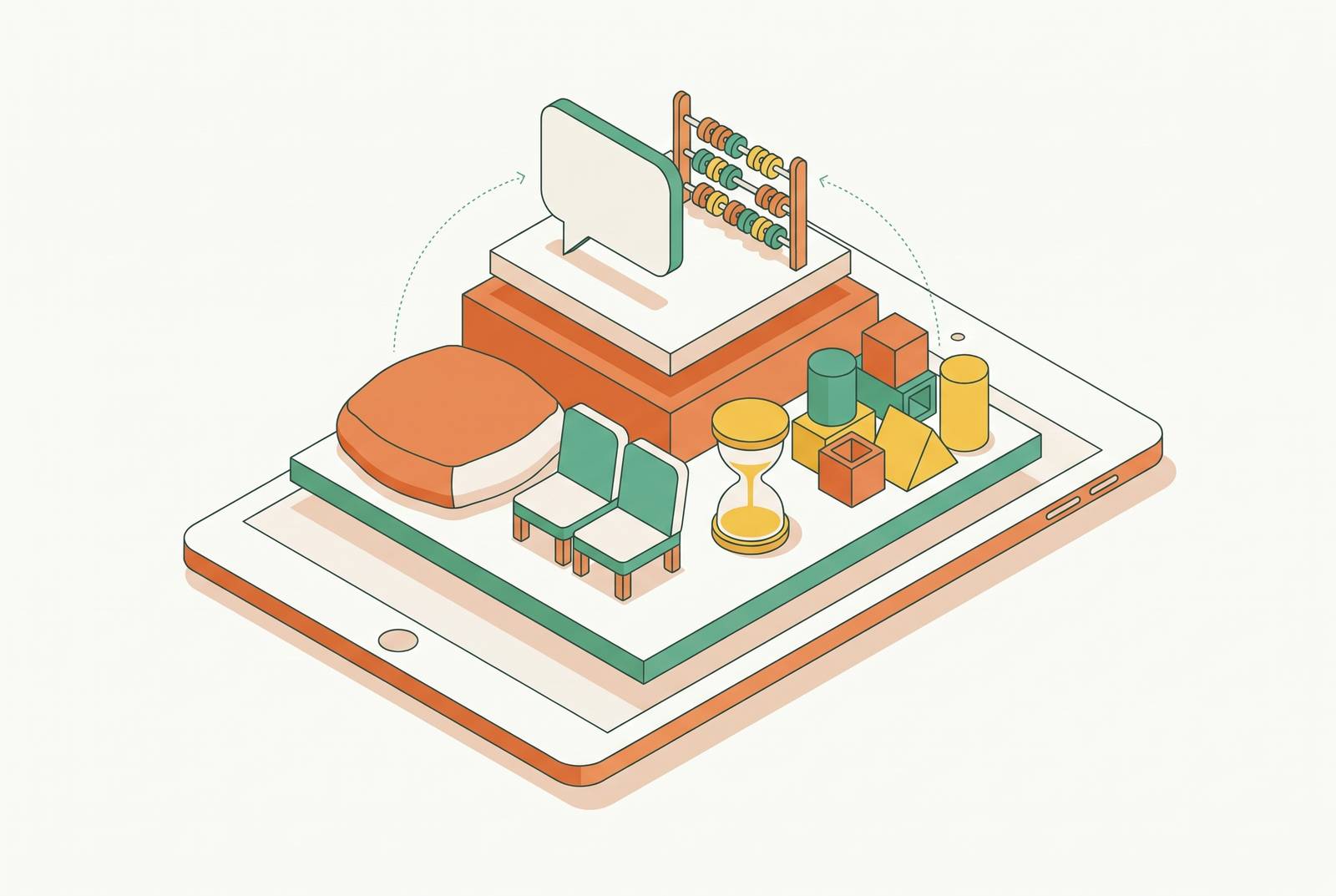
An AI math and reading app for preschool and kindergarten readiness should help children build oral language, sound awareness, and self-regulation before it pushes them into phonics and arithmetic. For a 4-year-old, the best fit is a tool that listens, responds to demonstrated readiness, and leaves room for a parent to join in. An app that skips these foundations mistakes delivering a lesson for teaching a child.
Why preschoolers need a developmental foundation before any instruction can land
The marketing picture is simple. An app opens, a child taps a bright letter, and the child starts to learn. What that picture leaves out is the child's ability to understand the prompt, hear the sound being taught, and stay with the task long enough to respond. Those abilities are not automatic in preschool. A lesson can be available before a child has the means to use it.
Instruction requires readiness. A human teacher faces the same constraint when instruction assumes skills a child has not yet developed. Oral language gives a child words and meaning, phonological awareness makes the sounds within words accessible, and self-regulation supports attention and response. These layers build on one another, with language providing the starting point. An AI app's instruction needs to reach the child who is actually using it.
What oral language actually does for a child before a single letter is taught
Oral language includes vocabulary, the way words fit into sentences, and the back-and-forth of conversation. It gives printed words something to mean. When a child eventually decodes a word, understanding depends on the language the child already knows. Without that connection, sounding out a word can become a performance without meaning. Phonics teaches a code, but the code does not supply the whole message.
A 2025 systematic review and meta-analysis of more than 23,000 children found that preschool vocabulary and grammar were significantly related to later reading comprehension, word reading, and pseudoword reading. The National Reading Panel identified five pillars of literacy that underpin the Science of Reading. Illinois Early Learning identifies oral language, especially phonemic awareness and vocabulary, as the most critical skills to develop at the preschool stage. Early talk is part of literacy itself.
Everyday conversation and the language of instruction make different demands. Words such as “rhyme,” “syllable,” and “more than” may be unfamiliar even to a child who tells lively stories. A longitudinal study published in the Journal of Cognition and Development found that mathematical language at ages 3–5 predicted subsequent mathematical achievement. Reading and math both depend on understanding what the lesson is asking.
Phonological awareness as the bridge between spoken language and print
Understanding words is different from hearing their parts. Phonological awareness is the ability to hear, recognize, and play with sounds inside spoken words. A child noticing that “cat” and “hat” rhyme is developing literacy, even with no letters in sight. Nursery rhymes, clapping syllables, and isolating the first sound in a word all work at this level. None requires a screen or a printed page.
Sound-play activities develop the ability the next reading lesson will use. An app that jumps straight to letter-sound correspondence may ask a child to link a letter to a sound the child cannot yet pick out. More prompts do not repair that missing step by themselves.
For children showing early signs of dyslexia or other learning differences, the sequence needs particular care. PRIDE Reading Program describes explicit, systematic, multisensory instruction with phonological awareness as the foundational entry point before phonics. Clapping makes syllables physical, while sand-tracing can bring touch into later work with letters. What children touch, hear, or do must help them learn the skill being taught. Touching a letter and hearing a sound are distinct, connected tasks.
Early math has a parallel, though not an identical process. Cardinality means understanding that the last number counted tells how many objects there are. Saying number names is not enough on its own. All About Learning Press describes this principle as part of preschool math readiness. Just as sound awareness gives phonics something to build on, cardinality gives counting meaning before a child is asked to do arithmetic.
Self-regulation as the prerequisite most apps are designed to ignore
A child may understand the words and hear the sounds yet still struggle to use a lesson. Attention, frustration, and the impulse to quit can block participation. Working memory, inhibitory control, and cognitive flexibility are among the executive functions. A study published in Frontiers in Psychology describes executive functions and self-regulation as fundamental to learning, school functioning, and academic achievement. Another study in the same journal found that self-regulation predicted pre-academic skills in mathematics and literacy, as well as social-emotional competence.
Wyatt and colleagues' 2025 research followed how preschool executive control was linked to learning behaviors in kindergarten, including attention/persistence, attitude toward learning, and competence motivation. These learning behaviors help a child participate in academic learning. When a child is tapping randomly, skipping steps, or melting down, continuing to deliver prompts is not the same as teaching. A good tool must account for that state rather than treat every response as evidence of understanding.
Rewards do not settle the problem either. A coin may keep a child going, but earning it does not show that the child can keep trying from within. That makes self-regulation a design criterion. Research published in 2025 found that parents' reported math anxiety when their children were three was associated with poorer numeracy at age three and lower math performance at age eight. How this happens is still unclear: parenting behavior and number talk are among the proposed pathways, but there is no direct evidence that children simply absorbed their parents' anxiety.
What AI genuinely can and cannot provide to a child at this developmental stage
AI can adapt instruction, listen to a child's voice, and respond to decoding or counting errors in real time. It can use what a child just demonstrated to choose the next prompt and adjust the pace. Those are useful teaching capabilities when the foundations are in place. They are different from playing the same lesson for everyone. They are also different from building the human relationship through which early learning develops.
The Harvard Center on the Developing Child's “serve-and-return” model describes exchanges in which a caregiver responds to a child's sounds, gestures, and questions. Those exchanges build attachment, trust, and memory. A machine's soothing voice cannot build that bond. Research published in Early Childhood Education Journal finds that AI can improve personalized learning but cannot fully offer the deeper exchanges and bonds that children need for their cognitive and social development as a whole. Nor can a screen provide the physical experience of handling and exploring the world.
The way a tool is used changes its role. A 2025 analysis found that systems supporting joint engagement between children and caregivers can foster discussion, shared problem-solving, and relational bonding, while solitary use may reduce social interaction and co-play. AI also has limits as a listener. A 2025 review in Societies reports warnings about difficulty understanding young children's non-linear, playful communication and biases embedded in training data. Real-time response is valuable, but it is not proof that a system understands every child's meaning.
What the Buenos Aires structured literacy reversal shows about sequencing at scale
Buenos Aires moved from a whole-language, balanced approach to a structured, explicit literacy curriculum across all schools and districts from 2025 onward. Its previous approach included no letter-sound instruction and no reading aloud in class. This change operated at the system level. The change dealt with whether children were being taught the component skills they need to read later. That makes it relevant to preschool sequencing without making it direct evidence about AI.
The CABA structured literacy study followed 537 children in 8 intervention and 7 control schools through Grades 1 and 2. Children in the intervention schools did significantly better on the posttest in passage comprehension and letter-sound naming, while their growth differed across component skills, including phoneme segmentation. The starting point also influenced the gains. Children with stronger component reading skills at the outset gained more from the intervention. Foundations did not merely make instruction possible, but helped children get more from it.
Literacy policy needs to address the sequence in which component skills are taught. Even a polished curriculum cannot make up for component skills that have been left out. The same concern applies when an app mistakes advancement through lessons for readiness to learn them. Early reading gaps can compound rather than close without intervention, a pattern of cumulative disadvantage.
What should parents look for in an AI app to teach a 4-year-old letters and numbers?
For parents choosing an app, the lesson is to examine the sequence before the promises. Does the curriculum begin with oral language, rhyme, and sound play before letter-sound correspondence? Does the child learn mathematical language, one-to-one correspondence, and cardinality before starting addition drills? One-to-one correspondence means matching one count to each object. A child should not have to guess what counting means while also being asked to calculate.
The next test is how the app listens. A video followed by a tap does not demonstrate real-time response to a child's voice. An adaptive tool should respond to what the child says or does. Its pace should follow demonstrated readiness. How the product responds after a child struggles reveals more than its activity count.
Parents also need visibility into the learning process. A score or badge says less than a clear account of what the child tried, where they struggled, and where they made progress. Specific reporting makes it possible to connect an app session with support away from the screen. Joint engagement belongs in the same judgment. A tool that makes room for a parent can support the relational foundation that the software cannot supply alone.
These criteria establish what a product would need to demonstrate before earning a recommendation for a particular preschooler. A reading feature is not automatically a readiness feature, and a reward system is not evidence of self-regulation support. For a toddler, the same distinction applies even more directly when choosing an app to buy. The aim is not the earliest possible start on formal lessons, but a tool that fits and extends the child's developing abilities.
How parents can build the prerequisite layers at home alongside any app they choose
At home, parents can build what no app supplies alone. Back-and-forth conversation develops oral language more directly than a running adult monologue. Asking questions with no single right answer, narrating an activity, and letting a child lead a story all leave space for a response. The exchange is the point. A parent can follow a child's meaning in a way that keeps language tied to shared experience.
Sound play fits into ordinary family life. PRIDE recommends activities such as clapping syllables, making up rhymes, and asking what starts with /b/ to develop preschool phonological awareness. Children can play with sounds in the bath, car, or park without making it a formal lesson. All About Learning Press's preschool math guidance also makes room for children to count in ways that mean something to them. Questions such as “how many?” and “which group has more?” connect number words to quantities, while counting one object at a time supports one-to-one correspondence.
The emotional tone deserves the same care. Parents can reduce pressure around how many answers were right and make more room for trying something together. That is not a promise to erase every difficulty, but a practical way to make learning warmer. When a child is asking about letters, enjoying rhymes, and sustaining a few minutes of focused play, a listening, adaptive tool can extend what home life is building. Readiness and technology are not opponents, and a parent who understands these foundations is better placed to judge when instruction fits.