Why Phonics-First Reading Apps and Math Apps Should Not Live in Separate Products
Unified instruction in reading and math strengthens both skills.

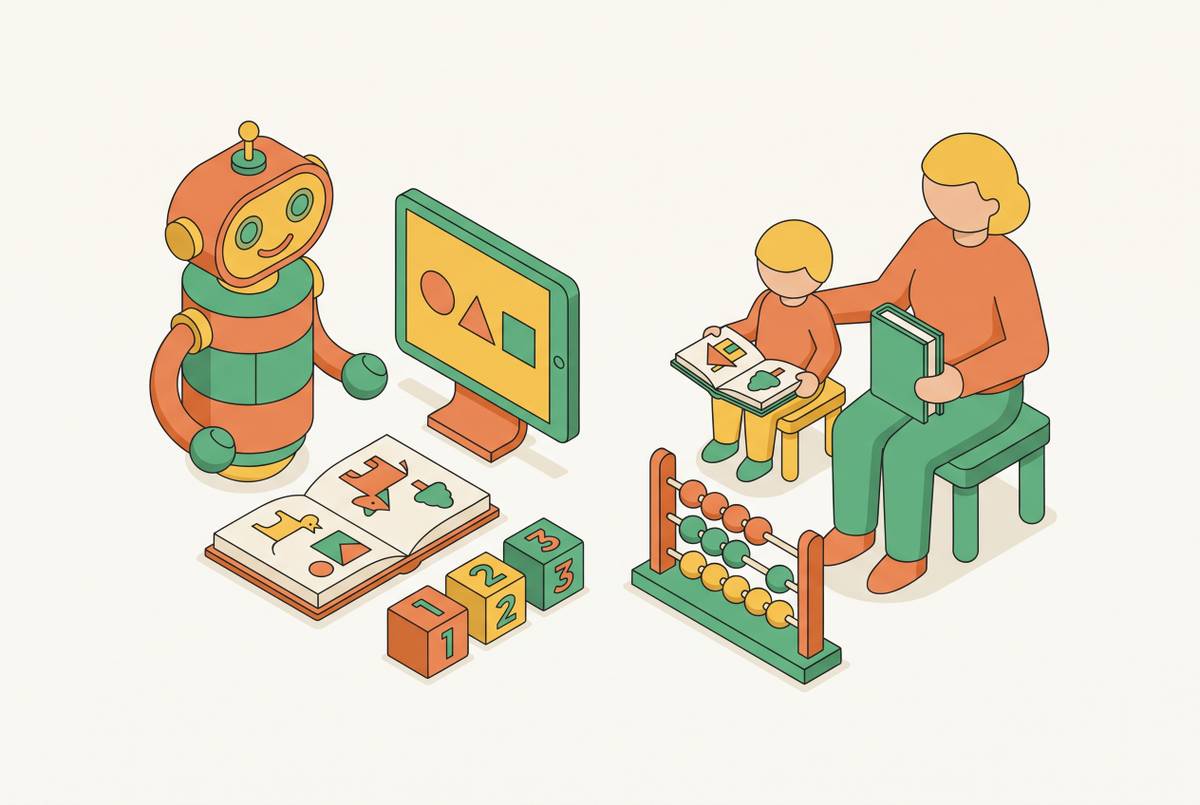
A personalized AI tutor for reading and math should teach both through one shared picture of a child’s progress. Phonics-first reading apps and math apps should not live in separate products because the skills they develop overlap. The strongest design combines explicit instruction, real-time listening, and adaptation across both subjects, while leaving complex judgments to parents and teachers.
Why reading and math share the same cognitive foundation in young children
A young child’s brain draws on some of the same resources when reading a word and making sense of a number. Those resources include attention, working memory, and cognitive control, which helps a child focus mental effort on a task. Both subjects also depend on representing and retrieving symbols. The overlap is part of how these abilities develop.
A 2025 Nature Communications meta-analysis of 3,308 participants found that the abilities to do math and read draw on some of the same cognitive mechanisms, including common cognitive control networks. Reading and math also activate different cortical regions, so shared resources do not make them identical skills. The distinction is important for teaching. Children need to be taught each subject, but understanding their progress in either one means looking at how both develop together.
In phonics, a child connects a written letter to a sound. In early numeracy, that child connects a numeral to a quantity. The meanings differ, but both tasks require a visual mark to stand for something beyond itself. A child learning to decode is therefore using a representational system that also supports understanding numerical symbols and a number line. Separate subject labels hide this common demand.
How phonological awareness feeds early math as well as early reading
Phonological awareness means noticing and working with the sounds of spoken language. Phonemic awareness narrows that skill to individual sounds in words. Together with alphabet knowledge, it is one of the strongest pre-reading predictors identified by the Science of Reading. Its role extends beyond learning to read. Research identifies phonological awareness as a shared risk factor for difficulties in both reading and math.
The connection runs through language and sequence. Segmenting “cat” into /k/ /æ/ /t/ requires a child to hear an ordered whole and separate its parts. The same auditory-sequential processing supports understanding that quantities can be decomposed. These tasks draw on overlapping resources. That gives researchers a reason to examine sound processing in both numerical development and reading.
Aunio et al. (2025) found that language ability was the strongest individual-difference predictor of numerical relational and counting skills in both 3- and 4-year-olds. That finding concerns language broadly. The distinction prevents a misleading shortcut. Children still need direct math instruction, even when language helps them learn. An integrated system’s advantage is that it can track phonological and numerical development together, rather than assuming improvement in one guarantees improvement in the other.
What the Simple View of Reading reveals when you place it next to early numeracy research
In the Simple View of Reading, reading comprehension is decoding multiplied by language comprehension. A child must recognize the words and understand what they mean. Once a child has secure word recognition, language and vocabulary are still key to understanding more of what they read.
Scarborough’s Reading Rope shows how this works by weaving word recognition and language comprehension together. Numerical relational skills need mathematical language if a child is to understand and use them. This analogy shows why knowing how to count can coexist with difficulty understanding a word problem.
A Journal of Experimental Child Psychology study from April 2025 found that vocabulary correlated more strongly with applied math scores than with any other cognitive skill measured. It also found that vocabulary contributed strongly to early math co-development with reading. Working memory also supports the tasks through which children demonstrate those skills, although it is not a separate term in the Simple View. A reading-only system cannot observe whether the language a child uses in reading is also helping that child understand numerical relationships.
Why early math skills deserve the same instructional urgency as early reading
Aunio and colleagues found that 3- and 4-year-olds had numerical relational and counting skills that could be measured, and that language helped explain why these skills differed between children. Children are already learning math in the years often set aside to get them ready to read. Both need attention during those early years. That is a reason to teach them together.
A 2026 Springer study found that short-term and working memory, together with domain-specific numerical precursors, significantly explained mathematical competence in five-year-olds, drawing on resources also used in decoding tasks. Yet shared resources do not remove the need for mathematical language. Children need words for quantity, comparison, sequence, and pattern to make sense of the relationships they encounter. Those words support numeracy from age three onward.
A 2025 study available through ScienceDirect found that children whose teachers had professional development in math-specific interaction quality gained stronger mathematical language and numeracy than children in the comparison groups. The finding puts language-rich math teaching inside the early learning window. Parents can, of course, run two apps at once. When neither system knows what the other is teaching or observing, neither can adjust across subjects during the period when both abilities are taking shape.
What children lose when phonics instruction and math instruction do not share a context
Consider a kindergartner whose decoding is becoming strong but whose math word-problem performance is lagging. A phonics app may record words read correctly, while a math app records wrong answers. Those results do not explain the gap. The child may need support with the language of the problem. Without a shared view, the connection between those performances remains outside either system’s assessment.
Frontiers in Psychology research from 2025 identifies language, narrative comprehension, and sequencing as supports for tasks including word problems and pattern recognition. These dependencies create opportunities for reinforcement across subjects. A shared instructional context can connect language practice with the numerical reasoning that uses it. A child may make that connection on their own even when using separate products. They do, however, lack a built-in way to observe and respond to it together.
Fluency adds another link through working memory. Effortful decoding draws mental attention away from meaning, while effortful calculation leaves less room for solving a larger problem. Automatic word recognition and automatic retrieval of number facts reduce those demands. A unified system can consider both forms of effort when adapting instruction. Parents otherwise receive separate progress reports that leave them to work out how reading and math difficulties might relate.
How Harvard's CALC study frames the clinical question no siloed app can answer
Harvard’s Gaab Lab CALC study, Children’s Arithmetic, Language, and Cognition, was designed to examine how math and reading skills develop and interact. It followed 163 students for up to four years. Its assessments covered language and cognitive abilities, brain structure and function, and the home learning environment. The study treated development as an interaction among abilities and conditions over time.
The central clinical question concerns which children are on a trajectory to develop both math and reading problems. Answering that question requires observations across subjects and across time. A reading-only record cannot establish a child’s numerical trajectory, just as a math-only record cannot establish decoding development. This is a limit of what is observed. It is not something a more detailed single-subject score can fix.
The study’s design offers a principle for educational assessment. An app cannot replicate a longitudinal neuroimaging study or turn lesson responses into a clinical diagnosis. An integrated tool can, however, track phonological development, decoding, vocabulary, and numerical reasoning within the same record. That broader view can reveal patterns a single-subject system never observes and may help flag cross-domain concerns earlier. Such flags still need human interpretation rather than being presented as conclusions about a child’s future.
What adaptive AI makes possible when it can see both domains at once
Adaptive AI is most useful where tasks have clear answers and skills follow a well-defined progression. Early phonics and numeracy both offer that structure. Letter-sound correspondences, blending, and segmenting can be assessed through focused responses. Counting, numerical relations, and symbolic magnitude also provide structured evidence of what a child can do. That makes both subjects suitable for instruction that responds to performance.
Frontiers in Education research from September 2026 identifies adaptive personalisation, timely diagnostic feedback, sustained learner participation, and actionable information for teachers as mechanisms through which intelligent tutoring systems support learning. Seeing both subjects gives those mechanisms more to draw on when responding. A child with strong phonological processing but weak numerical relational skills has a different mix of skills from a child who struggles in both areas. A shared model can preserve that distinction. Two separate models cannot assess how what one sees relates to what the other sees.
The useful claim is therefore narrower than “AI makes learning personal.” An integrated system can use evidence from both subjects when adjusting what comes next, how it is taught, and when the child moves on. That is different from placing reading and math content behind the same login. It also remains limited by what structured responses reveal. More complex, open-ended understanding needs human mediation, so the appropriate role is a responsive one-on-one instructional partner.
How do parents and educators find an AI tutor that adapts to a child’s reading and math level?
Parents and educators should start with instructional quality. Reading instruction should follow a structured, explicit progression through phonemic awareness, phonics, fluency, vocabulary, and comprehension. Math needs a similarly principled progression covering numerical relations, counting, symbolic magnitude, and applied problem-solving. Neither subject should be a token addition. A shared system is useful only if it teaches both well.
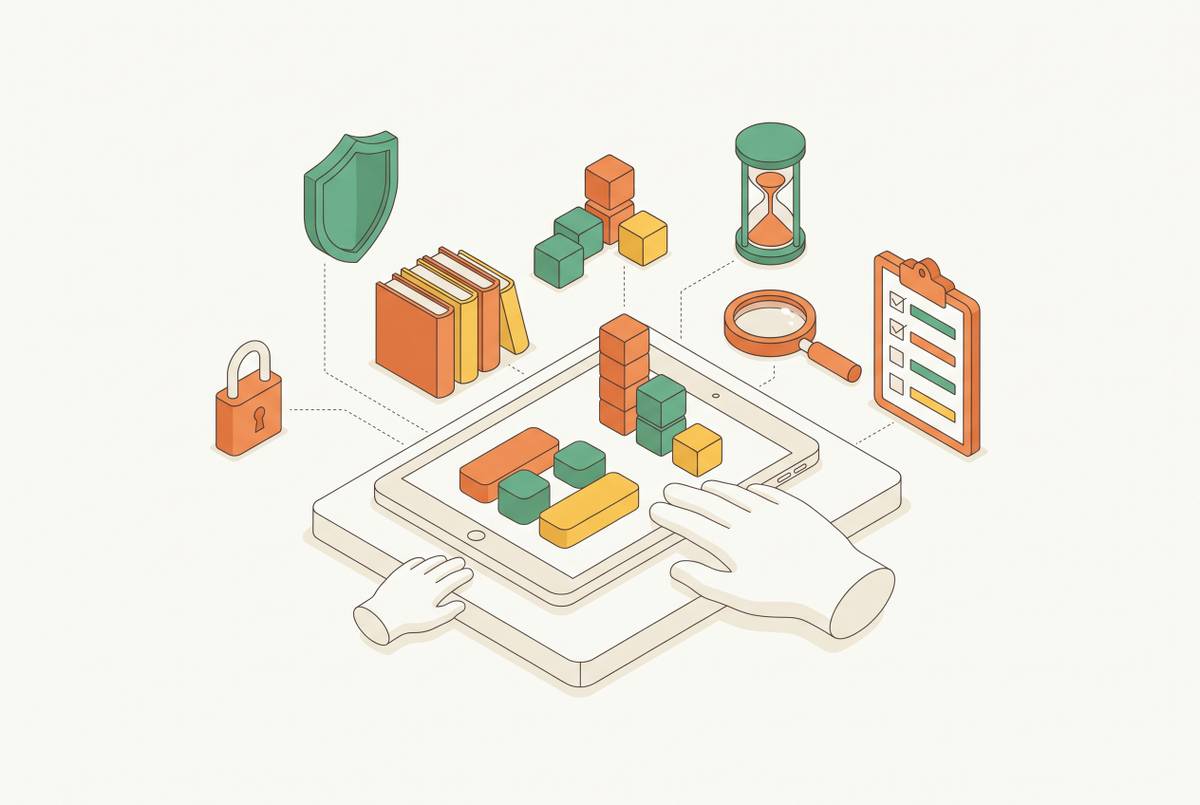
The next test is what the tool actually observes. Taps, drags, and multiple-choice answers alone cannot directly show how a child processes and produces sounds when reading aloud. Real-time listening gives the system access to spoken responses and a basis for responding to what it hears. Parents should also ask whether those observations update one model used across reading and math. A fixed sequence with two subject tabs is not cross-domain adaptation, even if both tabs appear in one product.
Engagement should serve the lesson. Stories calibrated to a child’s reading level and interests can make narrative part of instruction. Letting a child co-create a story and then read it back connects participation with reading practice. Access deserves the same scrutiny as features. A free tier with no ads and no in-app purchases, available across iOS and Android, is a meaningful commitment to making one-on-one support available beyond families able to pay for it. Before buying, assess whether the tool combines those commitments with evidence from both subjects to decide what this child needs next.