What Elementary AI Tutoring Apps Actually Do Differently for the Five to Eight Age Band
Real-time listening and a systematic phonics sequence separate true AI tutors from games.
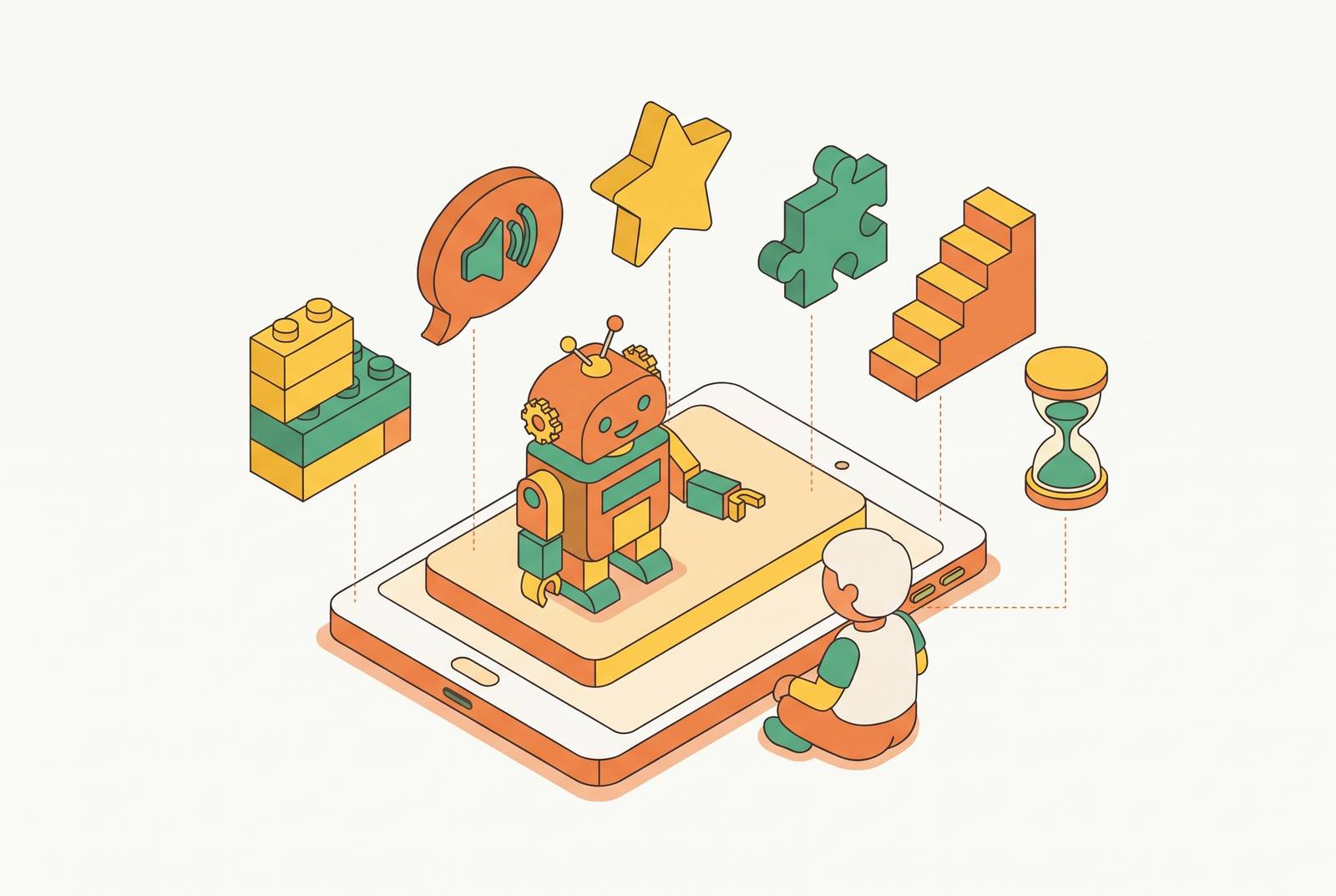
AI tutoring for children ages 5–8 goes beyond generic learning apps when it listens in real time, adjusts what it teaches within the session, and teaches reading in a systematic, evidence-based sequence. For parents seeking a personalized AI tutor for reading and math, responsiveness is the test of a tool labelled “AI-powered”. For children with dyslexia or language-based learning disabilities, the distinction is especially important, but the product descriptions below do not establish effectiveness for those needs.
Why the five-to-eight window is the pivotal moment for reading and math development
Children in this age band are building foundations. In reading, decoding supports fluency, which helps make comprehension possible. A child who must work hard to identify every word has less attention left for its meaning. The National Reading Panel found that phonics instruction is most effective in kindergarten and first grade, with effect sizes dropping sharply afterward.
Screening for phonemic awareness and alphabet knowledge can identify children likely to struggle with decoding before they can read words. Math follows a similar developmental pattern, as early numeracy is a leading indicator of later mathematical achievement. Confidence develops during this period too, and falling behind can lead to avoidance that compounds the gap. The right tool therefore has to meet a child’s actual place in the learning sequence, rather than assume that age determines the starting point.
What the Science of Reading actually requires from any tool claiming to teach reading
The Science of Reading is a body of converging evidence. Its starting point is straightforward. Children need to be taught explicitly how written language works. Phonemic awareness helps them hear and work with the separate sounds in spoken words, and phonics links those sounds to letters and letter patterns. These skills work together to help with decoding, which lets children work out written words.
Decoding is the bridge to further reading skills. Children also need to be taught fluency, vocabulary, and comprehension. Fluency helps a child read with enough ease to focus on what the words mean, and vocabulary gives them the word meanings they need. Comprehension brings that work together into understanding. An app that teaches letter sounds but never helps children use them in reading addresses only part of the task.
“Systematic” means the teaching follows a planned sequence. Children practise blending sounds into simple words before meeting more complex phonics patterns, rather than encountering whatever a game happens to serve next. Pairing sounds with letters is more effective than teaching either alone, and playful practice can help sustain attention. That sequence does not end after kindergarten, because English spelling patterns grow more complex. Hall et al. (2025) found moderate-to-large decoding effects in a pilot of the family-implemented “Launch into Reading” intervention, with families delivering it faithfully and reporting high satisfaction. Structured teaching can work at home as well as in class.
Why most apps aimed at this age group do not actually teach reading
A reading game and a reading intervention can both look cheerful. Their instructional structure is what separates them. An intervention teaches skills explicitly in a planned sequence, while a game may reward right answers without teaching the skill behind them. Tapping the right picture, for example, can show picture-word association. When pictures substitute for working through the letters, the child is practising guessing.
A content library or passive video cannot notice that a child has stopped understanding or is unable to decode a word. Rule-based quizzes can follow predetermined paths, but struggle when a child’s response falls outside them. Adding generative AI does not solve that problem on its own. Shen et al. (2026) found that even large models such as GPT-4o struggle to keep vocabulary and sentence structure at a set level of difficulty while keeping the story coherent.
Enjoyment is useful, but it is not proof of learning. A child can love an app, finish levels, and still have a widening decoding gap. That does not make the parent’s choice foolish, because an app listing rarely makes the distinction clear. A tool can address the decoding gap by responding to the child’s reading.
What genuine adaptive AI instruction actually does in the moment with a young child
In a genuinely adaptive reading session, the child speaks and the system listens. That is different from choosing an answer on-screen. A young child who cannot type can still read aloud, giving the system access to errors, hesitations, and mispronunciations that taps cannot reveal. Feedback can then address what the child just did. The next passage or question changes within the interaction.
The child gets practice that fits their current decoding skills, instead of working through fixed material no matter how hard it is. The system can also use interests to engage the child in that practice, such as generating a decodable story about dogs for a child who loves dogs. Interest gives the child a reason to keep working through the instructional sequence.
That responsiveness requires control over the reading material itself. Shen and colleagues showed that fine-tuned compact language models can make stories whose difficulty can be controlled to match K–2 teaching standards. This supports a more precise approach than asking a general chatbot for an “easy” story. Meanwhile, passive progress tracking can show how much a child remembers without making each interaction a stressful test. Hall and colleagues also identified the need for more retrieval practice than classroom time allows, giving structured home sessions a clear purpose beyond extra screen time.
Which apps offer AI help with reading and math for ages 5–8?
The apps can be compared by whether they listen in real time, teach reading in a systematic sequence, and adapt from moment to moment. Those features should not be inferred from the label. The options here meet different needs, and their descriptions do not show that each offers the full reading framework. They also do not establish which is best for a child with dyslexia or a language-based learning disability.
Askie is a voice-first AI companion that adjusts answers to a child’s age. Its scope includes questions, stories, homework explanations, language practice, and creative image-making under parental controls. Age-adjusted answers, however, are not the same as a documented phonics sequence or feedback on oral decoding.
Khanmigo prompts students through reasoning. It covers K–12 math and other subjects, with its strongest fit described as grades 4–8 math. That places its clearest use case above much of this article’s age band. As of 2026, it costs a few dollars a month or $44/year, but that price does not establish suitability for beginning readers.
Osmo Learning System combines physical manipulatives with digital adaptive games. It supports motor skills, literacy, math, coding, and early concepts. Its distinguishing feature is tactile learning. For children who need physical objects to anchor an activity, that is a different offer from a voice-first companion, though it does not by itself demonstrate real-time listening to reading.
The platform by Abacus Mind Math Tutors, Inc., funded under Phase IA/IB SBIR, combines digital read-aloud stories with an interactive abacus. It uses AI and gesture recognition to adapt to each child’s pace and cognitive patterns, with real-time feedback and visual support for mental math. Its stated focus is foundational math gaps in underserved populations. That describes a targeted numeracy approach.
What parent-facing progress reporting actually reveals — and why it changes outcomes
A parent needs to know what practice has changed. Time-on-task cannot answer that question on its own. A reading report should show which phoneme-grapheme correspondences a child has mastered, that is, the links between sounds and written letters or patterns. Fluency rate and decoding accuracy on new words add further detail. Lesson completion says that the child reached the end.
Knowing that a child can count to twenty but has not developed numerical relational skills gives a parent a specific gap to discuss. Knowing that the child spent a few minutes doing math does not. The format also counts, because parental math anxiety can negatively affect early numeracy performance. A report should help adults see how a child is doing without making them feel helpless about the gaps.
Skill-level information can help a parent decide whether the next step is more practice, a conversation with a teacher, or a human tutor. It also gives that conversation a clearer focus than “reading is going badly.”
What apps cannot do, and where human presence still determines the outcome
Systematic practice does not replace a trusted relationship. A child who feels defeated needs more than a correction or a celebration of the next right answer. An app can respond to performance, but it cannot feel the weight of discouragement. Parents and teachers bring the praise, reassurance, and interpretation that help a child begin to think of themselves as a reader or mathematician. That emotional work supports continued practice.
Choice also gives reluctant readers a reason to return. Story co-creation can offer ownership, but it is not the same as an adult noticing a child’s interests and putting exactly the right book in their hands. A child reading five “easy” books can be building habit and a positive association with reading. Constantly pushing challenge may weaken the motivation needed to sustain it.
An adult still needs to supervise because five-to-eight-year-olds cannot yet judge AI outputs critically. The app needs guardrails for what it teaches, and the parent needs to watch over its use. The home’s emotional climate also remains outside the software’s reach, including mathematical anxiety that needs awareness and conversation.
How to evaluate any app for this age band using the criteria that actually predict outcomes
The child’s learning need guides the practical evaluation of an app. For a child struggling with phonics and decoding, including a child with dyslexia or a language-based learning disability, ask what the tool actually teaches. Does it follow a planned sequence of sound-letter relationships and decoding, or depend on picture cues and memorized whole words? A tool that helps a child access content has not necessarily taught the child to read it. The options named above need that evidence before they can be treated as proven decoding interventions.
Next, examine what makes the instruction personal. Does the app listen to the child read, and does the next interaction change because of what the child just said? Real-time responsiveness is different from assigning a level based on an earlier session. The reading material also needs to be at a level that helps the child practise decoding without leaving them frustrated again and again. For math, the same test is whether practice responds to the child’s current numeracy skills.
Then look beyond the child’s screen experience. A report should explain which phonics or numeracy skills the child has gained, and the provider should explain how it designed both its curriculum and its AI. Educator and subject-matter expertise should be visible, as should the guardrails that keep generated material appropriate. The choice also depends on cost and access. A free tier without ads or in-app purchases is a meaningful access signal, though it is not evidence of instructional quality.
Finally, consistency depends on more than points and prizes. The best fit is a tool the child will use regularly because its responses make practice feel manageable and worth continuing. For parents choosing a personalized AI tutor, that is the decisive distinction between software that holds attention and instruction that responds to a learner.
Sources
- What the science of reading tells us about how to teach decoding—including phonics - Teach. Learn. Grow.
- Piloting an Approach to Family-Implemented Decoding Instruction for Kindergarten-Aged Children - PMC
- Children's English Reading Story Generation via Supervised Fine-Tuning of Compact LLMs with Controllable Difficulty and Safety