How Adaptive Learning Algorithms Work in Children's Education Apps
Real adaptive systems estimate what children know, not just adjusting difficulty.
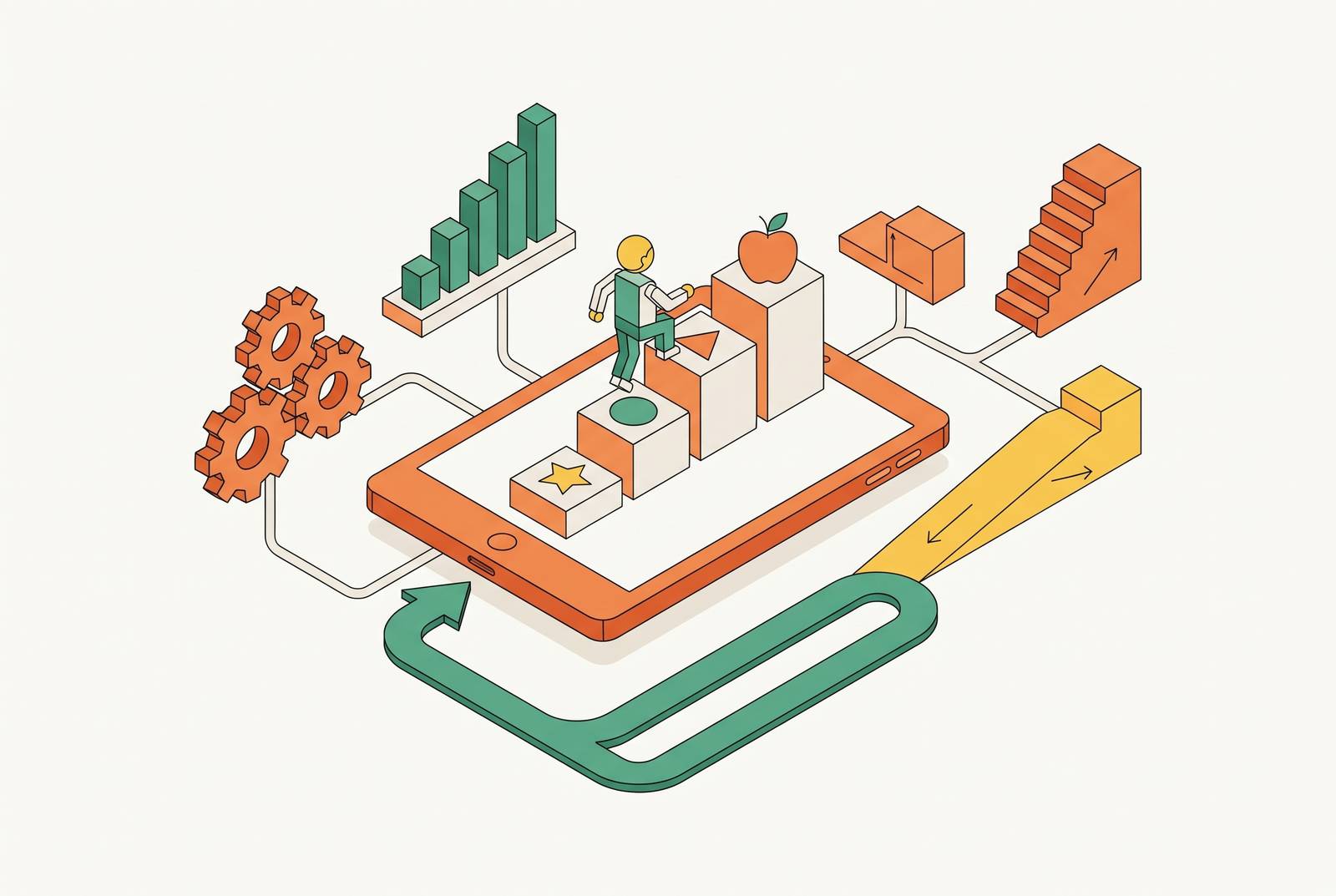
A genuinely adaptive AI tutor for children’s reading and math tracks how a child answers, builds a model of individual skills, and uses it to choose what to teach next. This article explains how those algorithms work and why changing difficulty alone is not enough.
What adaptive learning algorithms actually do — and why most parents misunderstand them
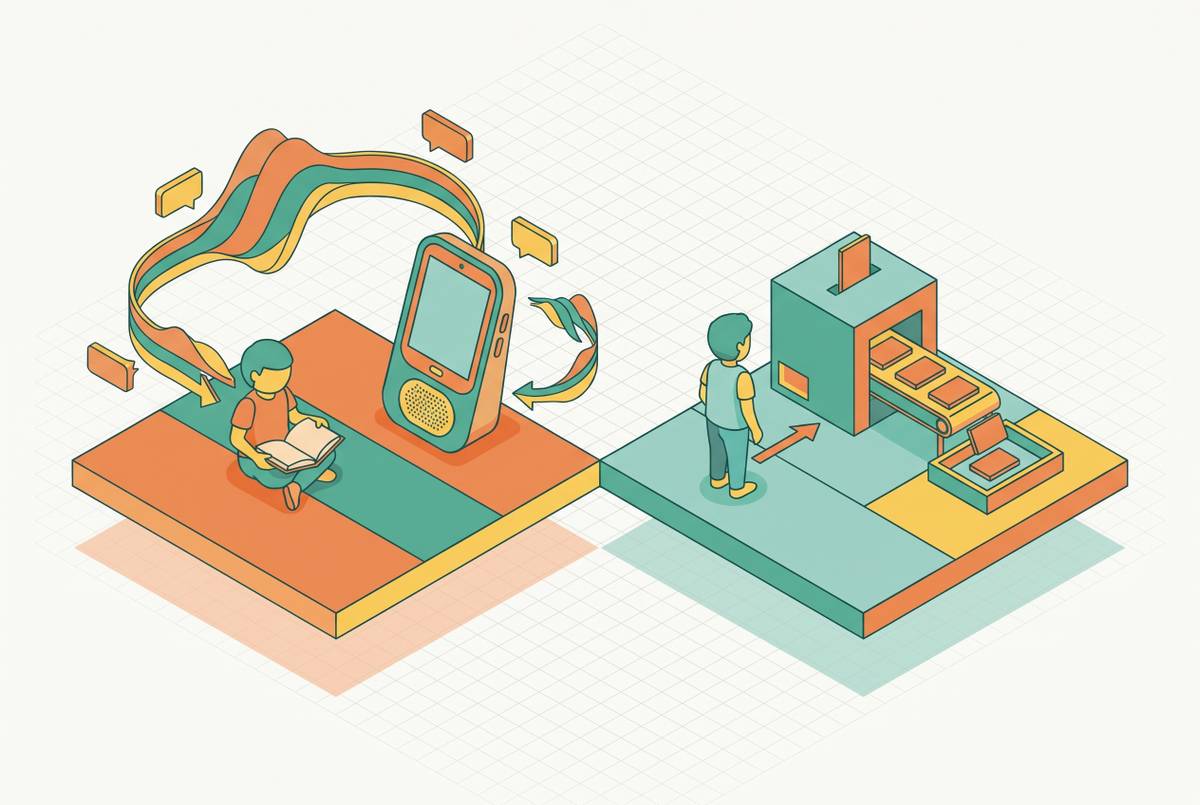
Most parents and educators understand “adaptive” to mean a difficulty dial. A child struggles, so the app serves easier questions. The child does well, so the questions get harder. That changes the challenge, but it does not necessarily reveal what the child understands or what teaching would help.
Genuine adaptive systems work from a different premise. They continuously estimate what a child knows, predict what the child is ready to learn, and decide both what to teach and how to present it. Difficulty is only one part of that decision. An app might need to revisit a missing skill, offer more examples, or reinforce something the child understands but cannot yet use fluently. Mixing up these two approaches lets a simple question sorter pass for teaching that fits the child.
The input signals an adaptive system collects before it decides anything
Response time helps a system judge whether a child knows an answer with confidence or is less sure and may have guessed. Hint use adds context by showing whether help was needed, how much, and at what point. A child who succeeds independently has supplied different evidence from one who reaches the same answer after several hints.
Wrong answers also contain more than a failed score. A child who keeps confusing b and d has a different problem from one who reverses digit order in addition. Patterns across attempts help separate a slip from a gap that persists across sessions. The system can also track time spent on a topic, self-correction, and pacing through a session. Taken together, these signals give it a better chance of distinguishing shaky understanding from a bad day.
Voice-based systems can track pronunciation at the level of individual speech sounds, fluency measured in words read per minute, and specific decoding errors made aloud. A text-only interface cannot pick up those spoken signals.
How knowledge tracing turns a stream of signals into a model of what a child knows
Knowledge tracing turns those interactions into a working estimate of understanding. For each skill, the system maintains a probability of mastery rather than simply recording “knows it” or “does not know it.” A child can guess correctly without understanding, and a child who understands can still make a careless mistake.
Each new interaction changes the estimate in light of what came before. A correct answer raises the estimated likelihood of mastery, with allowance for guessing. An incorrect answer lowers it, with allowance for a slip. One mistake need not erase a history of success. Repeated difficulty, however, gives the system stronger grounds to treat errors as evidence that a skill is insecure.
Over time, this produces a map of individual skills. It separates skills that appear solid from those that remain fragile or have not yet been encountered. Early literacy makes the distinction especially useful. Phonemic awareness, letter-sound correspondence, blending, and decoding need separate attention because they are distinct skills with important relationships in the Science of Reading. A broad label such as “beginning reader” cannot tell the decision system which of those skills needs work.
How spaced repetition schedules what a child sees again — and when
A skill that looks secure today may still need review. Spaced repetition addresses that problem by spreading practice across sessions over time. After a child demonstrates mastery, the system brings the skill back at a calculated interval. Successful recall lengthens the wait before the next review. Difficulty shortens it, so fragile knowledge gets attention sooner.
This is not a technique invented for the current AI boom. Piotr Woźniak developed the SM-2 algorithm in 1987, and many vocabulary and language apps still use versions that have been changed since then. Spacing practice at increasing intervals supports longer retention than massing it in a single session, while adjusting those intervals responds to how well the learner remembers.
The technique is especially relevant to vocabulary, sight words, and math facts, where the aim includes automatic recall. Understanding is not the whole job in these areas. Early readers also need to see words again at the right times so that recognizing them takes less effort. Knowledge tracing supplies an estimate of what is secure, while spaced repetition governs when previously taught material returns. Together, they help avoid advancing too soon or repeating material unnecessarily.
The decision layer — how the system translates its model into the next lesson
The model becomes useful only when it changes instruction. In algorithmic adaptability, performance and behavior signals drive the selection of the next concept, activity type, or difficulty without someone configuring each child’s sequence. Differentiated learning pathways take a less detailed approach by routing children through different pre-built sequences. Those pathways can fast-track a child who is ready or provide more support to one who is struggling. The distinction is how finely the system can adjust its next move.
That move concerns presentation as well as content. A child may need more examples, a different way to encounter the material, or a simpler sub-skill taught first. In reading, these choices must take into account how the skills connect. Phonics supports decoding, accurate decoding enables fluency to develop, and fluency bridges decoding to comprehension. The Simple View of Reading also treats language comprehension as an independent requirement, expressing reading comprehension as decoding multiplied by language comprehension.
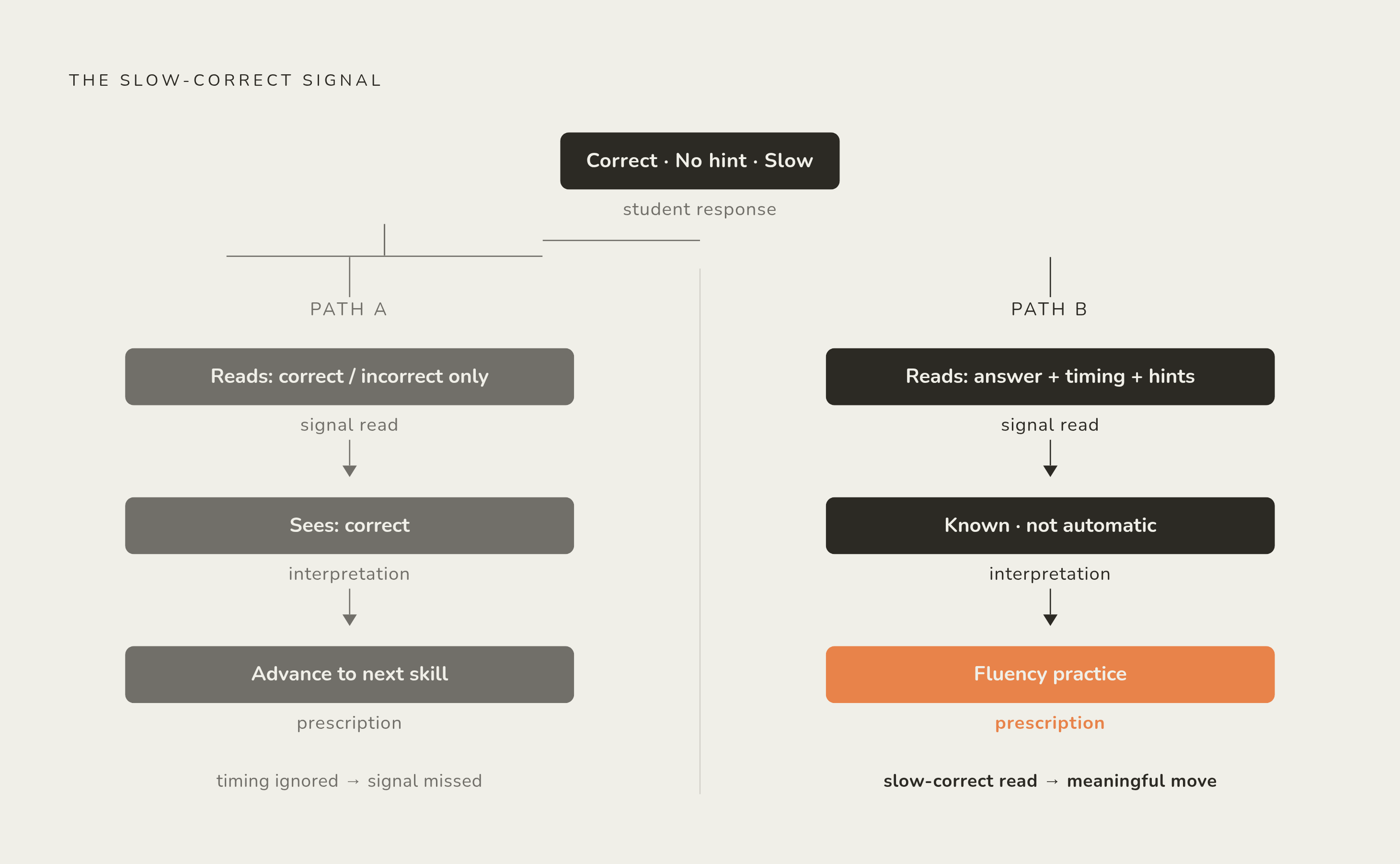
A concrete example shows why this layer is consequential. A child answers a phonics question correctly but slowly, without a hint. That pattern suggests the letter-sound mapping is known but not yet automatic. The appropriate next move is fluency practice. A tracker that sees only a correct answer misses the reason to stay with the skill.
Why rule-based branching is not the same thing as adaptive learning
Simple branching follows instructions fixed in advance by a human. An app might serve easier questions after three wrong answers in a row and advance a level after five correct answers. That rule responds to performance, but only within narrow limits. It does not estimate whether those correct answers were guesses or examine the particular mistakes behind the wrong ones. It also lacks the accumulating probability model that knowledge tracing provides.
Pre-built pathways can still offer useful differences in support. Treating a fixed right-or-wrong trigger as equivalent to a system that continuously assesses understanding and learns from accumulated student data is a mistake. Both may be sold as “personalized,” “adaptive,” or “AI-powered.” Those labels do not show how the system works. A simple branching rule cannot use a lasting skill model to anticipate a difficulty before the child encounters it.
For parents evaluating an app, the practical test is concrete. Does its behavior change because of how a child answered, including timing and error patterns, or only because the answer was right or wrong? Does the model deepen across sessions, or does each session appear to start fresh? These questions probe what the app actually responds to. They are more revealing than whether its next question happens to be harder.
Where genuine adaptive systems produce measurably different outcomes — and where they fall short
The evidence supports adaptive learning, but not without conditions. Children who were previously struggling tend to show the largest gains when instruction meets their current level. That is where precise targeting has the most room to help. Yet outcomes depend on the quality of the AI design, the subject, how long the system is used, and the learner’s characteristics. Success in math does not establish that the same approach provides strong reading instruction.
The format also limits what a system can accomplish. An adaptive quiz engine can identify a gap and direct practice toward it, but that is not the same as explaining a concept as a skilled teacher would. Practice is not a substitute for teaching. Too much gamification also limits learning when the parts meant to entertain crowd out the thinking an activity is meant to build.
These limits support using adaptive tools as complements to human instruction. Help from parents and teachers leads to better results even when software adjusts the lesson. For a parent choosing an app, the question therefore needs to be specific. Does it adapt in the ways the child’s target skills require? Tracking spoken decoding errors helps guide teaching in a different way from counting correct answers in math practice.
What genuine adaptive instruction means for children who learn differently
Mastery-based progression lets a child move forward when ready. For a child who needs more time or a different route, that changes the conditions of learning. By contrast, advancement based on elapsed time or session count can push new work onto skills that are not secure. A knowledge-tracing model can instead start with what the child knows, even when that is below what is expected at their grade level.
The kind of gap is as important as its size. A child who struggles to blend speech sounds needs different support from one with solid phonics who struggles to hold information in mind during multi-step decoding. Counting wrong answers treats those children alike. Tracking error patterns makes a more precise response possible, including for children with learning disabilities.
English language learners can benefit from adjustable pacing and supported vocabulary exposure. Voice-based systems can also track pronunciation errors connected to the sound patterns of a learner’s first language. Across these situations, mastery-based progress shifts attention away from a fixed label of “behind” toward the child’s consistent progress from the skills they actually have.
How do you find an AI tutor that genuinely adapts to your child’s reading and math level?
Parents can look for evidence of a lasting skill model in both the lessons and the progress reports. Useful reports identify mastered skills, fragile skills, and what the child will practice next. The stars a child earns and the minutes they play cannot show that. A session that picks up a previously identified weakness offers a stronger sign of continuity than one that simply opens another level. The relevant evidence is a connection between past difficulty and current instruction.
The teaching sequence deserves the same scrutiny as the reporting. Reading instruction should build phonics, decoding, and fluency toward comprehension while also addressing language comprehension. In math, foundational number sense should precede operations. For early reading, an app that listens to spoken reading can gather evidence a text-only activity cannot provide. Listening is useful because it can expose the specific errors that should shape the next lesson.
Warning signs appear when difficulty changes but teaching does not, progress reports show only activity, or sessions appear to forget earlier struggles. Gamification is also a warning when serving the reward loop takes priority over the child’s learning in the instructional sequence. A genuinely adaptive app can choose different next steps for two children who gave the same answer because their histories reveal different needs.
Sources
- The Future of Child Development in the AI Era. Cross-Disciplinary Perspectives Between AI and Child Development Experts
- Inclusive Education with AI: Supporting Special Needs and Tackling Language Barriers
- Supporting fluency and comprehension using practices grounded in the science of reading - Teach. Learn. Grow.