AI Tutors vs. Human Tutors for Early Readers and Math Learners
AI tutors excel at daily practice while humans provide emotional support and deeper understanding.
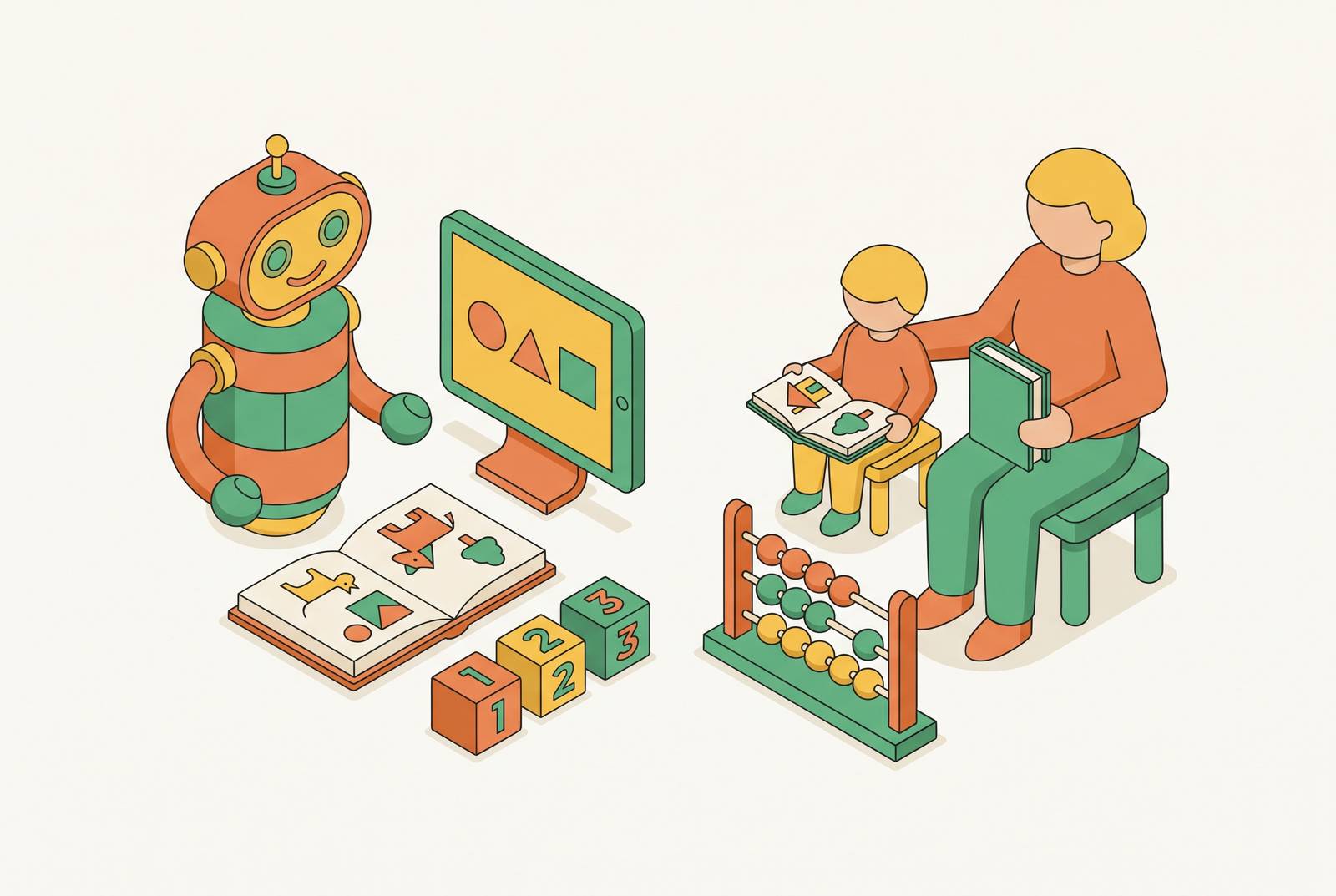
For early readers and math learners, the best choice is usually a well-designed AI tutor for frequent, patient practice plus a human who supports language, understanding, and confidence. A personalized AI tutor should teach skills in a clear sequence and adapt to specific mistakes. The right balance depends on what the child needs most.
How children actually learn to read and do early math
Children need teaching that is clear and follows a plan to learn to read and build early math skills. Exposure alone is not a teaching plan. NWEA’s science of reading overview explains that children must be taught how written code works. In the Simple View of Reading, reading comprehension is decoding multiplied by language comprehension. A child who sounds out every word but does not understand the words still struggles to read for meaning.
NWEA’s component framework identifies five connected parts of reading instruction, including phonemic awareness, phonics, fluency, vocabulary, and comprehension. Phonemic awareness is the ability to hear and work with the separate sounds in spoken words. Phonics connects those sounds to letters in a planned sequence, from simple patterns to more complex ones, supported by decodable texts. Accurate decoding and repeated practice build fluency, freeing attention for meaning. Vocabulary and comprehension need rich conversation and meaningful engagement with text, so sound-letter practice cannot do the whole job.
Early math also depends on more than correct answers. Numeracy and general language development predict each other from toddlerhood, and both predict mathematical language. Treating math as isolated arithmetic drill misses that connection. Teaching needs to be clear, follow a plan, and change with the child’s needs while building these linked skills together. That is the standard any tutor must meet, whether the teaching comes through a person or a screen.
What a skilled human tutor can do that technology currently cannot replicate
A skilled human tutor can notice distress before a child can explain it. Body language, hesitation, and early signs of overwhelm can prompt a change in tone, pace, or task. That response helps the child stay able to learn. Current AI systems do not have access to those signals in the same way. A correct answer followed by another question is not a substitute for recognizing that a child is close to giving up.
Human tutors can also change course beyond a program’s defined interactions. They can switch to an oral activity, briefly change the subject, or use humor when a session starts going sideways. For a young learner, that flexibility supports the trust needed to try something difficult again. Emotional support is a functional part of teaching.
A tutor can connect a word or math idea to the child’s neighborhood, family, or current fascination, then develop the conversation around the child’s response. Those connections make language concrete. NWEA’s framework identifies “high-quality, language-rich interactions” and explicit vocabulary instruction as essential. A skilled adult can provide both naturally in conversation.
Carnegie Mellon University’s study comparing human-AI tutoring with AI-only tutoring found that the combined group was measurably ahead by the school year’s end. More AI use strengthened that advantage. But human tutoring has a hard access problem. Tutors are expensive and scarce, and many families cannot arrange the multiple sessions per week that research recommends. AI tutoring is built to address that shortage.
What AI tutors can do that human tutors structurally cannot
AI’s clearest advantage is availability. It can offer individualized practice every day, at a frequency and cost that human tutoring cannot match. For a child consolidating phonics or numeracy, the chance to practice between human sessions is valuable. Repetition needs time that adults may not have. A well-designed AI tutor can provide that time consistently, for as long as the child remains engaged.
Brookings Institution research describes programs that let students use everyday language and change sessions to fit what students have learned and where they struggle. A child who has mastered short vowel sounds can move forward, while one who needs more practice can return to them without delay. Pace follows the learner rather than a fixed script. That is a genuine advance over a program that serves the same sequence regardless of the child’s responses.
An AI tutor does not show adult frustration or disappointment on the hundredth attempt. For some children, that removes a source of anxiety. It can make repetition feel less like a judgment. The distinction is important because a neutral response and an emotionally attuned response solve different problems.
A reading tool that rewards guessing, favors speed over accuracy, or skips work on manipulating speech sounds fails the instructional standard even if it adapts constantly. A math tool that drills arithmetic without developing mathematical language leaves a different gap. The instructional design is the product. Producing correct answers is not the same as helping a child understand how to reach them.
Harvard’s study by Kestin et al., published in Scientific Reports in June 2025, found that students learned much more with AI tutoring than with traditional instruction. But it tested a custom-built tutor with university students. It was not a consumer test for ages 4–9. Much of the research base concerns older or adult learners. For that reason, what the AI is built to do matters more for a 5-year-old than for a college student.
Why the combination of human and AI tutoring outperforms either alone
Neither human nor AI tutoring is categorically better. Their strengths address different constraints, so the useful comparison concerns how much of each a child needs. The CMU study changes that framing from either/or to a question of balance. Lee Branstetter, the study’s coauthor and a CMU professor of economics, said that “human tutors enhance the benefits of AI tutors.” The finding supports complementarity, though it does not establish that every combination beats every human-only arrangement.
The likely division of work is straightforward. A human handles the relational, emotional, and diagnostic work, including noticing confusion and building the trust that makes another attempt possible. AI handles frequent, patient practice that helps decoding and numeracy become automatic. In reading, human conversation is especially useful for vocabulary and language comprehension, while AI practice fits the repetition needed for phonics and fluency. Phonemic awareness still needs deliberate attention rather than an assumption that either side will cover it incidentally.
Early math benefits from a similar division. A human can develop mathematical language and conceptual understanding through conversation, while AI adjusts pacing and provides procedural practice. For families, the practical implication is that a combined approach need not mean paying for both a private tutor and an app. It can include a parent reading aloud and discussing books while a child also uses a well-designed AI reading tool daily.
That option still needs an adult who has the time and takes part. Some families cannot reliably arrange even informal support. When the AI tool becomes a child’s main learning relationship, parents need to look even more closely at how it teaches because there is less human help to fill its gaps. A combined approach is useful, but it should not disguise unequal access to the human part.
How do you find a personalized AI tutor for your child’s reading and math?
Parents evaluating an app should begin with its teaching. For reading, the first question is whether it teaches phonemic awareness and phonics explicitly and sequentially. Phonics offered as one content category among many is not a reading curriculum. A reading tutor needs a plan for what to teach next, with decodable texts to support that teaching. Otherwise, an engaging session can leave the underlying skill gaps untouched.
Parents need to check how a product teaches math too, even when it promises both subjects. Parents should ask whether it develops mathematical language and conceptual understanding or only checks arithmetic accuracy. Getting a procedure right is not the whole goal. A product’s strength in reading does not establish its strength in math, because the two require different instructional content.
“Adaptive” can mean changing question difficulty or identifying a specific phoneme a child struggles with and changing instruction in response. Parents should ask what the system adapts and what evidence it uses. Real-time voice recognition that responds to what the child actually says is a useful feature for reading practice. But listening technology needs a sound curriculum behind it.
Progress reports should make that teaching visible. Badges and stars show that work is done, but they leave out whether decoding accuracy has improved or which phonics patterns still need work. Parents should look for specific skill data that can guide the next step. Useful signs are an explicit phonics sequence, decodable texts, reports that show what the child has learned, and a curriculum that reading specialists built. Parents should watch for tools that reward guessing, put speed ahead of accuracy, skip phonemic manipulation, or make reading a side feature of a game.
Those criteria offer a more honest basis for choosing than a universal best-app ranking. The evidence here does not support naming one consumer product as best for every child’s reading and math needs. A tool earns consideration by showing how it teaches, how it responds to errors, and how it reports skill growth.
Matching the tutoring approach to the child in front of you
Start by identifying whether the child most needs more practice or more human support. Practice needs include frequency, repetition, and suitable pacing. Human support includes motivation, emotionally responsive teaching, and vocabulary-rich conversation. Most children need some of both, but the immediate priority can differ. That distinction gives parents a way to choose without treating every struggle as the same problem.
For a child who is behind in reading, high-frequency, explicit phonics practice with immediate, patient feedback is a priority. AI is well suited to supplying that repetition. Adult support during sessions can help prevent avoidance and build confidence, so the two contributions belong together. For a child struggling with math, the corresponding question is whether practice is missing or whether mathematical language and conceptual understanding need more attention. More arithmetic questions alone do not address both possibilities.
A child who resists reading may need a different balance. The text may not fit the child’s interests or reading level, or past correction may have made reading feel like a test. An adaptive, nonjudgmental tool can ease one part of that difficulty. An adult who picks books that fit the child and makes reading fun to share can help with another part.
For children at or ahead of grade level, the goal shifts toward enrichment and acceleration. Adaptive AI can move at the child’s pace, while a human tutor can deepen learning through curiosity and discussion. Children with special needs or who learn differently deserve particular care. A skilled tutor’s emotional attunement and diagnostic sensitivity are especially valuable here, and AI should supplement rather than become the primary instructional relationship without careful monitoring.
English language learners who already know some English may find it helpful to have patient, low-pressure spoken practice at any hour. AI can reduce the social anxiety that sometimes accompanies practice with native speakers. An unsupported child using an app reluctantly gains less than one who feels someone cares about the work.