How a Reading App Should Sequence Phonics and Decoding for a Child Whose Brain Wires Language Differently
Explicit, cumulative sequencing adapts to each child's spoken errors.
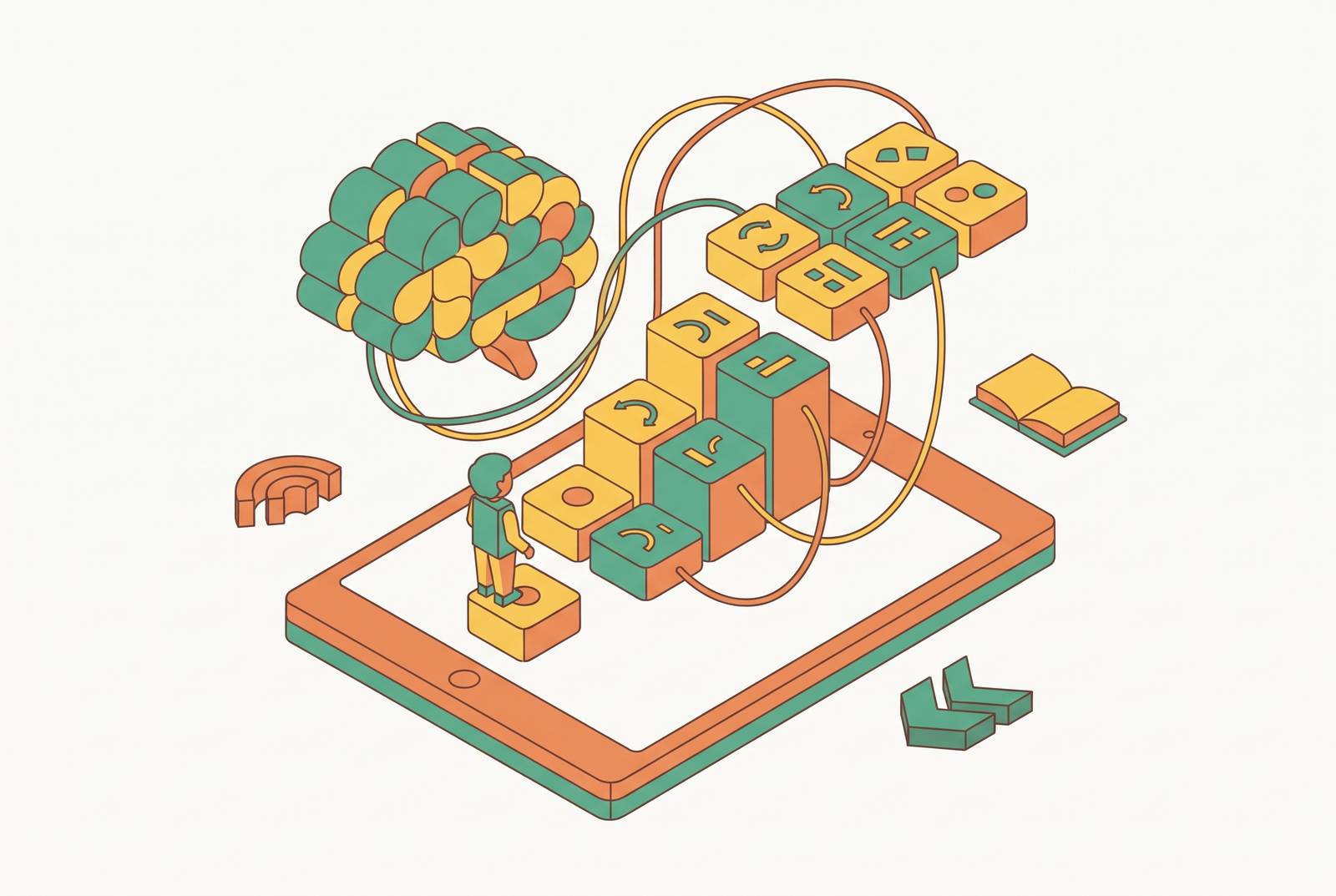
A reading app for kids with dyslexia or language-based learning disabilities should teach phonics and decoding explicitly, in a cumulative sequence that adapts to the child’s spoken errors. It should pair sounds with print and active sound production, require mastery before advancing, and revisit unstable skills. The app should teach the child to decode on their own, beyond helping them finish a screen.
Why the dyslexic brain struggles with automaticity, not intelligence
Dyslexia is a neurodevelopmental difference in language processing that is independent of intelligence or effort. The central difficulty is making reading automatic. A child may work hard to connect letters with sounds yet still struggle to recognize those connections reliably the next time. An app that relies on repetition alone to make reading click can keep a child busy without helping with that struggle.
A Stanford-led study found that the Visual Word Form Area (VWFA), a small region on the left side of the brain involved in reading, was detectable in only about two-thirds of children with dyslexia at the start of intervention. Its response to words was weaker, and smaller size correlated with weaker reading. The wider reading network is also organized differently in dyslexic readers, making decoding effortful. These differences in how reading develops are independent of a child’s potential.
That distinction changes what instruction must provide. When letter-sound connections do not become dependable through ordinary exposure, an app cannot leave the child to infer them. It must deliberately control what is taught, what comes next, and how much review each connection receives. More practice is useful only when it targets the skill that needs building.
What the Science of Reading says must happen before decoding can succeed
The Science of Reading supports explicit, systematic, cumulative teaching of phonemic awareness, phonics, and fluency. Phonemic awareness means hearing and working with individual sounds in spoken words. Phonics links those sounds to the letters and letter groups used to write them. For a child whose implicit learning of these connections is unreliable, clear teaching is a requirement.
The sequence begins with isolating sounds before blending them, then moves to segmenting words into sounds before decoding consonant-vowel-consonant, or CVC, words. CVC work precedes consonant blends and more complex patterns. If a child cannot reliably assemble spoken sounds, adding printed words asks them to handle another layer before the foundation is stable.
Structured Literacy gives this progression a wider framework. It connects phonology, sound-symbol association, syllable instruction, morphology, syntax, and semantics rather than treating reading as disconnected exercises. Orton-Gillingham and its derivatives make mastery-based progression central, so a child demonstrates consistent accuracy before moving on. Completing a lesson is not enough evidence. The question for a reading app is therefore not whether the Science of Reading provides a sound foundation, but whether its teaching actually follows that foundation.
How a differently-wired reader's error patterns demand a different kind of sequencing logic
Even when a curriculum is in the right order, the next lesson can be wrong for the child. Dyslexia does not have one uniform profile, and phonological processing, visual processing, working memory, and other functions can be affected differently. An app needs more than a route through content. It needs a way to decide where this child belongs on that route today.
Consider two children who both read slowly. One cannot reliably isolate or blend sounds and frequently mismatches letters and sounds. The other can decode accurately but laboriously, with slow rapid automatized naming, or RAN, and weak fluency. The first child needs work on assembling sounds. Sending that child into fluency practice too early adds pressure to an unstable skill, while repeatedly drilling basic blending for the second child misses the bottleneck in automaticity.
The errors help distinguish those needs. Substituting a visually similar letter may suggest an unstable letter-sound connection, while leaving a sound out of a blend may point to difficulty assembling sounds. Reading a word correctly once but failing on it next session may suggest that its written form has not become securely stored.
An app that analyzes spoken responses can use those signals to pause advancement for targeted review. It also needs to distinguish a new gap from a previously learned skill that has weakened. The Stanford study found that brain differences persisted even after reading scores improved. Equal scores therefore do not necessarily mean equal instructional needs.
Why multisensory encoding is not an enrichment but a structural requirement at each stage
Multisensory instruction connects the same learning target through more than one channel. In a multisensory reading approach, a sound-letter pairing is linked through seeing, hearing, articulation, movement, and touch. Those actions belong to the teaching itself. For a reader whose reading network works less efficiently, the purpose is to build connections that visual exposure alone does not reliably establish.
In a digital lesson, the child should hear the sound, see the letter or letter group, and produce the sound aloud. Active production changes the task from watching to doing. An animation may show the relationship, but it does not require the child to form the sound. Voice input therefore serves an instructional purpose as well as supplying information about the child’s response.
That does not make every talking app equivalent to a full multisensory lesson. The app’s sensory activities need to strengthen the same sound-symbol connection, regardless of how many effects are on screen. Immersive and game-based approaches have shown promise over the short term, but there is still little evidence that those gains carry over to literacy in the long term. Novelty cannot stand in for instructional design.
Multisensory teaching needs to carry on when longer words arrive. Each new pattern needs sound, print, and active production linked together, with earlier patterns kept in the sequence for review.
What research on intervention timing reveals about when sequencing must start
The Stanford-led intervention study gives a concrete reason to begin structured teaching early. Children with dyslexia who received intensive, evidence-based reading intervention showed measurable VWFA growth as well as improved reading. Children who did not receive the intervention showed no such change over the same period. Instruction changed more than their test performance. It was associated with development in a brain region involved in reading.
The gains did not erase every difference. After intervention, the children with dyslexia still had, on average, smaller VWFAs and weaker neural responses than typical readers. That finding supports continued attention to individual needs after improvement. It does not show an age after which teaching stops working.
Jennifer Christenson’s 2026 adult emergent reader case studies show meaningful and sustained progress with structured literacy practices. Adults developed more slowly and effortfully, with reduced neuroplasticity among the factors discussed. Earlier instruction has more neuroplasticity available to work with, but later learners can still progress.
For an app, beginning early means including the skills that come before print. In the pre-reading sequence, children need to work on phoneme isolation, rhyme awareness, and oral blending before they work on letter-sound correspondence. Going straight to letter matching may look like a head start. Without the spoken-sound foundation, it starts at the wrong point.
What separates a genuine adaptive phonics sequence from a "personalized" app that just adjusts difficulty
Adjusting difficulty is not the same as adapting instruction. An app may give children more tries, more time to answer, or a simpler screen while keeping them all on the same path. Those changes alter the conditions of practice. They do not necessarily identify an unmastered prerequisite or send the child back to learn it.
Genuine adaptation operates within a visible, structured phonics curriculum built and validated by reading experts. It uses what the child says aloud to find shaky sound-letter connections and tell them apart from trouble with blending or consolidation. The child moves on when they show mastery. Review is built into the sequence, including returns to skills introduced much earlier.
The red flags are concrete. An opaque curriculum makes the teaching order impossible to judge, while multiple-choice-only responses allow a correct guess to look like decoding. Picture clues beside decodable text can invite the child to bypass phonics. Automatic read-aloud after a brief pause can turn word assembly into waiting and repeating. Badges and completion counts reveal little about which sound-letter pairings are secure.
An “AI-powered” label resolves none of these problems. Without a structured phonics foundation, a system may detect struggle yet prescribe more of the same misaligned work. Evidence for AI-based diagnostic and adaptive approaches is promising but constrained by small samples and differences between studies. A specific explanation of how errors change instruction is more useful than a broad personalization claim.
How a well-designed reading app sequences phonics instruction in practice
In a well-designed sequence, approximately Pre-K and early K work begins with spoken language. The child practices oral sound isolation, rhyme recognition, and blending through auditory, oral, and movement-based tasks. Letters have not entered the task yet. This gives later letter-sound teaching a foundation to attach to, rather than asking the child to learn print and sound assembly at once.
Early phonics, approximately late K through Grade 1, introduces single consonants and short vowels one at a time. The child sees each grapheme, hears its phoneme, and says the sound aloud. CVC words use only previously mastered graphemes. Decodable texts also use only patterns that have been taught, and high-frequency words come with a phonics explanation. The app tracks individual pairings rather than marking every part of a lesson secure after one pass.
As complexity builds, approximately Grade 1 through Grade 2, instruction adds consonant digraphs, blends, and then vowel teams. Longer words require explicit syllable teaching, including closed, open, vowel-consonant-e, vowel-team, r-controlled, and consonant-le syllables. Complexity grows from known patterns. Fluency practice uses text the child can decode with current knowledge. These stage labels show the order of learning, while mastery sets the child’s pace.
An unstable sound-letter pairing prompts targeted work on that connection, while an omitted sound in a blend calls for attention to assembly. Difficulty with a previously mastered word can trigger a return to earlier learning. Review is presented as practice of a known skill.
Parent reports then show which pairings are strong, emerging, or inconsistent. That information makes the instructional response visible outside the app. Christenson’s case studies support the value of consistent structured literacy teaching, but they do not prove that any particular app delivers it. A digital tool still has to demonstrate fidelity to the sequence.
What should parents check in a reading app for kids with dyslexia or language-based learning disabilities?
Start by asking to see the scope and sequence. You should be able to find which phonics skills the app teaches, in what order, and what the child must demonstrate before advancing. “Adaptive” is not a curriculum description. If the teaching order is hidden, you cannot judge whether the system has a sound foundation to adapt within.
Next, watch what your child actually has to do. Does your child have to say sounds and words aloud, or can tapping, matching, and guessing get the same result? Then watch an error and the instruction that follows it. The teaching that follows should work on the sound-letter connection or syllable skill your child struggled with and return to it in later sessions. Simply supplying the answer and moving on is not the same as teaching the missing skill.
Check the reading material against what has been taught. Your child’s practice text should use known phonics patterns. Appealing picture books and leveled readers are not substitutes for decodable practice. In the progress report, look for specific sound-letter correspondences that are mastered, emerging, or inconsistent. Time spent, lessons finished, and a generic reading level do not provide that detail.
Outside the app, watch for a change in approach. Attempting to sound out an unfamiliar word instead of guessing from its picture or immediately asking for help is a sign that instruction is transferring to decoding. Finally, check whether meaningful free access is available as well as any paid tier. Explicit, cumulative, multisensory, adaptive instruction is a baseline educational need, and access should be available without a prohibitive subscription.