What Parent Progress Reports in EdTech Apps Should Actually Show
Most edtech progress reports measure engagement, not whether children are actually learning to read.

You open the app after a month of steady use and see a bright dashboard. Your child has logged nine hours, completed forty-two lessons, and earned a streak of twenty-one days. The report says "Great week." But you still cannot answer the only question that matters: why is your child struggling with a chapter book?
That is the quiet failure baked into most educational technology. The metrics a parent sees (time spent, books completed, stars earned, badges unlocked) sit at the wrong end of the learning chain. They describe engagement, not acquisition. The distinction matters because engagement numbers can look healthy while the underlying skill is stalling. You see a graph trending upward and feel reassured, when in fact the child is practicing the same gap over and over without closing it.
The problem has a structural cause. Apps built around gamification have an incentive to surface the metrics that keep parents feeling satisfied. The metrics that would prompt a harder conversation (which decoding strategies are still effortful, whether fluency is advancing or just speed) are harder to read and harder to celebrate. So they sit buried, or do not appear at all. A parent cannot tell from it whether a child is actually building the skills that lead to reading or math fluency. And that is the central design failure this article unpacks: most of what passes for a progress report in edtech is a usage report wearing the clothes of a learning report.
How reading actually develops: the chain a report must trace
Reading does not emerge whole. It develops as a cascade, one skill laying the groundwork for the next, and a progress report that skips the early links in that chain cannot tell a parent where a child's development has stalled. The framework that captures this sequence is well established in reading research. The Simple View of Reading states that comprehension is the product of two factors: decoding and language comprehension. Both must be tracked. A report that shows only the final output (the reading level, the comprehension score) has collapsed a two-factor system into one opaque number.
The Science of Reading evidence goes further and identifies five components that work together: phonemic awareness, phonics, fluency, vocabulary, and comprehension. Each is a distinct target. Each can lag while the others advance. Each demands its own instructional response. The earliest link is phonemic awareness: the ability to recognize and manipulate individual sounds in words. Without it, phonics instruction cannot take hold, because phonics requires a child to connect sounds to letters. A child who cannot hear that "cat" is three sounds (/c/ /a/ /t/) cannot learn why those three sounds map to three letters. So a useful report must make the absence of phonemic awareness visible.
Phonics is the next link: the predictable patterns that connect sounds to letters. Decoding is the mechanism by which a child uses those patterns to translate print into spoken language. It is not guessing from pictures or context. The process by which that happens is called orthographic mapping: words move from "decodable" to "instantly recognized." The brain has a fixed budget of attention, and decoding that consumes most of it leaves little left for meaning.
Fluency is the bridge between decoding and comprehension. It has three parts: accuracy, automaticity, and prosody (appropriate expression, phrasing, and intonation). Fluency can only be demonstrated with connected text. The implication for report design follows directly: a report that only shows "books completed" is measuring the last link while ignoring whether the first three are solid. The child may be moving through text by guessing or by leaning on pictures, and the chain will eventually break.
Why decoding is the hinge point parents most need to see
Decoding is where most early reading difficulties originate, and it is the component most reliably obscured by surface-level metrics like books read or minutes logged. Research on explicit instruction in early childhood education shows that phonemic awareness and phonics are critical foundations linked to reading achievement in upper elementary grades and beyond. The gaps do not stay small. A child who misses phonemic awareness in kindergarten enters first grade without the entry condition for phonics, enters second grade still guessing at words, and reaches third grade reading below grade level across every subject. A child reading below grade level faces challenges in social studies, science, and word problems, not just in reading class. The stakes of an invisible decoding gap reach far beyond literacy.
The diagnostic problem is that a child can look fine on a summary metric while lacking the underlying mechanics. This is the sight-word illusion. But give that child an unfamiliar word (one that requires blending and segmenting) and the performance collapses. The report must distinguish between sight-word recall and genuine decoding skill. These are different things with different instructional implications.
Decoding strategies are discrete and teachable. A good report should show which of these a child has secured and which remain effortful. Without that granularity, a parent whose child is stuck on segmenting multi-syllable words sees only a generic "word reading" score. The parent cannot act on it, and neither can the app's adaptive system if the signal is too coarse. This is the hinge point because it is where the most diagnostic power sits. A report that shows decoding at the level of specific strategies gives a parent something to do. A report that shows a single score gives a parent something to worry about.
How fluency fits between decoding and comprehension — and what a report should show about it
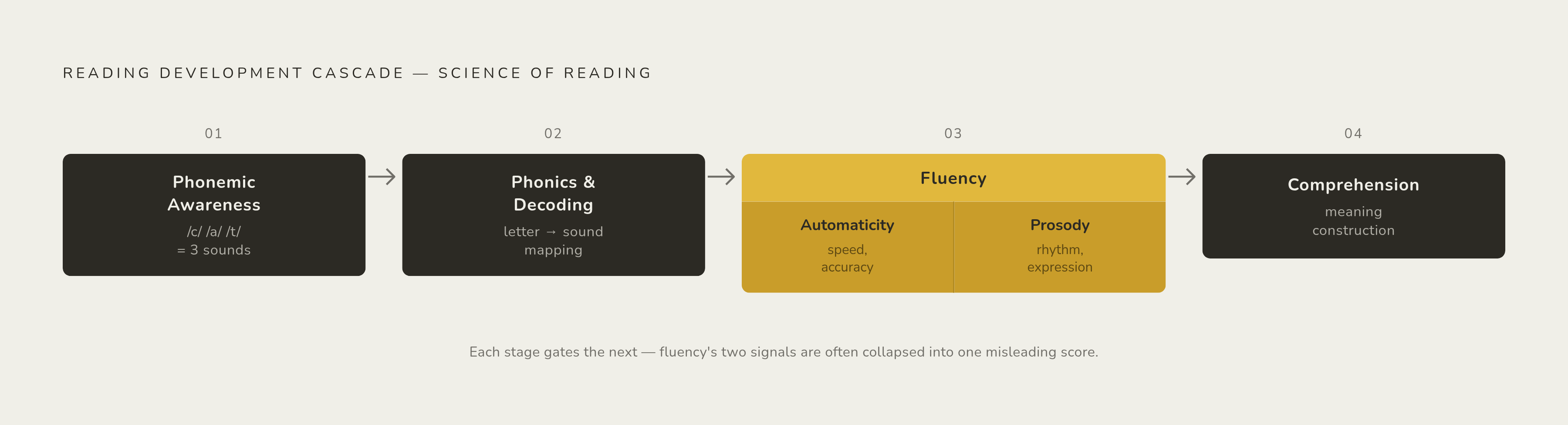
Fluency is not one thing, and a report that reduces it to words-per-minute is hiding the half of it that most directly signals whether a child is reading for meaning or merely decoding aloud. NWEA's analysis separates fluency into two components. Prosody is intonation, phrasing, and expression, and it can only be demonstrated with connected text. These are different signals requiring different instructional responses.
Automaticity frees cognitive space for comprehension. When words are recognized instantly, the child's attention is available for meaning. Prosody signals that the child is already constructing meaning while reading. Here is the diagnostic trap. A child can hit grade-level speed while reading in a monotone, with no comprehension whatsoever. The report says "on track." A single WCPM score cannot separate the child who reads with expression and understanding from the child who reads like a metronome. The number looks identical.
What a report should show instead is two separate signals. First, whether the child is moving words into automatic recognition (the visible trace of orthographic mapping progress). Second, whether oral reading demonstrates appropriate phrasing and expression. The second requires the app to have heard the child read connected text aloud, not just count correct responses to isolated prompts. When a report shows only a reading level or a WCPM score, it collapses this distinction. Ask your app whether it tracks both halves of fluency, not just speed. The answer tells you a great deal about whether the report is built on the learning chain or on the activity log.
Early math has its own skill chain, and reports flatten it the same way
The same structural flaw appears in early math, which means the problem is not specific to reading. Early math develops through a sequence of foundational skills: counting, cardinality, and one-to-one correspondence. A report that treats math as a single pass/fail misses the specific subnumeracy targets that predict later achievement. "Math score: 87%" tells a parent as little as "Reading level: 2.1."
The research makes the chain concrete. A cross-lagged panel study tracking 389 children ages 2½ to 4 examined how numeracy and general language skills mutually predict each other. The findings show reciprocal relations that shift across early childhood. Between ages 2½ and 3, general language and numeracy each foster the other, and both build mathematical language. Then, from ages 3 to 4, mathematical language predicts both numeracy and general language development. What a report should flag at age 2½ is different from what it should flag at age 4.
The stakes are high. An invisible gap in subnumeracy is as consequential as one in early phonics. The design implication follows directly: a useful math progress report should show where a child sits on counting, cardinality, one-to-one correspondence, and mathematical language separately (not just "math score" or "levels completed"). The same chain logic that applies to reading applies to math, and so do the same design criteria.
One mechanism no app dashboard currently captures: what happens at home
A child's performance inside an app can be undermined by dynamics the app cannot see. A progress report that says nothing about those dynamics is an incomplete diagnostic tool. The clearest case comes from research at Loughborough University with Italian colleagues, which found that parents' anxiety about mathematics can negatively affect their children's early numeracy skills, influencing performance as they progress through school. A child can be receiving well-designed adaptive instruction and still stall, because homework time is anxiety-charged.
The same mechanism operates in reading. A parent who reacts to errors with visible frustration, or who frames reading as a test rather than an activity, shapes the child's relationship to reading. No dashboard reflects that. The report shows the symptom. The cause sits at the kitchen table.
A progress report designed with this in mind would do two things current reports do not. First, it would surface when a child's in-app performance shows unexplained plateaus that correlate with home practice sessions. Not to diagnose the cause (an app has no business speculating about family dynamics) but to note the pattern and invite reflection. The strongest objection to this is that it is overreach: apps should report on what they can measure, not speculate about home dynamics. The answer is that a report need not diagnose the cause. It only needs to note the plateau and offer constructive framing, so the parent's response does not compound the problem. A great report makes parents more effective partners without making them feel blamed.
What a well-designed progress report actually looks like in practice
A progress report that serves parents maps each child's position on the specific skill chain: phonemic awareness, decoding strategies, fluency components, comprehension, and subnumeracy skills. It shows what is moving, what is stalling, and what the next instructional step is. The design test is simple: if a report could have been generated without the app ever listening to the child read or solve a problem, it is a usage report, not a learning report.
For reading, the report should show which decoding strategies the child has secured versus which remain effortful. Not a composite "reading level" that hides where on the chain the difficulty sits. For fluency, the report should show separate signals for automaticity and prosody. Are words moving into instant recognition? Is the child reading with appropriate expression and phrasing? Both require the app to have heard connected oral reading, not just counted correct responses.
For math, the report should show separate indicators for counting, cardinality, one-to-one correspondence, and mathematical language. Not a single score or a level badge. Not passive completion. Feedback quality matters as much as accuracy rates, because an app that helps a child understand a mistake is teaching, while one that only marks it wrong is testing.
Finally, the report should translate what it shows into a next step a parent can understand without an education degree. "Reading level: 2.1" is not. The second tells a parent only that a number exists. A useful report makes the underlying mechanics of learning visible, then hands the parent the tool to act on what it reveals.
How to evaluate whether an edtech app's progress report actually tells you anything useful
Parents can assess any edtech app's progress report against a short set of criteria that separates reports grounded in the learning chain from reports that recycle engagement data. These five questions take two minutes to ask. An app that cannot answer them clearly is giving the answer by its silence.
Criterion 1: Does the report require the app to have listened to the child? A reading app whose report never reflects oral reading performance is not reporting on reading. It is reporting on tapping and clicking.
Criterion 2: Does the report show component skills separately, or only a composite? A useful report shows phonemic awareness, decoding, and fluency as distinct signals, not a single progress bar. The same applies in math: counting, cardinality, and one-to-one correspondence separately, not a blended score.
Criterion 3: Does the report tell you what changed since last time, and why? Progress should be shown as movement (which skills moved, which plateaued) not as a static snapshot of a level. A report frozen in a single number is a postcard, not a map.
Criterion 4: Does the report connect to next steps? If a parent cannot tell from the report what the child should work on next, the report is decorative, not diagnostic. The measure of a report is whether it changes what a parent does on Tuesday.
Criterion 5: Is the curriculum behind the report grounded in a validated framework? A report is only as useful as the instruction it reflects. A phonics progress report from an app whose phonics instruction is not systematic tells parents nothing reliable, because the child was not reliably taught.
Parents who ask these questions are doing what a good teacher's aide would do: checking that the tool is actually teaching, not just entertaining. Most apps do not provide that yet. Knowing what to ask is how parents start demanding it.