Fluency Instruction Strategies Beyond Round-Robin Reading
Research-backed strategies replace a discredited classroom practice with proven results.
Round-robin reading has been standard classroom practice for over two centuries, and it doesn't work. That's not a matter of opinion. It's the finding of more than 30 studies, and it's why fluency researchers, literacy professors, and reading specialists have spent the last few decades trying to talk teachers out of it. This piece lays out what actually replaces it: strategies with real evidence behind them, ready to use tomorrow.
More than half of elementary and middle school teachers still use some version of round-robin reading, whether it's called popcorn reading, combat reading, or a method where names get pulled at random. Literacy specialists Gwynne Ellen Ash, Melanie Kuhn, and Sharon Walpole surveyed 80 teachers and found close to half admitted to using some variation of it. More than 30 percent said they knew the research didn't back it up, and used it anyway.
Timothy Shanahan, distinguished professor emeritus at the University of Illinois at Chicago and former director of reading for Chicago Public Schools, has said the same about his own early years teaching. Graduate school warned him off round-robin reading. He used it anyway, because it kept kids on task and he didn't know what else to do. His own words on it: "They were telling me not to do it 50 years ago... and it will be 50 years from now if we don't end it ourselves."
That's the real problem. Teachers aren't clinging to round-robin reading because they believe in it. They're clinging to it because nobody handed them the alternative. This article is that alternative.
What round-robin reading actually does to readers
Listening to a classmate stumble through a paragraph, word by halting word, breaks comprehension for everyone else in the room. It's not just that the reading is slow or choppy. It's the interruptions: a teacher jumping in to correct a mispronounced word, a student losing their place, the whole class waiting through dead air while someone sounds out "necessary" for the third time. Comprehension needs continuity, and round-robin reading is built entirely out of stops and starts.
Fluency takes the same hit, for a different reason. Kids sitting in a circle waiting for their turn aren't practicing fluent reading. They're either zoning out or bracing for their own turn, and when it does come, they're often modeling poor pacing and flat expression right back at their classmates. In a typical round-robin session, only a handful of students actually get meaningful reading time. Struggling readers face public embarrassment in front of peers. Research consistently finds no measurable improvement in word recognition or comprehension from the practice.
There's also the matter of how little text each student actually reads. A paragraph here, a sentence there, chopped up across 25 kids, doesn't build reading stamina. Fluency develops through sustained contact with connected text, not fragments of it. Round-robin reading breaks up exactly the kind of extended practice that fluency work requires to be intact.
The damage runs deeper than test scores, too. Katherine Hilden and Jennifer Jones put it plainly: there's no research evidence that round-robin reading makes students better readers, in fluency or comprehension. And reading coach Cecile Somme has noted that popcorn reading is one of the more reliable ways to take a kid who's already nervous about reading and turn that nervousness into outright hatred of it. The anxiety round-robin reading creates can outlast the classroom, and the irony is that teachers who remember those feelings may be uncertain how to handle oral reading themselves. That uncertainty costs their students just as much.
What reading fluency actually is and why it matters for young readers
Fluency means reading with accuracy, expression, and understanding, not just speed. It's reading accurately, at a natural pace, with the kind of expression and phrasing that shows the reader understands what the words mean. Fluency researchers commonly break it into three parts: accuracy, rate, and prosody. Leave any one of those out, and what's left isn't fluency, it's just speed.
Fluency also serves as a bridge toward comprehension, not an endpoint in itself. It's the bridge. When decoding and word recognition become automatic, the brain frees up room to actually build meaning from the sentence, instead of spending all its effort sounding out individual words. Models of skilled reading reflect this well: word recognition and language comprehension work together, with decoding sitting at the core of word recognition.
Neuroscience backs this up. Even skilled adult readers process individual letters and letter groups, along with their sounds, every time they read. That's not a phase kids grow out of. It's how the reading brain works, full stop, which is why fluency instruction built on systematic phonics and repeated oral reading lines up with the brain's actual wiring rather than fighting it. Once a student's phonemic awareness and phonics knowledge become solid, word recognition increasingly becomes automatic, and that automaticity is what fluency looks like in practice.
None of this means speed drills. Pushing a kid to read faster before their accuracy is solid undermines the careful decoding that fluency is built on. For context, fluency researchers note that proficient adult readers typically land somewhere around 166 to 178 words correct per minute. A student reading under 100 words correct per minute tends to fall below basic in reading comprehension, a sign that more than timed drills may be needed. And accuracy has its own threshold: timed repeated reading is most effective when a student is reading the text at 90 to 95 percent accuracy. Below that range, the text is too hard for that kind of practice to help.
Repeated reading: the strategy with the strongest evidence base
Two decades of research point to one strategy above the rest for building fluency: repeated reading. A national child health research body flagged it back in 2000, and it's held up since. The mechanism is simple. Students read the same text more than once, out loud, with feedback and guidance available along the way.
The Pride Reading Program lays out a clean three-pass structure that many literacy specialists use as a template:
- First read: focus purely on accuracy, getting the words right
- Second read: focus on rate, picking up natural pace
- Third read: focus on expression and prosody, making it sound like real speech
The recommended setup is a grade-level passage of 150 to 250 words, a timer, and a tracking sheet where the student logs words correct per minute after each read. That tracking sheet does more work than it looks like. Watching the number climb across three reads gives a kid a concrete, visible reason to keep going, and it turns rereading from a chore into something with a purpose the student can actually see.
This is also where fluency instruction connects directly to the Science of Reading. Repeated oral reading of connected text, not isolated words or flashcards, is how automatic word recognition and expressive, natural-sounding reading get built together, in the same practice session. One honest caveat from Reading Rockets: there's no research pinpointing the exact right moment to start pushing for speed. Most teachers wait until around the middle of first grade before formally encouraging beginning readers to pick up their pace.
Assisted reading strategies: echo reading and audio-assisted reading
Students read better when they've got a model of well-paced, expressive reading right next to them. Rereading alone doesn't do this. A live or recorded model does.
Echo reading works like this: the teacher reads a line aloud with real expression, and the student repeats it right back, immediately. The student hears fluent reading and practices it in the same breath. Research has consistently supported assisted reading as an effective method for boosting fluency, and it has held up especially well with early or hesitant readers, since there's no public performance pressure attached. It works one-on-one and in small groups, and can be adapted for larger classroom settings.
Audio-assisted reading swaps the live teacher for a recording. Students follow along with a fluent, prerecorded reading before trying the passage on their own. It reinforces the same accurate phrasing and pacing, and it's especially useful at independent practice stations where a teacher can't be present for every student. Playing audiobooks in class gets similar results. Dr. Betsy Okello of the Notre Dame Center for Literacy Education recommends choosing books with rich vocabulary that also build rhyming skills and phonemic awareness, so the same read gets double duty.
What both strategies give students that round-robin reading never does is a fluent model to measure their own reading against. Without that anchor, a struggling reader has no real sense of what fluent even sounds like.
Choral reading and the fill-in-the-blank variation for whole-class settings
In choral reading, the teacher and the whole class read a passage aloud together, at the teacher's pace. Every student gets a live fluency model while reading out loud themselves, and no single kid gets singled out or put on the spot. Research from Paige (2011) found that just 16 minutes of whole-class choral reading was enough to produce real gains in decoding and fluency.
It works best with short decodable passages or texts students already know well, and the point is accuracy and expression rather than speed. It's accuracy and phrasing, done together as a group.
A useful variation flips the setup slightly. The teacher reads aloud while students follow along silently with their eyes, then pauses mid-sentence so students call out the next word together. Stronger readers stay engaged because the pace moves faster than a peer-read text ever could, and struggling readers get scaffolded support without any embarrassment attached. Teachers can drop in think-alouds or comprehension questions mid-passage without breaking the flow. And there's a built-in way to check who's tracking: the teacher circulates and taps a student's shoulder, the student points to where the class is in the text. No calling out, no penalty, just a quick check.
This fill-in-the-blank approach combines well with the other two strategies: echo a sentence back for expression practice, or drop into a full choral read on a sentence with a key vocabulary word. Both approaches scale across grade levels and work equally well with fiction or dense nonfiction.
Partner reading and peer-assisted strategies that multiply practice time
Round-robin reading has a math problem built into it: in a class of 25 to 30 kids, only one student is reading out loud at any given moment. Partner reading fixes that instantly, since every student in the room is reading at the same time.
The basic model pairs a more fluent reader with a less fluent one, or pairs two students at similar levels rereading a text they already know. Students read the passage aloud alongside a proficient partner, and partner reading structured around repeated reading has been shown to support gains in fluency and comprehension. Paired oral reading built around repeated reading is generally considered more effective than paired reading that skips the repetition.
Peer-Assisted Learning Strategies, or PALS, structures this even further. Students swap between tutor and tutee roles across a session, and pairings get built around complementary strengths, say, a student strong in pronunciation paired with one strong in comprehension. The structure builds fluency, decoding, and comprehension all at once, through practice that's genuinely peer-driven rather than teacher-led every second.
Fluency-Oriented Reading Instruction, or FORI, threads partner reading into a full weekly routine rather than treating it as a standalone activity. The cycle runs like this: teacher reads aloud while students follow along, then echo reading, then choral reading, then partner reading, with optional home reading tacked on if a student needs more repetition. The same passage gets read multiple times across the week, with repeated reading built directly into the structure instead of left to chance.
Reader's Theater and the Fluency Development Lesson as performance-based practice
Reader's Theater gives students scripted roles to rehearse and perform in front of the class. It's repeated reading dressed up with a real purpose behind it, and that purpose changes how kids engage with the rereading. The Iowa Reading Research Center notes that Reader's Theater delivers the same repeated-practice benefit as a standard fluency drill, while raising engagement and motivation considerably higher.
A quasi-experimental study by Kariuki and Rhymer, run with sixth graders, found that students who took part in Reader's Theater scored significantly better on comprehension measures than peers who got standard reading instruction instead. Separate research published in Reading Horizons found gains across the board for struggling readers, word recognition accuracy, automaticity, prosody, and comprehension, along with a measurable improvement in how every student in the study felt about reading generally. A 2025 study by Rodgers and colleagues found that combining Reader's Theater with phrase-cued texts, where natural phrase breaks are marked on the page, improved prosody, accuracy, and rate together. Garrett's 2010 research adds another layer: the fluency gains from Reader's Theater carry over into reading-based confidence and self-esteem, not just the reading scores themselves.
The Fluency Development Lesson, or FDL, runs on a similar logic but without the full production. Short texts, poems, scripts, brief passages, get used for repeated, guided oral reading in a set sequence: students listen to a model, read together, practice with a partner, then perform. Vocabulary and word study get folded in as well, which makes the FDL more of a full comprehension approach than a simple drill. It pairs naturally with Reader's Theater scripts, since both rely on the same repeated-reading backbone.
A more playful variation, sometimes called the Crazy Professor Reading Game, runs through four stages. It begins with a solo expressive read, followed by a reread with dramatic gestures thrown in, then a teach-your-neighbor retell, and finally a question-and-answer round where one student plays "crazy professor" and another plays "eager student." It's high energy by design, and it builds fluency, oral retelling, and comprehension through repetition disguised as play.
Teacher read-alouds and CLOZE reading as fluency tools for comprehension
Teacher read-alouds remain, by a wide margin, the most recommended method for building both fluency and comprehension, a point Adams made as recently as 2019. During a strong read-aloud, the teacher functions as the expert model, and that's the whole value of it: students hear exactly what pacing, prosody, and phrasing are supposed to sound like, live, from someone who already knows how to do it.
Reading from a large-format book lets the whole class follow along visually while listening. Teachers can pause to think aloud, ask a question, or point out how a shift in tone signals something in the story. Dr. Betsy Okello's earlier recommendation applies here too: choosing vocabulary-rich books that also build rhyming and phonemic awareness lets a single read-aloud session do work on several fronts at once.
CLOZE reading takes a different approach. Certain words in a passage get removed, and students fill in the blanks using context, which activates vocabulary knowledge, comprehension, and critical thinking all at the same time. Research (Ijsshmr, 2024) found regular CLOZE practice produced real gains in comprehension skills, including identifying main ideas and following sequence. It's worth separating this clearly from the old discredited habit of guessing words from context instead of decoding them. CLOZE reading works because it comes after phonics instruction is already in place, drawing on vocabulary and sentence structure rather than replacing the decoding work entirely.
Both strategies scale across grade levels and both work with fiction or nonfiction. And unlike round-robin reading, both keep the teacher firmly in control of what fluent reading actually sounds like for the class.
How to match the strategy to the reader's current level
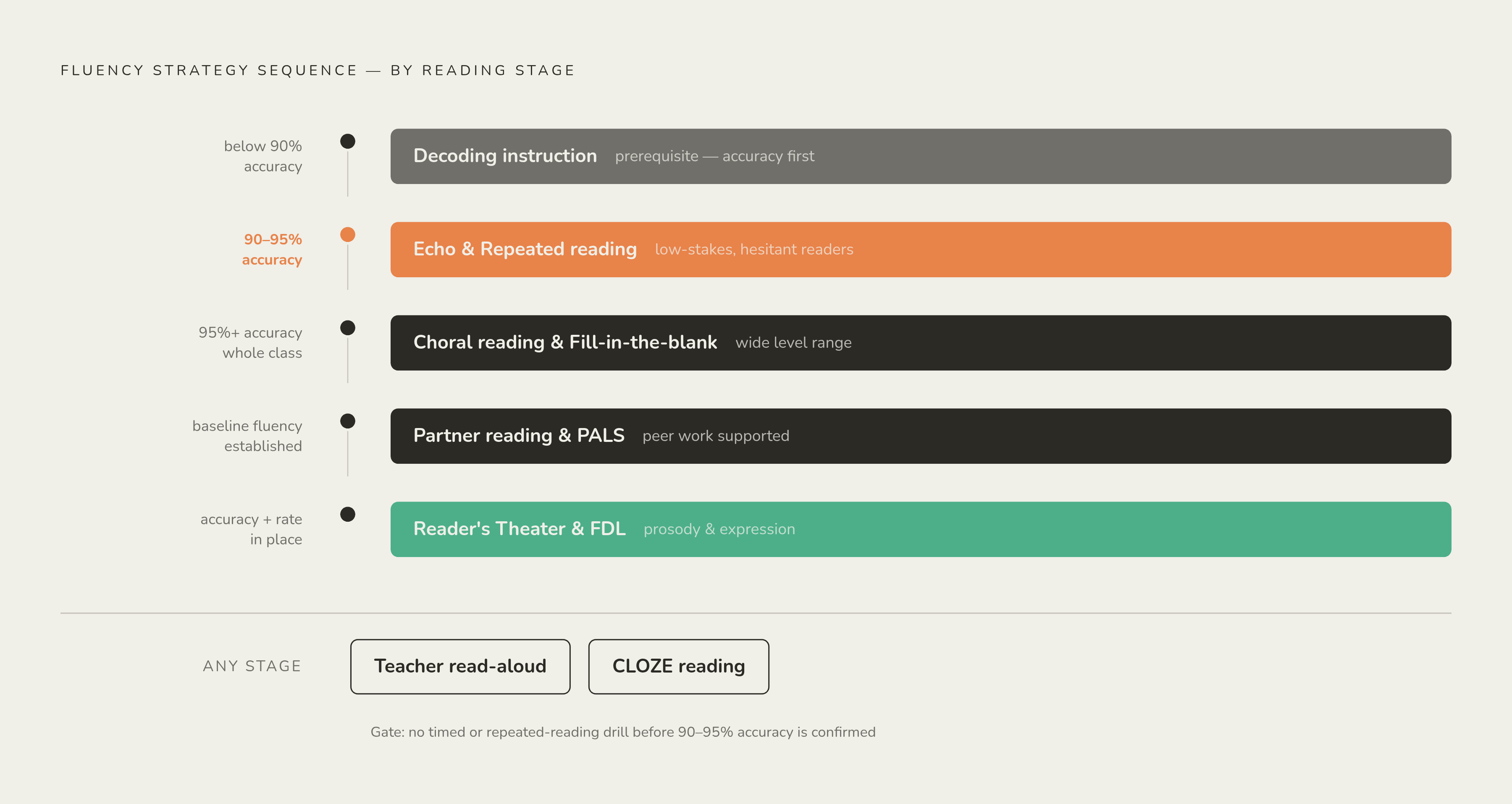
None of these strategies is a universal fix, and picking the wrong one for a student's stage can waste real practice time. A student still working below 90 percent accuracy on a passage isn't ready for repeated reading drills yet; decoding instruction needs to come first, since fluency work on text that's too hard just reinforces guessing. Once accuracy clears that threshold, repeated reading and echo reading are the natural next step, especially for a hesitant reader who needs a low-stakes format before facing any kind of audience.
Choral reading and its fill-in-the-blank variation work well for a whole class with a wide range of reading levels sitting in the same room, since stronger readers stay challenged by the pace while struggling readers get carried along without being singled out. Partner reading and PALS make sense once students have enough baseline fluency to support each other productively, rather than one student simply modeling errors for the other. Reader's Theater and the Fluency Development Lesson fit best once a student has the accuracy and rate in place and just needs more reps on prosody and expression, ideally with a genuine audience or performance goal attached to keep motivation high.
Teacher read-alouds and CLOZE reading sit apart from the rest, since they work at any stage and serve comprehension as much as fluency. They're less about diagnosing where a student stands and more about a daily habit worth keeping regardless of level. The throughline across all of it: every one of these strategies gives a student more reading practice, with a real fluent model attached, than a single turn in a round-robin circle ever could.
Sources
- 4 Reading Strategies to Retire This Year (Plus 6 to Try Out!)
- Developing Fluent Readers | Reading Rockets
- The Gentle & Effective Way to Read as a Whole Class
- 11 Alternatives to Round Robin (and Popcorn) Reading
- Alternatives to Round Robin Reading
- Is Round Robin Reading Really that Bad? | Shanahan on Literacy
- readingrockets.org
- renaissance.com