Read-Aloud Techniques That Build Comprehension in Ages 3–7
Pausing to question, predict, and connect builds comprehension better than reading alone.
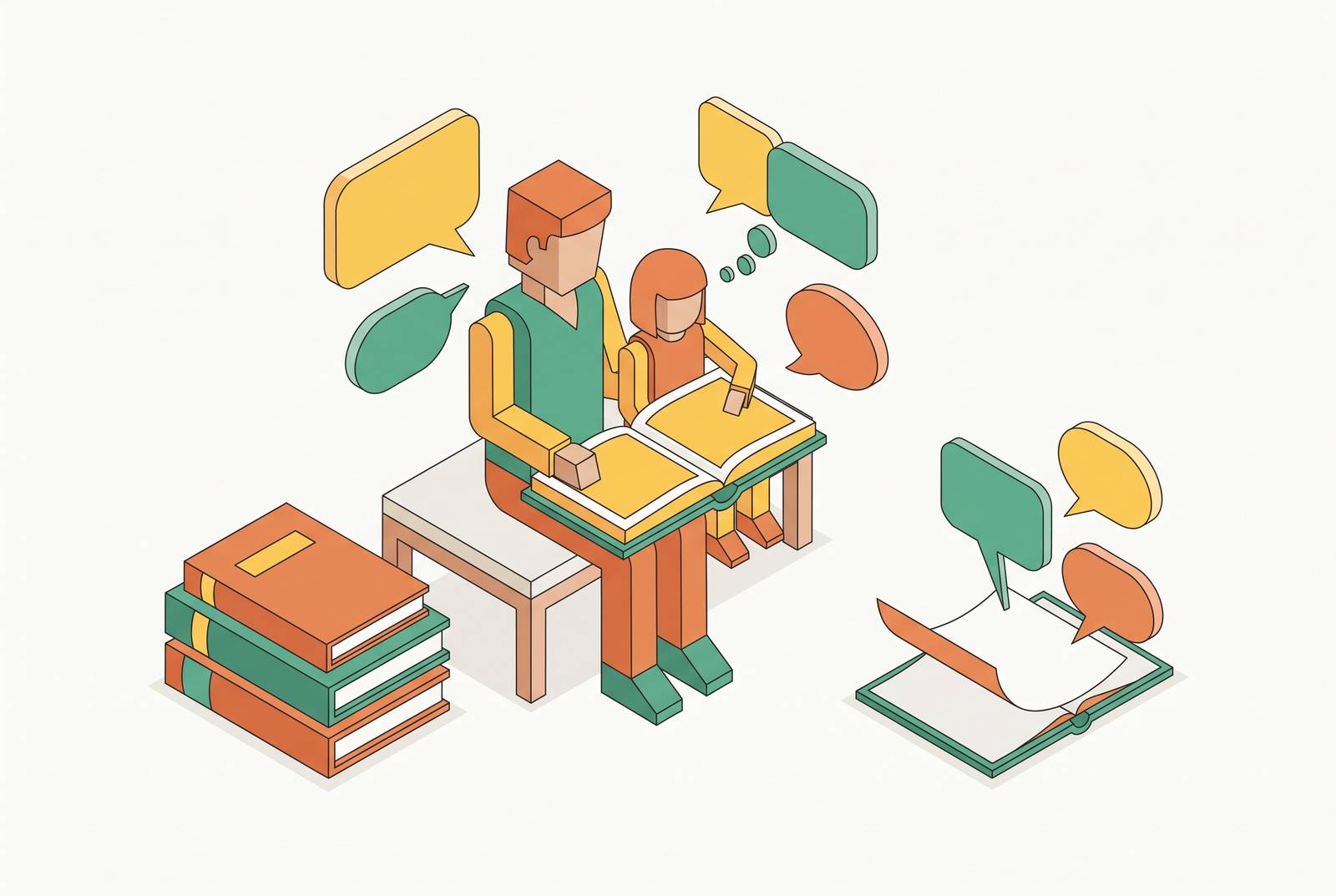
Reading aloud to a child does not automatically build comprehension. The mechanism that builds comprehension is what an adult does before, during, and after the story. A parent who reads with warmth and good expression but never pauses to ask a question, invite a prediction, or talk about the pictures is giving a child something valuable, but not the specific thing that grows understanding.
Why read-alouds alone are not enough to build comprehension
Most parents treat the read-aloud as a delivery system. Open the book, read the words, close the book, done. That's a reasonable instinct: more reading time feels like it should always help.
But researchers who study early literacy describe the read-aloud differently. K-State Libraries cites a well-known passage from Anderson, Hiebert, Scott, and Wilkinson calling read-alouds "the single most important activity for building the knowledge required for eventual success in reading." Notice the wording: it's an activity, a form of active engagement during the reading. The quote assumes some kind of active engagement is happening during the reading.
That's the gap: reading with expression, doing the voices, and keeping a toddler's attention on the page all matter, but none of it, by itself, is comprehension work. Reading with expression, doing the voices, keeping a toddler's attention on the page, all of that matters. None of it, by itself, is comprehension work. Comprehension work is the questioning, the predicting, the connecting back to the child's own life. Skipping that part still leaves a read-aloud as a nice fifteen minutes together. It's just not doing the heavy lifting on comprehension that it could be.
What comprehension requires at ages 3–7
Comprehension is the act of taking new information and hooking it onto something the child already knows or has already felt. It's the act of taking new information and hooking it onto something the child already knows or has already felt. A three-year-old who's had a cold understands "Buddy felt awful and stayed in bed" in a completely different way than a child who's never been sick a day in their life.
Three things drive that process at this age:
Engagement, the child's active attention and their willingness to guess, infer, and fill gaps
Effective read-alouds work on all three at once. They build language, add knowledge, spark creative thinking, sharpen comprehension skills, and expose kids to settings and ideas outside their own life. None of that is a side effect of reading aloud. It's the actual point.
Decoding, sounding out letters and words on a page, isn't the bottleneck here. Kids ages 3 to 7 are mostly pre-decoding or just starting to decode. At this age, comprehension gets built through the ear, listening to language, following its structure, absorbing its rhythm, long before a child is reading independently.
Before you open the book: activating prior knowledge and previewing vocabulary
The before-reading phase gets skipped more than any other part of a read-aloud, and it's also where a few minutes of preparation pays off the most.
Start with the book itself. Books should match a child's developmental stage and their actual interests, balancing what's engaging against what's accessible. For younger children, keep character development and plot simple. Too many characters or a tangled sequence of events loses them fast. Older children in this range can handle richer structure and more complexity. Mix in nonfiction alongside the fiction, too: nonfiction introduces real-world vocabulary and concepts that storybooks rarely touch (how volcanoes form, what bees do all day). And look for books that show a range of characters, cultures, and ways of living. That range becomes part of the background knowledge a child draws on later.
Before reading, ask one or two open questions to activate what the child already knows. Something like, "Have you ever had a cold? What was that like?" An example from Exchange Press's Mr. Markus. That single question means the child meets "Buddy feels tired and stays in bed" with their own memory already loaded up. They're meeting it with their own memory already loaded up.
Then preview vocabulary. Pick a small number of words the child probably doesn't know. Give a quick, plain definition and, where possible, show a picture or an object. If the story uses the word "exhausted," show a picture of someone slumped over asleep before the reading starts, not after the word has already flown by.
During reading: questioning, predicting, and thinking aloud
The right pace pauses at a handful of strategic points, not constant ones; stopping every other sentence causes a child to lose the thread, while never stopping leaves comprehension nowhere to attach. Stopping the story every other sentence causes a child to lose the thread. Never stop and comprehension has nowhere to attach. The right pace pauses at a handful of strategic points, not constant ones.
Questioning does double duty. Literal questions, "What just happened to Buddy?", confirm the child followed the basic plot. Inferential questions, "Why do you think Buddy feels sad?", push toward the deeper meaning-making that actually builds comprehension. For younger children in this range, lean on literal questions and lean on the pictures for support. Inferential questions start paying off more as children develop greater working memory and more language to reason with. And give the child real wait time before jumping in with a hint or the answer. Young children need that processing time; adults tend to fill silence too fast.
Predicting works well at a natural pause point in the story. "What do you think will happen next?" forces the child to take everything heard so far and project it forward, which is a genuinely different cognitive task than just following along. Circle back once the answer is revealed: "Were you right? What surprised you?" That callback is where the real payoff sits. A wrong guess isn't a failure here, it's often more useful than a right one, because it opens up a conversation about why the story went differently than expected.
Thinking aloud means narrating your own comprehension process out loud, so the child can see what understanding actually looks like from the inside. Something like: "I'm not sure what 'exhausted' means here. Let me look at the picture. Oh, Buddy is lying down. I think it means very, very tired." That's the invisible mental work of reading, made visible. Tie it back to the child's own life when it fits naturally: "That reminds me of when you were sick last winter."
When a previewed word shows up mid-story, pause just long enough to reinforce it. "There's our word! What does 'exhausted' mean again?" takes two seconds and locks the word in without breaking the flow of the story.
Illustrations do real work too. Kids can check the words against the picture: "The words say he's fine, but look at his face. What do you think?" That question builds the skill of cross-referencing text against image, which is its own form of comprehension.
How rereading the same book multiplies comprehension gains
Parents tend to assume variety is the goal, always reaching for something new to keep a child interested. Research points the other way. Rereading a favorite book builds comprehension, vocabulary, fluency, and storytelling confidence, and eventually lets the child become the storyteller.
Cognitive load explains this. On the first read, a child is spending most of their attention just tracking the plot and picking up new words. By the second read, the anxiety of "what happens next" is gone, so attention shifts to language, illustrations, and details missed the first time. By the third read and beyond, the child starts to anticipate lines and co-tell the story alongside the adult, which is close to the highest form of comprehension available at this age.
Technique should shift across those reads, too:
Third read and after: invite the child to take a more active role in telling the story alongside the adult
After reading: the conversations and activities that cement understanding
Closing the book and moving on to the next activity is the most common missed opportunity in the whole process. Comprehension needs to be externalized, spoken, drawn, acted out, to actually stick.
Talk works at every age from 3 to 7. An open retell ("Tell me what happened in your own words") exercises sequencing and summarizing, both real comprehension skills, not just memory tricks. A character question ("Why do you think Buddy got better at the end?") pushes past plot recall into inference. And a personal connection question ("Has anything like that ever happened to you?") anchors the story to something lived.
Creative extension suits ages 3 to 6 especially well. Dramatic play, acting out or retelling the story physically, supports both comprehension and retention. Making puppets out of recycled materials and performing the story does the same thing through a different channel. So does drawing a scene at a writing center, which forces a child to summarize and sequence without needing to write a single word. All three turn comprehension from something passive into something reconstructed by hand.
Writing and dictation fits ages 5 to 7 better, once a child has enough language to work with. Have the child dictate an alternate ending while an adult writes it down, so the composing and the handwriting are separated and comprehension is the actual focus. Or have the child illustrate a favorite scene and explain the choice out loud. Illustrating forces a child to select and prioritize what mattered most in the story, which is comprehension work in disguise.
There's a knowledge-building payoff to this that compounds over time. First and second graders taught with a knowledge-rich curriculum scored 18 percent higher on science-related comprehension tests. Extending a book's topic through conversation, talking about animals, weather, how machines work, adds to that same kind of accumulating knowledge base.
None of this needs to be elaborate. A two-minute conversation at bedtime counts as much as a full puppet show. Consistency is the variable that matters, not production value.
Adjusting technique for children who resist, struggle, or need more support
A child who squirms, interrupts, or checks out during a read-aloud is signaling a mismatch, in the book, the pace, the difficulty of the questions, or even how everyone's sitting. They're signaling a mismatch, in the book, the pace, the difficulty of the questions, or even how everyone's sitting.
Book choice is the first lever to pull. Understanding a child's individual learning style and interests affects comprehension more than any technique does: a reluctant listener who gets handed the right book is already most of the way to comprehension without any extra effort. For kids ages 3 and 4, or any child with a short attention span, five minutes of highly interactive reading beats fifteen minutes of them staring off at the wall. Shorter and more active wins over longer and passive, every time.
Movement helps too. Research on early literacy development has found that connecting physical movement to language and sounds can help engage young children and anchor meaning to something physical. Inviting a child to stomp, stretch, or mime a sneeze at the right moment in a story keeps their body in the game and anchors meaning to something physical.
Extending, not replacing, the interactive read-aloud with AI reading tools
Research on interactive AI programs used with young children suggests they can support language development and vocabulary, and can even improve family interaction. These tools are designed to extend, not replace, the hands-on and relational experiences that remain central to early learning. AI extends the read-aloud. It doesn't stand in for it.
That distinction matters because a lot of what gets marketed as an AI reading tool is really just a passive content library or a quiz app wearing a friendlier interface. Content delivery without real-time responsiveness is just reading aloud with extra steps. It's just reading aloud with extra steps.
A purpose-built AI reading teacher is a different animal. It listens to a child read out loud in real time and responds to what it actually hears, the same active-listening principle behind every technique in this piece. It adjusts vocabulary, pacing, and question difficulty moment to moment, based on what an individual child is demonstrating right then. And it builds an evolving picture of a child's strengths and gaps over time, the kind of individualized knowledge a parent normally builds up slowly across years of shared reading, made visible and trackable instead of just carried around in memory.
None of that replaces a parent's lap, a shared book, and a well-timed question. It just means the gap between read-alouds doesn't have to be dead air.
Sources
- 5 Research-Backed Ways to Build Better Readers
- Bringing Read-Alouds to Life in Early Childhood and Kindergarten Classrooms – Exchange Press
- Read Alouds – Teaching Literacy in Grades Pre-K to 2 – 2nd Edition
- Repeated Interactive Read Alouds in Preschool and Kindergarten | Reading Rockets
- readingrockets.org
- ncbi.nlm.nih.gov