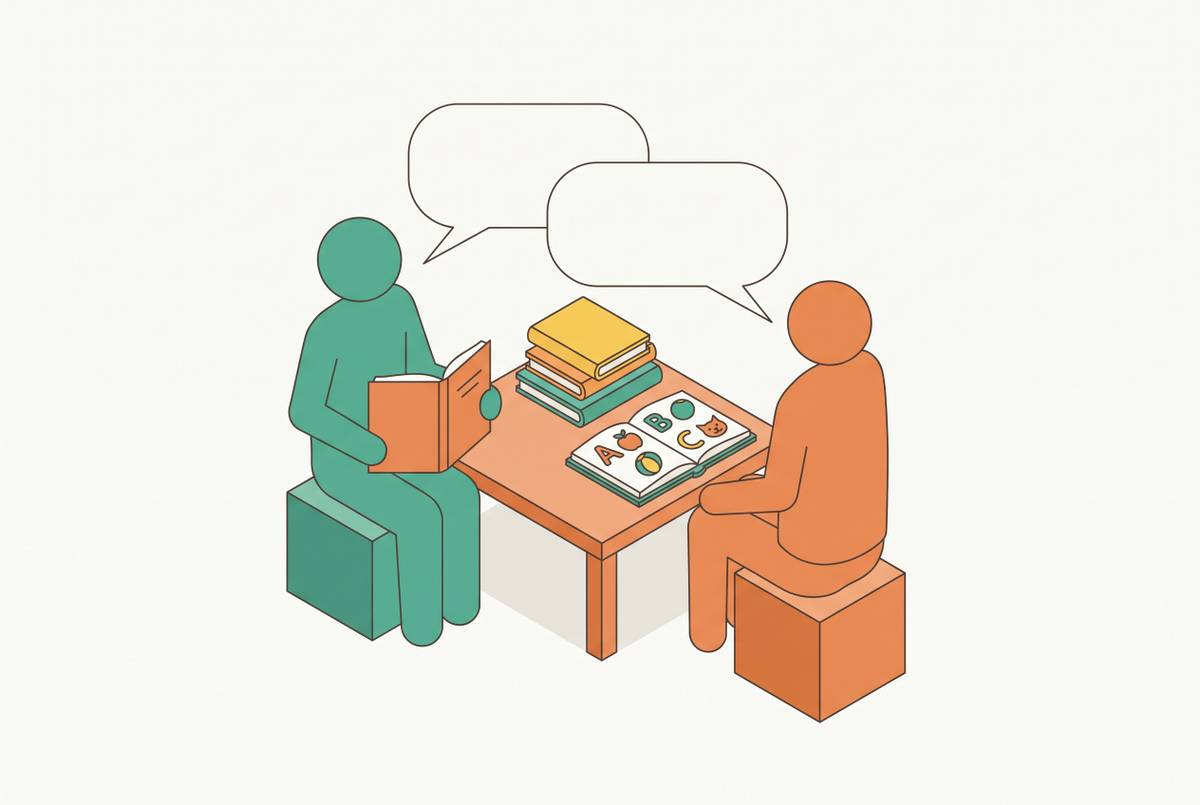
Building a Home Reading Environment for Pre-Readers Ages 3–5
Research-backed sound play and read-aloud conversations matter more than books alone.

A strong home reading environment for ages 3–5 isn't just about books on shelves, it's about the specific, research-backed interactions and habits that activate the pre-reading skills children need before formal decoding begins, from phonemic awareness play to print-rich surroundings and read-aloud routines.
The pre-reading window between ages 3 and 5
A child does not learn to read the way a child learns to walk or talk. Reading has to be taught, deliberately and in a set order, and the Science of Reading has spent decades building the evidence for that across cognitive science, linguistics, and psychology. Of the five pillars of literacy (phonemic awareness, phonics, vocabulary, fluency, comprehension), the first and last are already within reach for a 3 to 5 year-old. Most parents treat this stretch as a holding pattern before "real" instruction starts in kindergarten, and that assumption gets the sequence backwards: oral language and sound awareness get built during this window, forming the scaffolding that decoding instruction later hangs on, and skipping it does not get made up cheaply once kindergarten starts.
The instinct to reach for flashcards and alphabet magnets at this age points at the wrong pillar. It runs on listening alone, and it works in the car, the bathtub, or the dinner table, with no book required. Print earns its place later in this piece, but the sequence starts with sound. Getting that order backwards, letters before ears, is the single most common mistake in how families approach this age.
What phonemic awareness looks like in a 3–5 year-old before letters appear
Phonemic awareness means noticing, isolating, and rearranging the individual sounds inside spoken words. None of it requires a page. A child working on it is working entirely by ear, so the skill can be built and checked with no text in sight.
Phonological awareness is the umbrella term, covering bigger units like rhyme and syllables alongside individual phonemes. Phonics is a different animal: the system that maps letters to sounds, and it belongs later, once print enters the picture. Phonemic awareness has to come first, since it is the prerequisite that makes phonics make sense at all. A child who cannot yet hear that "cat" is built from three distinct sounds has nothing to hang the letters C, A, and T on. Skipping straight to letters, which is what a lot of well-meaning preschool prep does, teaches a code the child's ear isn't ready to use yet.
Noticing that "sun" and "sock" start the same way. Clapping out the syllables in a sibling's name. Catching the rhyme buried in a tongue twister. Answering "what word do you get if you put /d/ and /og/ together?" with nothing written down anywhere. It is all play. None of it needs a worksheet, and all of it lays down the circuitry that formal phonics instruction will lean on later.
How read-aloud routines build more than vocabulary
Reading aloud to a 3-to-5-year-old does several jobs at once, and vocabulary is only the most visible one. A read-aloud puts a child in contact with words that never come up at the dinner table, which is valuable on its own terms. It also teaches comprehension: following a story's shape, guessing what happens next, working out why a character did something. Rhyming books and repetitive text quietly build phonemic awareness inside the story itself, without ever calling it a lesson. And read-alouds build background knowledge, which turns out to be the strongest long-range predictor of how well a child will eventually comprehend what they read.
None of that happens just because a book got opened, though. The conversation around the text is what activates the gains. Asking an open-ended question about what a character might do next, expanding on whatever the child says back, pointing to a word while saying it out loud: these dialogic moves are doing the actual work. Reading a book start to finish with no back-and-forth leaves a lot of that value sitting on the table.
Read-alouds build oral language, rich and wide. They do not, on their own, teach a child how to break a written word into sounds and put it back together. That takes something more explicit, covered further down. IMSE names this exact gap as the flaw baked into balanced literacy: the whole-language assumption that children will pick up reading through exposure to books alone, when read-alouds build oral language and nothing in them teaches decoding. Read-alouds are necessary. They come nowhere close to sufficient, and treating them as a complete reading strategy is where a lot of well-intentioned home routines quietly stall out.
What a print-rich home environment accomplishes
A print-rich home is not just a house with a full bookshelf. Writing appears on cereal box labels, grocery lists, sticky notes on the fridge, and street signs glimpsed from the back seat. Any text woven into ordinary life counts toward this.
What that environment teaches a 3-year-old is abstract, and more powerful than its simplicity suggests: print carries meaning. Those squiggles on the cereal box are not decoration. They stand for something, and they say the same specific word every single time. From there a child starts to grasp that letters are distinct symbols with their own identities, and that written language moves in a fixed direction and follows a structure.
What print exposure does not do on its own is teach decoding, and this is where a lot of parents overestimate what a full bookshelf buys them. Surrounding a child with text does not produce phoneme-grapheme correspondence or blending skill by osmosis. Someone has to teach those directly. It is the same gap the Science of Reading points to when it critiques whole-language approaches more broadly: immersion is not instruction. A house buried in books can still raise a child who struggles to decode, if nobody ever sits down and does the sound-work.
The fix is making the print interactive instead of just present. Point to the first letter on the cereal box and say its sound out loud. Read the grocery list together, finger tracking under each word as it gets said. Label objects in a child's room, bed, door, lamp, and reference them in conversation. Let a child watch an adult write something down, narrating which letter is being formed and why. Ambient print sets the stage. Someone still has to teach.
Phonemic awareness games parents can run in ordinary daily routines
The Science of Reading sequences instruction by phonological complexity, and home games can follow the same ladder. Simplest first: rhyme recognition, asking whether "cat" and "hat" sound the same at the end. From there, rhyme production, where the child has to generate the rhyme rather than just spot it. Then syllable segmentation, clapping out the beats in a name or a food word. Then alliteration and initial-sound spotting, asking what sound "penny" starts with. At the top of what is reasonable for this age range sits phoneme blending, where an adult says the sounds separately, /k/ /æ/ /t/, and the child fuses them into "cat".
None of this needs a curriculum or a scheduled time slot, and treating it like a formal lesson is exactly the wrong instinct. Car rides and waiting rooms work fine with zero materials. At the dinner table, "can you think of a food that rhymes with rice" turns a meal into practice without anyone noticing it is practice. Bath time works for alliterative naming games with body parts or bath toys. One rhyming round before lights out at bedtime keeps the skill warm without turning into homework.
The music angle deserves more attention than it usually gets. Research out of Florida International University connects rhythm training directly to literacy skill development, meaning songs, chants, and clapping patterns are not just filling time pleasantly. They prime the same phonological processing that phonemic awareness games target. A clapping song and a rhyming game are doing more of the same work than either one looks like it is doing.
Keep it short, and keep it playful. Turning this into drill-style repetition backfires at this age. The goal is repeated, incidental exposure inside a moment the child already enjoys, and the second that shifts into something that feels like testing, the value drops off fast.
The home numeracy environment runs parallel to literacy and deserves equal attention
Reading soaks up most of the conversation about school readiness, and that balance is off. Numeracy runs its own parallel track at home, and the evidence behind it is just as concrete, arguably more so.
A 5-year longitudinal study followed 196 children from preschool through third grade, and the findings were specific enough to act on https://pubmed.ncbi.nlm.nih.gov/39977681/. How often a family did number book activities, pointing at numerals, counting pictures together, predicted a child's nonsymbolic math skill by third grade. How often a family did number application activities in daily life predicted symbolic math skill by that same point. Both relationships held even after researchers controlled for the child's preschool number skills and for parenting style generally, a strong signal that the home activity itself is doing the work rather than standing in for something else.
Numeracy is visible in preschoolers years before formal math instruction begins, and in a form that looks nothing like math class. Preschoolers can solve simple object-based addition and subtraction, working something like 2 plus 2 with physical objects, years before they could solve the same problem stated in words. That argues for counting steps on the way upstairs, sorting toys by how many there are, measuring cups of flour together, and using ordinal language out loud: first, second, more, fewer, the same number. Early numeracy skills at ages 5–6 predict later mathematics achievement and are an important predictor for success in the labor market.
The conditions that make adult interaction effective
The Science of Reading's core operating principle holds that explicit instruction beats incidental exposure, consistently. "They'll pick it up eventually" does not hold up as a strategy for phonemic awareness or decoding, no matter how much a child likes books, and parents who lean on that assumption are the ones most likely to get blindsided in kindergarten.
Explicit does not mean formal, and it definitely does not mean a worksheet at the kitchen table. At home, it looks like naming what is happening out loud: "I'm going to say this word slowly so you can hear each sound in it". It looks like modeling the skill once before ever asking a child to try it solo. It looks like feedback that is specific rather than generic, "yes, /d/ is the first sound," instead of a flat "good job" that tells the child nothing about what they got right.
Responsiveness is harder to fake than the other pieces of this. An adult tracking what a child already knows, and adjusting the game up or down in real time, is doing at home roughly what a classroom teacher calls progress monitoring. Replicating that informally is a real undertaking, arguably the hardest part of this entire approach to get right without training, and no store-bought flashcard set can do it for you.
A few habits undo the value of everything above, and the biggest offenders are the ones that feel productive in the moment. Correcting every single error erodes a child's confidence fast, so choosing which mistakes are worth stopping for preserves that confidence better than catching all of them. Turning a game into something that feels like a quiz kills the intrinsic motivation tied to how engaged a child stays with reading over time. Passive co-viewing, sitting a child in front of educational content with no conversation layered on top, does not replicate what an engaged adult does. Screen content alone is not a substitute for back-and-forth, no matter how well designed the content is.
Digital Tools and AI Reading Apps in the Home Environment
Screen time or no screen time is the wrong question to start with. The sharper one: does this tool do what good instruction does, adapting to this specific child, responding to what the child actually says and does in the moment, and building phonemic awareness and decoding in a real sequence, rather than serving up a randomized grab bag of activities?
Zero to Three's position on this is direct: AI-enabled tools can personalize a learning path, but they are not necessary for a child to succeed, and in-person adult interaction remains the strongest foundation available. Tools sit downstream of that relationship, serving as a supplement to it. Springer Nature raises a sharper concern on the same subject, warning that AI exposure during critical windows of brain development can disrupt attention and build addiction-like dependency on artificial stimuli, a concern the paper applies broadly to AI in early childhood education rather than narrowly to badly designed products.
Most reading apps on the market today fail at least one of a handful of questions that ought to be run before any of them earn a spot on a child's tablet. Is the underlying curriculum actually grounded in the Science of Reading, meaning phonemic awareness and systematic phonics taught in a structured sequence, rather than a loose assortment of games? Does it listen to the child's actual voice and respond to what was really said, or push the same fixed content regardless of the answer? Does it adjust moment to moment based on how this particular child is performing, or run a static quiz loop no matter who is using it? Is there a parent-facing report showing what the child is working on and where they are stuck? Is it free of ads and in-app purchase pressure aimed at a preschooler? Who built the curriculum, teachers and reading specialists, or a general content team with no specific literacy background?
The gap between good instruction and average instruction is visible even inside classrooms staffed by certified teachers. A Thomas B found that about a third of K to 3 teachers surveyed in fall 2025 said they mixed phonics with cueing, a discredited approach. If that gap exists with certified teachers standing in the room, betting that a consumer app has closed it on its own is not a safe assumption. The screening questions above are necessary steps in a purchase decision, not optional diligence tacked on afterward. They separate a tool that reinforces what the research actually supports from one that just looks like it does from the app store description. Separately, a Vanderbilt University study developed and validated a measure of parental knowledge about early math development, working across five studies with a combined 616 U.S. parents of 3- to 5-year-olds https://www.ncbi.nlm.nih.gov/pmc/articles/PMC10232842/. About a third of K–3 teachers surveyed in fall 2025 said they mixed phonics with cueing, a discredited approach https://www.edweek.org/teaching-learning/how-the-science-of-reading-is-reshaping-teaching-what-the-data-say/2026/04. The Fordham Institute and RAND Corp. poll asked more than 1,200 K-3 teachers about their perspectives on reading instruction. The poll was conducted by the Fordham Institute and RAND Corp https://www.edweek.org/teaching-learning/how-the-science-of-reading-is-reshaping-teaching-what-the-data-say/2026/04..