What Parents in Early Childhood Education Actually Look for When Choosing an AI Reading and Math App
Parents should prioritize curriculum quality and real learning over engagement metrics.
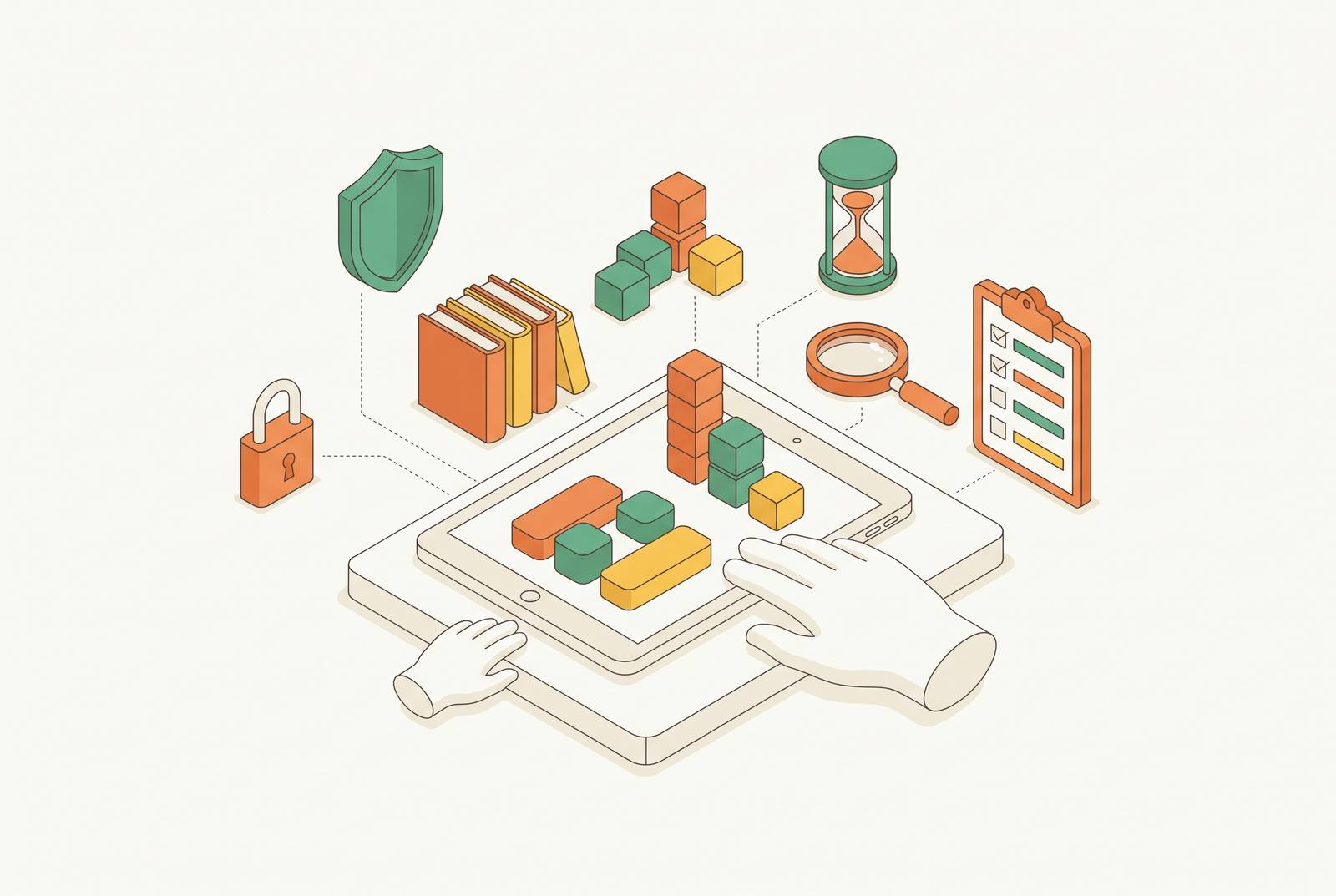
The best personalized AI tutor for reading and math for kids teaches a grounded curriculum, adapts during learning, protects children’s data, and shows parents which skills are improving. The deciding factor is not how long an app holds a child’s attention, but what the child can do without it.
Why choosing an AI learning app for young children is harder than it looks
When parents search an app store, they see bright characters, bold promises, and rows of stars. More than 500,000 apps are marketed as educational across major app stores. The choice is overwhelming, but the labels reveal little. A five-star rating can reflect entertainment rather than instruction, while a less polished app may have a stronger curriculum. Parents are being asked to judge teaching quality from a storefront built to sell downloads.
An app can include letters and numbers without teaching children how either works. Novelty complicates the decision further, because something that fascinates a child for a week may offer little as their skills grow. Lasting interest needs somewhere useful to go. Parents need an app whose learning progresses.
What effective reading instruction actually requires, and why it rules out most apps immediately
The Science of Reading provides the first filter. Skilled reading depends on five connected components, which are phonemic awareness, phonics, fluency, vocabulary, and comprehension. Phonemic awareness is noticing and working with the sounds in spoken words, while phonics links those sounds to letters. Fluency is reading smoothly without having to work at each word, vocabulary is knowing what words mean, and comprehension is understanding the text as a whole. An app covering only one or two cannot offer complete reading instruction.
Decoding is the hinge between recognizing words and understanding them. When working out each word consumes a child’s attention, little is left for meaning. Systematic phonics builds those sound-letter connections in an ordered way, helping decoding become automatic. But instruction must also reach children before they can read words. Explicit work on phonemic awareness and alphabet knowledge provides that foundation, while attention to early skills can help flag likely difficulties.
For parents, the lesson is to look beyond letter games. A claim of Science of Reading alignment should come with a clear account of what the app teaches. That includes pre-reading readiness. The practical filter is whether the curriculum explicitly covers all five components and gives beginners a route into them.
What effective early math instruction requires, and why it is easy to fake with games
Early math is more than arithmetic practice. Number sense and counting give children a base to build on that a string of correct taps may not give them. Early math skills at kindergarten entry are among the strongest predictors of later academic achievement, so a math label deserves scrutiny. Yet parents may not know which skills preschoolers can develop. That makes cheerful counting animations an easy substitute for a clear explanation of the curriculum.
Language belongs in this picture too. Numeracy, general language, and mathematical language help each other grow, and the ways they do so change across early childhood. Isolated number drills leave out that connection. Games can help when motivation is the obstacle, but their mechanics must serve the skill being taught. Earning virtual stars for selecting a number is not itself evidence of growing number sense.
For K–3 math, Common Core is a useful curriculum anchor in most U.S. states, though adoption varies and some states use modified or renamed standards. Alignment therefore needs to be checked against the standards used in the child’s state. Parents should ask whether content maps to Common Core or an equivalent framework. Parents should ask what mathematical understanding the game builds beyond getting the next answer right.
What real-time adaptability means and why most apps that claim it don't have it
Adjustable difficulty is not the same as adaptive teaching. An easy mode and a hard mode sort content into broad bands. Genuine real-time adaptability responds to a child’s voice, errors, and pace as the lesson unfolds. Unlocking another level after enough correct taps does not demonstrate that ability. The distinction is between reacting to performance totals and responding to the learner.
This difference works in both directions. A child who understands basic addition gains little from repeating the same problem type, while a child struggling with number sense can feel defeated by harder content. Useful adaptation keeps the challenge within reach without leaving the child stuck in repetition. High engagement cannot establish that this is happening, because pattern-matching and reflex-based gameplay can also hold attention.
Parents should therefore look for clear claims about what an app teaches and evidence to back them up, since the AI label alone proves little. Alignment with early literacy frameworks and input from child development researchers are useful signals. The practical test is whether adjustment is visible during a session. A learning path described as personalized still needs to respond to the child actually using it.
The cognitive offloading risk that makes AI design philosophy a parent's concern, not just a developer's
Bastani et al.’s 2025 research offers a warning about unrestricted AI help. Students using an unrestricted AI chatbot performed better during practice but worse on independent assessments than students who had not used AI. That is cognitive offloading, where the system does thinking the learner needs to practice.
The age distinction is important here. The scaffold-versus-substitute research involved high-school or college students, so its applicability to children ages 4–9 remains unestablished. An app that supplies answers or rewards correct taps without checking understanding can make successful performance a poor guide to learning.
Adaptation alone cannot settle that concern. A system might respond quickly even when the child can get by without thinking. Parents should ask whether the child must form answers, make decisions, and understand the task to succeed. Those actions are also the bridge from an abstract AI concern to something visible on the screen.
How to read an app's engagement design to tell teaching from distraction
Parents can start by watching for five minutes. Watch whether the child makes decisions, solves problems, and forms answers, or mostly swipes through screens and watches animations. Then say aloud what the child is doing without mentioning the screen. If the description is mostly about collecting stickers, it reveals where attention is going. This is a useful filter for engagement.
Rewards become a problem when pop-up characters, bonus mini-games, and flashing animations compete with the lesson. A reward that supports practice has a different role from one that repeatedly pulls the child elsewhere. The comparison is between engagement in learning and engagement around it. Time spent collecting prizes should not outweigh time spent practicing the promised skill.
Learning scientists use four observable criteria, which are active learning, engagement in the learning process, meaningful content, and social interaction. In plain terms, children should think, stay focused on the lesson, connect content to real experience, and have prompts for discussion or explanation. Session design offers another clue. Shorter, focused sessions suit young learners better than endless gameplay, while growing challenges give children a reason to return beyond another burst of animation.
Why privacy and ad-free design are non-negotiable for children under nine, not optional nice-to-haves
Young children cannot judge advertising and data collection the way adults can. Children under eight generally do not recognize advertising’s persuasive intent, even if they notice that a commercial looks different from other content. Even the older children in the 4–9 range are not well prepared to judge persuasive design. Ad-free design is a basic requirement here. It keeps commercial persuasion out of a setting presented as teaching.
The American Academy of Pediatrics warns that engagement-based design can encourage prolonged use, displace sleep and physical activity, and contribute to negative developmental outcomes. That warning concerns design priorities. Privacy requires a separate check. COPPA, the Children’s Online Privacy Protection Act, sets protections for children’s personal information.
COPPA’s 2025 amendments took effect June 23, 2025, and must be followed in full by April 22, 2026. They added biometric and government-issued identifiers to covered personal information and require data retention limits, while device IDs and IP addresses were already covered. Parents should look for a clear privacy policy naming COPPA compliance, explaining collection, and stating that data is not shared with advertisers or data brokers. Independent certification such as kidSAFE is another signal to check, together with ad-free use and no child-accessible in-app purchases.
What progress reporting actually tells parents — and why its absence is a red flag
Douglas, Msall & Rittle-Johnson’s 2023 paper suggests that parents’ knowledge of preschool math skills may shape their beliefs and efforts to support learning at home. Progress reporting can help parents understand what their child is ready to practice. Without that visibility, a parent may know that a session happened but not what it was for.
Time spent and badges earned cannot tell parents what the session was for. Useful reports identify skills covered, accuracy on specific concepts, and areas needing reinforcement. When those reports are linked to practice at home, parents can use what they learn from them away from the device. For a child who is struggling or learning differently, it also helps parents see whether the work is pitched above or below their level.
A month of use should not remain opaque. If a parent cannot name even one skill the child has built, the app has failed to explain its contribution, whether or not learning occurred. That signals a lack of transparency about progress. Good reporting treats parents as partners who can support learning, rather than bystanders expected to trust a badge count.
How do parents choose an AI reading and math tutor for a child who is struggling or getting ahead?
For a child who resists reading or falls behind in math, real-time adaptability takes priority. Content pitched too high can reinforce the resistance that brought the parent looking for help. Content pitched too low creates boredom instead. The useful target is a just-right challenge, backed by coverage of earlier foundations. A child who needs phonemic awareness cannot be served by an app that starts at grade level and stays there.
Progress visibility is especially valuable in that situation. Parents need to see whether the app is addressing gaps. Confidence should come from work the child can meaningfully attempt and learn from. Reward animations cannot make up for teaching that starts at the wrong level for the child.
For a child already at or above grade level, it matters more how far the curriculum goes. Parents should ask how far the content extends and whether adaptation can reach that far. A child who wants to learn needs a challenge more than extra prizes, and reports should show where the child is moving ahead. In either case, the app still needs to protect privacy and teach well.
A practical checklist parents can use before downloading or subscribing
Before subscribing, parents can turn these criteria into a short set of yes-or-no checks. Start with the curriculum. The reading program should explicitly cover the five components of reading and pre-reading readiness, while math should build number sense and counting within Common Core or an equivalent framework. A page advertising letter games and number activities does not answer those questions.
Look for responses to the child’s voice, errors, and pace, with adjustment visible mid-session. During a short trial, check whether the child thinks and forms answers, whether rewards help with that work, and whether there is a natural place to stop each session. Success should require more than tapping through animations.
Then check the terms of use. Confirm ad-free design, no purchases accessible to the child, a clear COPPA policy, and an explicit statement against sharing data with advertisers. Look for independent certification such as kidSAFE. Before paying, inspect whether parent reports show specific skills rather than time totals, and plan to check after one month whether at least three skills have been built. If the app cannot explain what it teaches, how it adjusts, or what progress looks like, its entertainment value is not a reason to subscribe.