Dyslexia Early Identification Before Formal Reading Instruction
Brain imaging shows dyslexia signals in infancy, years before schools typically look.
Dyslexia shows up in somewhere between 5% and 20% of kids, depending on which diagnostic criteria you use. That makes it one of the most common learning differences in any classroom, and most American public schools still run on what educators call the "wait to fail" model: a child has to fall visibly behind before anyone acts. That model has the timeline backwards. The signals are there years before a child opens a book, and the real failure is a lack of looking, even though the science has been available for years.
What the brain reveals about dyslexia long before a child opens a book
Start with what dyslexia actually is, because the popular version gets it wrong twice over. Kids aren't seeing letters backwards in any literal sense, and intelligence has nothing to do with it. Dyslexia lives in how the brain processes the sounds inside words and maps those sounds onto letters. It's a phonological issue, rooted in sound processing.
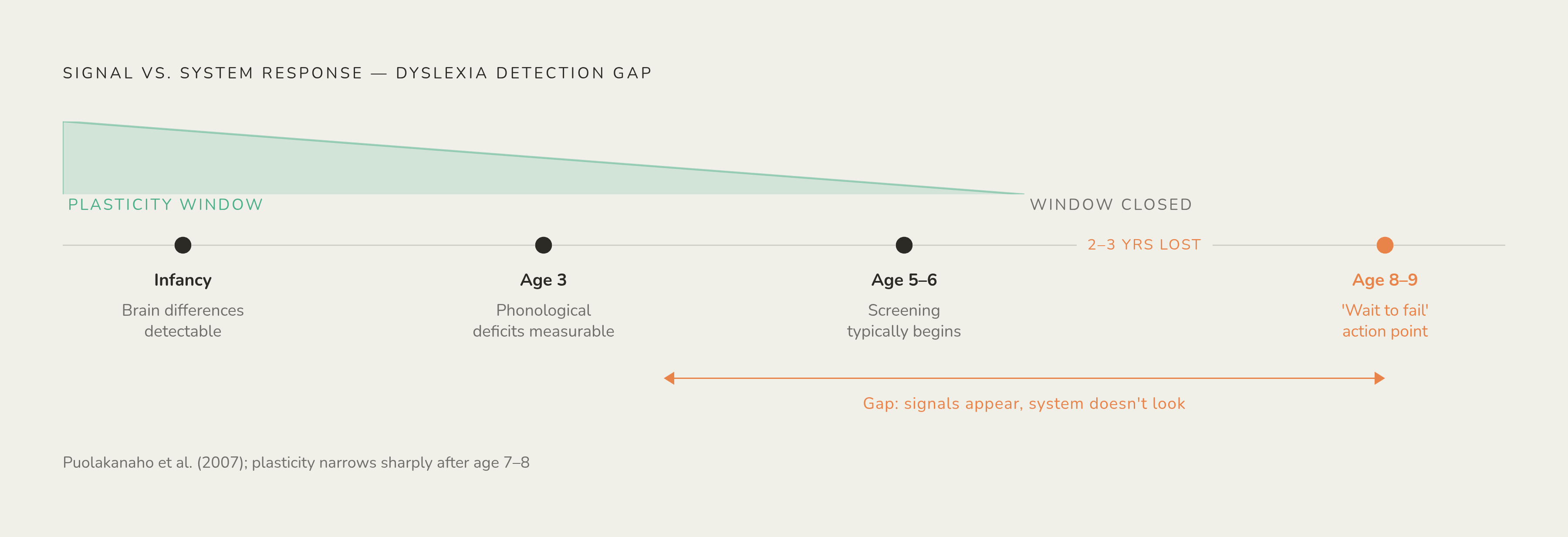
Here's the part that should change how parents think about timing. Neuroimaging research from Gaab and Duggan in 2024 found structural and functional differences in the brains of people with dyslexia as early as infancy, not kindergarten and not third grade. Dyslexia also runs in families, so a parent or sibling with a reading disability isn't a footnote on an intake form. It's a real risk signal, one that should raise a parent's attention before any academic struggle ever shows up.
Jack Fletcher, interviewed by the NIH in 2024, put the stakes plainly: "to develop reading skills, your brain has to reorganize itself." That phrase had to sit with the reader for a while before it clicked. That reorganization gets a lot harder after second grade, and the real deadline was never a school district's testing calendar, or a teacher's judgment call in October of third grade. It's the brain's own window for rewiring, and that window starts closing years before most screening even begins.
So if the signs are visible in infancy, why does the culture still treat early childhood as "too soon to know"? This question kept turning over, expecting a more complicated answer than the one landed on. Here's the uncomfortable answer: it isn't too soon at all. It's early enough that almost nobody's looking, and that gap between what the brain shows and what the system checks for is where kids lose years they can't get back.
The specific pre-reading signals parents can notice at ages 3–5
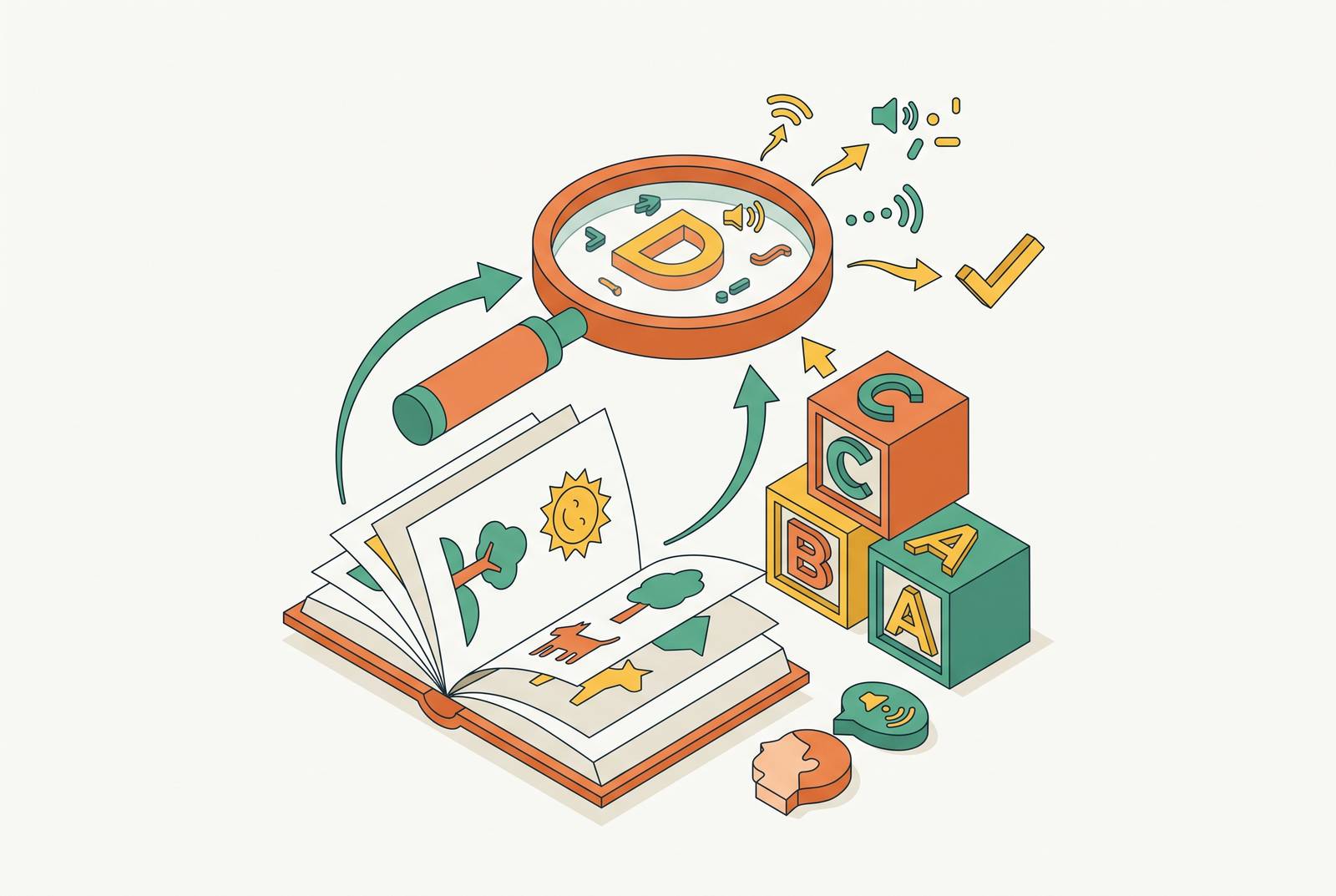
What does a parent actually look for? The most reliable early marker, well before letters or books enter the picture, is phonological awareness: can a child play with the sounds inside spoken words? That's a spoken-language skill, and it shows up long before any exposure to print. Parents waiting for a child to confuse "b" and "d" are watching the wrong signal at the wrong age.
A few concrete things worth watching between ages 3 and 5:
- Trouble remembering nursery rhymes or songs, or struggling to hear and produce rhymes during play
- Difficulty naming familiar objects quickly, with a noticeable lag retrieving words compared to other kids the same age
- Speech that's delayed relative to peers
- Trouble breaking words into syllables, or blending syllable sounds back together
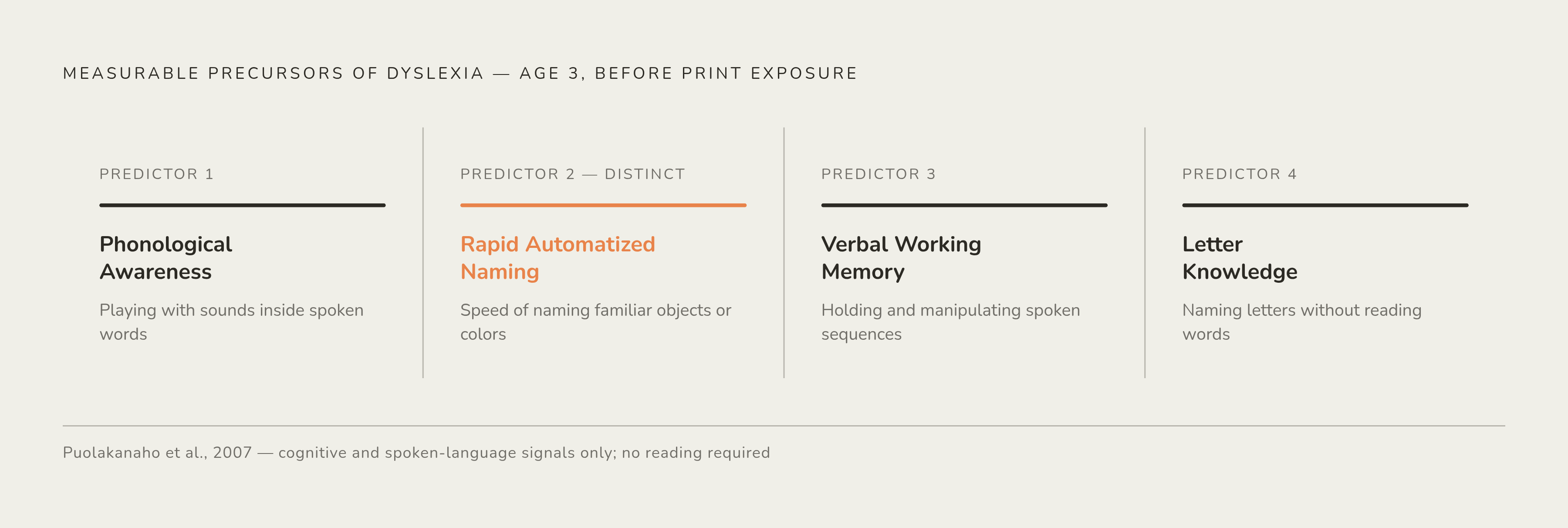
A 2007 study by Puolakanaho and colleagues found that deficits in phonological awareness, rapid automatized naming, verbal working memory, and letter knowledge were strong precursors of dyslexia in kids as young as three. Rapid automatized naming deserves its own mention: it's how fast a child can name a string of familiar objects or colors, and it turns out to be a distinct predictor from phonological awareness. Neither one alone tells the whole story, but together they're hard to ignore.
Noticing these signs isn't labeling a child, and none of it amounts to a diagnosis on its own. Family history changes the math, though. A child with a parent or sibling who has dyslexia, showing two or three of these markers, is a child worth getting evaluated soon.
Why waiting for kindergarten or first grade to raise concerns costs children time they don't have
The brain plasticity point from earlier gets very concrete here. Intervening before formal reading instruction starts means working with a brain that's still maximally open to reorganizing itself. Wait past that point, and the same intervention has to work harder for less. This is the part most parents and even some teachers get backwards: waiting to "see if it's really a problem" tends to turn a small problem into a large one.
A longitudinal study out of New England followed 1,200 kindergarten students and identified six distinct learning trajectories, three of them dyslexia risk profiles. The striking part: those profiles held stable over three years, meaning kindergarten patterns predicted third-grade outcomes reliably. There was back and forth on how much weight to put on a single study like this, but the stability of the finding is what settled it. That stability undercuts the comforting story parents and teachers like to tell themselves, that a child will just grow out of it. These are durable patterns, and durable patterns respond to instruction rather than to waiting around and hoping.
Without intervention, the gap doesn't stay the same size. Phonics and fluency expectations climb every year, so a small gap in kindergarten becomes a much bigger one by third grade. Catching up isn't just harder later; it's harder at a compounding rate, the reading equivalent of missed interest payments.
The good news: the window for action opens well before kindergarten. A pediatrician's well-visit at age 4 or 5, a preschool classroom, a parent simply asking for a screening — all three are legitimate starting points, and none of them require waiting for a school enrollment date.
How formal early screening works and what parents should ask about
Screening infrastructure has actually caught up with the science, at least on paper. Starting in the 2025-2026 school year, California became the 43rd state to require universal dyslexia screening in kindergarten through second grade. Over 40 states now have laws like this on the books, so most parents can expect some kind of school-based screening to happen, whether or not they ask for it. The mistake here would be assuming that just because a law exists, the screening will happen well or on time; it's worth checking rather than assuming.
What does a well-built screening tool measure? Phonological awareness, rapid automatized naming, verbal working memory, letter-sound knowledge, and, increasingly, spelling. Research has found that adding a kindergarten spelling measure to screening batteries meaningfully improved accuracy in flagging kids with reading difficulties. That surprised at first — spelling seems like a downstream skill, not an early indicator — but it turns out to be a genuinely good window into whether a child has actually internalized how sounds map to print, rather than just memorized shapes.
Parents may run into a couple of named tools along the way. The EarlyBird Program, developed by Dr. Nadine Gaab, Dr. Yaacov Petscher, and Carla Small in partnership with Boston Children's Hospital and the Florida Center for Reading Research, is a gamified pre-K and kindergarten assessment that works in a classroom or at home. The Tests of Dyslexia-Early, or TOD-E, covers ages 5 through 9 years and 3 months, assessing the core domains relevant to early dyslexia identification.
Timing matters as much as the tool. The recommended cadence is at least three screenings a year through third grade: fall, winter, and spring. Consistency matters more than any single snapshot; a single test on a bad day tells a parent almost nothing.
Worth sitting with honestly: universal screening throws off false positives. Some kids get flagged as at-risk who don't actually have dyslexia, and that creates real stress for families and real strain on already-thin school resources. A flagged result should prompt a closer look rather than panic or an assumption that something is wrong with the child.
What should a parent actually ask? Whether screening happens at the 4- or 5-year-old well-visit, and if a concern gets flagged, what the referral pathway looks like from there. Those two questions alone surface most of what a parent needs to know.
What a Science of Reading–aligned response to early risk actually looks like
Catching risk early only matters if something useful happens next. Identification without a real instructional response is half a solution, maybe less, and this is where a lot of well-meaning screening programs quietly fail: they flag the kid and stop. The research points toward structured, explicit, systematic phonics instruction: direct teaching of letter-sound relationships, moving away from guessing strategies built around picture cues or leveled readers that let kids skate past words they haven't actually learned to decode.
A few pieces matter most for kids showing early risk:
- Phonological awareness work done out loud, before print ever enters the picture
- Explicit phonics, teaching letter-sound relationships directly rather than hoping a child picks them up on the side
- Fluency practice, so word recognition becomes automatic and a child's mental energy goes toward understanding what they're reading instead of decoding it
- Oral language and vocabulary support, so comprehension keeps pace alongside decoding skill
Decodable texts matter a lot here too. Those are books built around the specific phonics patterns a child has actually been taught, as opposed to leveled readers, which often invite kids to guess at words from pictures or context. That distinction isn't cosmetic. For an at-risk reader, guessing becomes a habit fast, and it's a habit that's brutal to undo later, because the child learns to treat the picture as the answer key instead of the letters on the page.
One-on-one or small-group instruction is the gold standard for kids with dyslexia risk, and the reason is fairly mechanical: it lets an instructor slow down exactly where a child gets stuck and speed up exactly where they're ready, moment to moment. A whole classroom moving at one pace can't do that, no matter how good the teacher is. This is where AI-powered reading tools have started filling a real gap: software that listens to a child read aloud, adjusts to skill level in real time, and delivers instruction built on Science of Reading principles can bring that kind of responsive, one-on-one practice into homes that don't have access to a reading specialist.
The takeaway for parents isn't complicated, even where the science behind it gets technical. Structured literacy practice shouldn't wait for a formal diagnosis. Early, targeted, phonics-based instruction builds real skill for every young reader, and for a child already showing risk markers, that same instruction becomes protective, available years earlier than the system usually prompts anyone to look.