Supporting a Child Who Is Behind Grade Level in Reading
Research shows reading gaps stem from missing building blocks, not lack of ability.
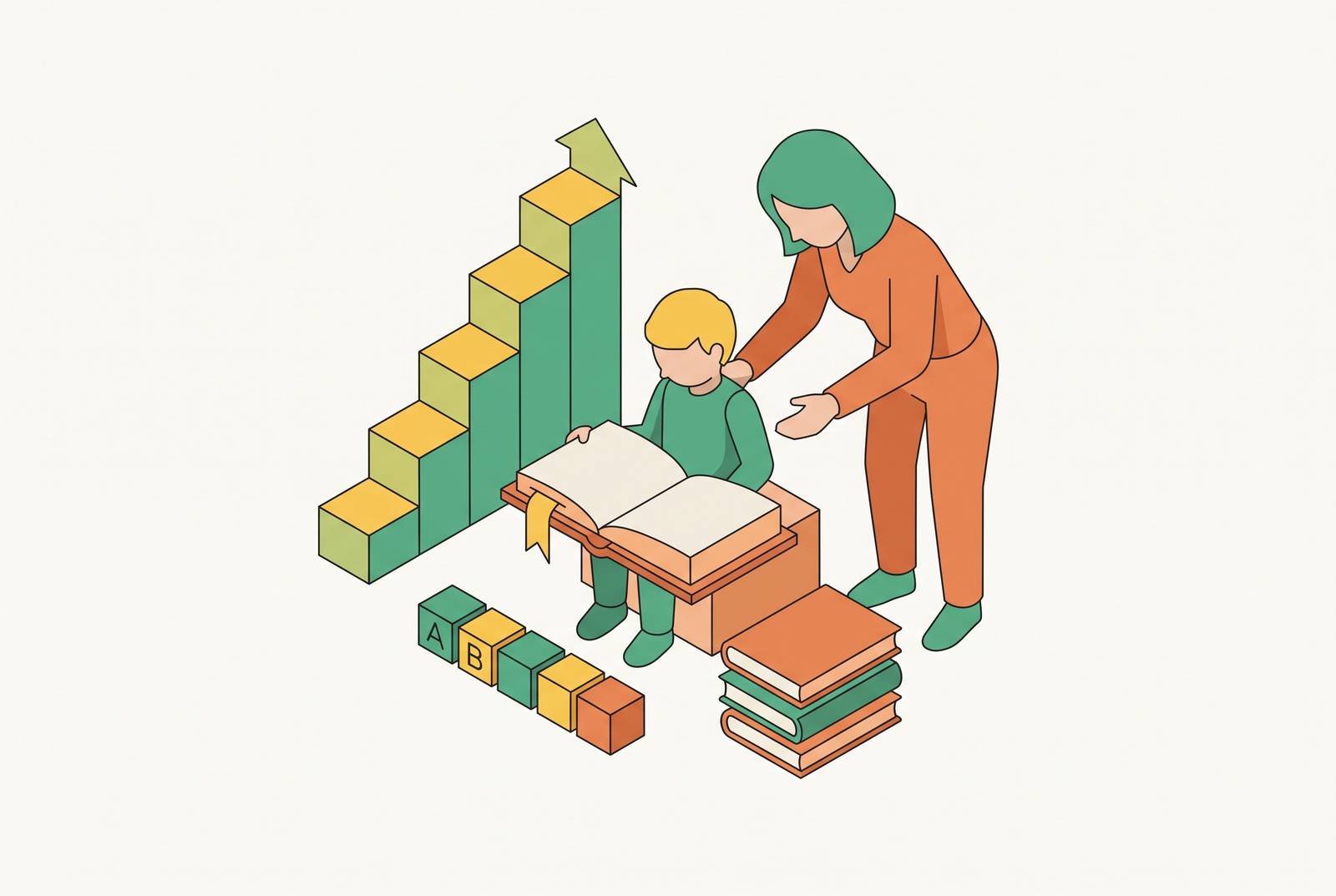
National reading scores have been slipping since before the pandemic, and the decline has continued in the years since. That trend carries real consequences for the kids living inside it, from classroom confidence to long-term academic trajectory. Naming this explains why so many parents sense something is off well before a teacher flags it, and why trusting that instinct matters. A child who is behind today is not destined to stay behind. The rest of this piece covers how reading develops, and what closes the distance.
The cognitive sequence behind reading gaps
Speech develops on its own. A baby surrounded by language starts talking without anyone running drills, because the brain is wired to pick up spoken language through exposure alone. Reading does not work that way. It has to be taught, deliberately and in sequence, and decades of research across cognitive psychology, linguistics, neuroscience, and education all land on that same conclusion. When a child is behind, it usually means a step in that sequence got skipped or never fully took hold, not that the child lacks some innate reading gift.
One of the clearest ways to understand that sequence is the Simple View of Reading, often written as R = D × LC: reading comprehension equals decoding multiplied by language comprehension. Decoding is the mechanical skill of connecting letters to sounds and blending them into words. Language comprehension is everything that lets a person make sense of those words once they're unlocked: vocabulary, sentence structure, the ability to infer what isn't said outright, and the background knowledge that gives words context. A child can decode fluently and still not understand the passage. Another child might understand everything read aloud to them but stall out completely on the page.
Scarborough's Reading Rope captures the same idea in a different shape: skilled reading is many strands braided together, word recognition strands and language comprehension strands alike, and if any single strand is thin, the whole rope weakens. Children also move through a predictable progression on the decoding side, starting with memorizing words by sight or shape, then grasping that letters correspond to sounds, then decoding words fully, and eventually recognizing familiar words automatically without sounding them out. A child stuck in an earlier stage needs instruction built for that stage, not simply more books placed in front of them.
Two skills appear as warning signs before a child ever reads a single word: phonemic awareness, the ability to hear and manipulate individual sounds inside words, and alphabet knowledge, knowing which sounds go with which letters. NWEA's explainer on the Science of Reading notes that screening for these two skills can flag children likely to struggle well before they visibly fall behind.
Kids who've learned to guess at words using pictures, sentence context, or the shape of a sentence rather than actually decoding them can fool a lot of attentive parents. This is a known artifact of the three-cueing approach, a method now considered discredited and explicitly banned under Oklahoma's Strong Readers Act. These children can sound like readers in a casual conversation at home. An unfamiliar word with no context clues to lean on makes the gap obvious.
What the Science of Reading requires, beyond phonics
Phonics has become shorthand for the entire Science of Reading in a lot of public conversation, and that shorthand causes real problems. Maria Murray, founder and CEO of the Reading League, has said directly that the idea the science of reading only supports phonics instruction has been hard to dislodge. She's also pointed out that the movement is now deliberately widening its focus to include language comprehension, vocabulary, and the social and cultural factors that shape how well a child learns to read.
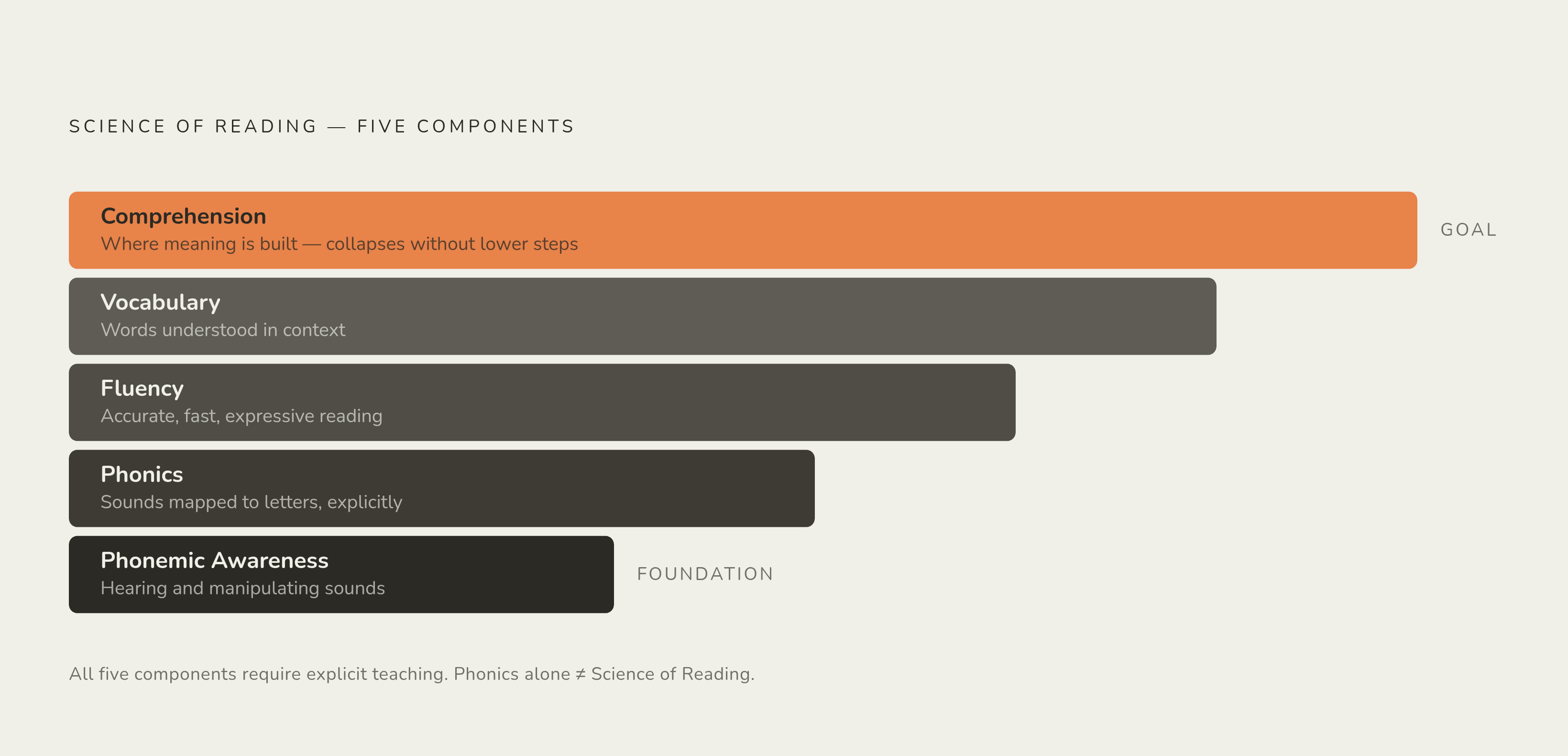
The full picture includes five components, each one building on the last: phonemic awareness, phonics, fluency, vocabulary, and comprehension. Phonemic awareness is the oral foundation, hearing and manipulating sounds before any letters are involved. Phonics builds on that by connecting those sounds to letters in a planned, explicit sequence that moves from simple patterns to complex ones. That instruction doesn't stop mattering once a child leaves the early grades. LiteracyPlanet's 2025 overview notes that older students keep relying on decoding skills when they hit complex, subject-specific vocabulary in later schoolwork. Fluency comes next, reading with accuracy, speed, and natural expression. When decoding is still effortful at this stage, the mental energy that should go toward understanding a sentence gets spent instead on wrestling with individual words. Vocabulary and comprehension are at the top of the stack, where words get understood in context and meaning actually gets built.
Language comprehension needs its own explicit teaching, the same way decoding does. Julie Van Dyke, a researcher at the Yale-UConn Haskins Global Literacy Hub, has pointed out that written language is full of structures, subordinate clauses among them, that appear constantly in books but rarely in everyday speech. Those structures have to be taught directly. A child doesn't absorb them automatically just because they can hold a conversation.
If a school says it's already using the Science of Reading, that doesn't necessarily settle things. Not necessarily. Adopting a phonics program is not the same as implementing the full Science of Reading. EdWeek's 2025 coverage of the Reading League's summit documented real cases, including in New York City, where a mandated program was chosen specifically for its systematic approach to word-reading, and that choice ended up introducing new gaps elsewhere in reading instruction. None of this is a case against schools or their programs. It's a reason for parents to understand the five components, phonemic awareness, phonics, fluency, vocabulary, and comprehension, well enough to ask precise questions about what's covered and what isn't.
Spotting the specific gap your child is in
The five components work together, phonemic awareness, phonics, fluency, vocabulary, and comprehension, each layer depending on the one before it. The same surface symptom, a child who won't read, reads painfully slowly, or reads without seeming to understand, can come from entirely different causes, and each one calls for a different response. A parent who can name the specific gap is already ahead of where most parents start, simply because so few people get past "my child isn't reading well" to ask what exactly is breaking down.
Three patterns appear most often at home. A decoding gap looks like a child who sounds out familiar words just fine but freezes on anything unfamiliar, often guessing from the first letter or a nearby picture and avoiding reading aloud. A fluency gap looks different: the child can decode individual words accurately but reads in a halting, word-by-word rhythm that burns up all the mental energy before comprehension even gets a chance. A comprehension gap is the trickiest to catch, because it can look like fluent reading on the surface. A child reads a paragraph smoothly out loud, then can't retell what it said in their own words. Asking for that retelling is a simple test. If it's difficult, decoding has outpaced meaning-making, even though the reading sounded fine to the ear.
For younger children who haven't started reading words yet, the markers are even earlier: trouble clapping out syllables, trouble rhyming, or trouble hearing the first sound in a spoken word. These are phonemic awareness signals, and they predict decoding trouble down the road if nobody addresses them now.
Schools organize support through a framework called MTSS, and parents should ask directly which tier a child is receiving. Whole-class instruction makes up Tier 1, which fits most students but isn't enough on its own for a child who's already behind. Tier 2 is small-group, targeted support, appropriate for a child who's somewhat behind. Tier 3 is intensive, individualized instruction for significant gaps, and parents have every right to ask why a child is or isn't placed there and whether the school has run early skills screening at all. Both NWEA and Science of Reading researchers agree that this kind of screening can catch at-risk kids before they fall measurably behind, so a school that hasn't screened has already told a parent something important by that absence.
One practical red flag belongs at home as much as at school: if a child keeps bringing home books that feel too hard, specifically below 90 to 95 percent word accuracy even with decent comprehension, that material is working against the child's confidence instead of for it.
If none of this resolves with consistent support at home and school, or if a child's self-esteem is visibly taking a hit from the struggle, that's the point to bring in a professional evaluation. A psychoeducational evaluation can identify dyslexia or another learning profile that changes the whole approach to intervention.
Evidence-based actions parents can take at home right now
Home support works best when it mirrors what actually works in a well-run classroom: explicit, structured practice with sounds and words, reading material pitched at the right difficulty, daily consistency, and real conversation that builds comprehension, rather than passive screen time or more of whatever approach has already failed to move the needle.
For a decoding gap, oral practice with sounds matters first: sound-sorting games, rhyming, and asking a child to count how many sounds are in a word like "ship." NWEA notes that pairing those sounds with visible letters, using magnetic tiles or a simple whiteboard, makes the practice land better than oral work alone. Decodable texts, books built specifically to reinforce the letter-sound patterns a child has already been taught, work better here than leveled readers, which can quietly encourage guessing instead of decoding. Word families help too: swapping one sound at a time, turning "cat" into "bat" into "hat," makes the underlying pattern visible in a way a child can actually see and hear.
For a fluency gap, repeated reading of a familiar, manageable text builds speed and natural expression without piling on new decoding demands. Audiobooks paired with the physical text, listening while tracking the words with a finger, take the decoding pressure off and let a child hear what fluent reading actually sounds like, which supports comprehension even in older kids who are still struggling. Reading aloud to a child at a level above what they can read independently builds vocabulary and language comprehension at the same time, without asking the child to do any decoding.
For a comprehension gap, the first move after reading a short passage is asking the child to retell it in their own words before asking any specific questions. That retelling shows whether meaning is actually being built or whether the child is just producing sounds in order. Talking through unfamiliar words before starting a new book lowers the mental load once reading actually begins. It also helps to teach a child to notice when understanding has broken down, simply asking "does that make sense?" while reading together models a habit of self-monitoring that strong readers do automatically.
The research points to "just-right" texts: books where a child can read roughly 90 to 95 percent of the words independently while still understanding what's happening. That range builds fluency and confidence together. Books pitched above it tend to damage both at once. Consistency also counts more than length of session. As little as 10 to 15 focused minutes a day builds real stamina and makes reading feel like a smaller, more manageable task over time, and a parent's own visible attitude toward reading shapes how much value a child places on it. A tricky word sounded out successfully, a new genre tried for the first time, a full page read without stopping, each one adds up, and those small wins accumulate into a child who genuinely believes reading is something they can do. What doesn't help is repeating the same failing task harder. If a child keeps stumbling on the same type of word again, the instructional approach needs to change rather than just the number of repetitions. Home practice like this moves the needle on its own, and for a child who's significantly behind, it tends to work best paired with structured support built for exactly these gaps.
What to look for in a reading support tool
Not every reading app adapts to a child, even when it claims to. The real distinction is between a tool that responds to what a specific child does, slowing down on a weak sound, adjusting material to the right difficulty, catching a comprehension gap a parent might miss, and a tool that just serves up the same fixed content in a shinier wrapper regardless of how the child is performing. That distinction is the single most important thing to understand before choosing one.
Given everything the research shows about how reading actually develops, a worthwhile tool should reflect the same structure: explicit, sequenced practice across phonemic awareness, phonics, fluency, vocabulary, and comprehension, not phonics in isolation. It should be able to recognize a decoding gap and a comprehension gap separately, the same way a parent is learning to in this piece, and adjust what it offers accordingly. It should offer texts at that 90 to 95 percent accuracy range rather than pushing a child into frustration or letting them coast. None of that requires AI to replace a parent's judgment or a teacher's instruction. What adaptive technology can reasonably do is bring the kind of targeted, responsive practice described throughout this piece into daily reach, consistently, in the small ten to fifteen minute windows that build stamina over time. The research is clear about what closes reading gaps: explicit teaching, the right level of material, consistent practice, and accurate information about where a child actually stands. Any tool worth a parent's time should be judged against that standard and nothing less.
Sources
- Science of Reading in 2025: Why Phonics Still Matters
- What is the Science of Reading?
- What the science of reading tells us about how to teach decoding—including phonics - Teach. Learn. Grow.
- 'Science of Reading’ Advocates Underscore: It’s Not Just About Phonics
- The Science of Reading: What Is It and How Does It Inform Literacy Instruction?