The Checklist Reading Specialists Use When a Child With Dyslexia Has Outgrown Basic Apps
Four tests show whether a reading app teaches the next stage.
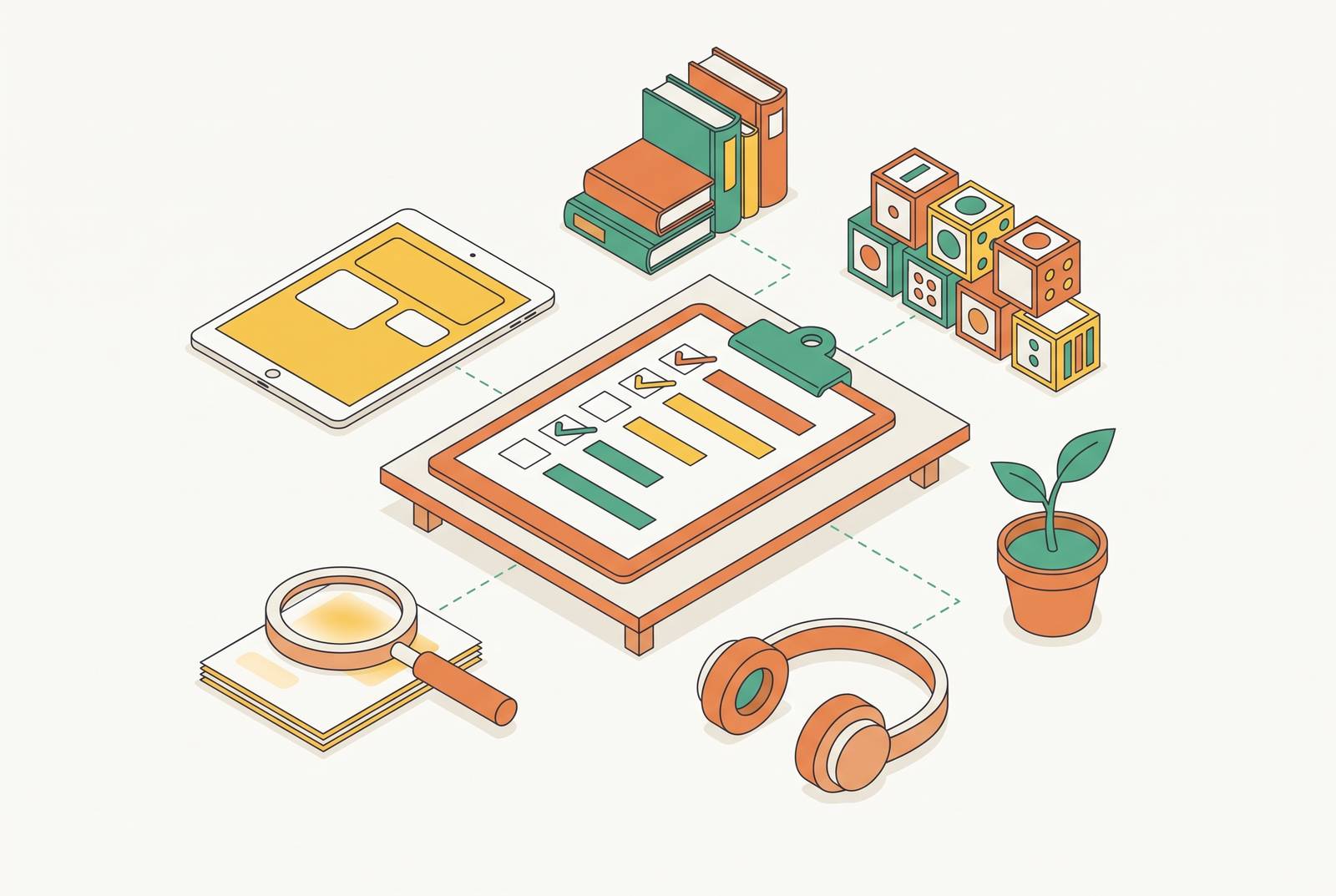
A reading app for a child with dyslexia or a language-based learning disability should move beyond rewarding skills the child already has and teach the skills the child still needs. After basic phonics, the tests are explicit multisyllabic instruction, real-time oral feedback, built-in fluency practice, and usable progress data. This checklist separates tools that teach the next stage from those that offer more of the first.
Why basic phonics apps hit a limit for children with dyslexia — and what that limit actually is
The levels are finished and the stickers collected. Then a parent hands over a real book, and the reading is still slow, uncertain, and full of guesses. That mismatch can look like a child failing to use what they learned. Often, it exposes a narrower problem. The app taught basic letter-sound mapping, consonant-vowel-consonant words, and early blending, while the book demands multisyllabic decoding, fluency, and comprehension.
Dyslexia is a neurological difference in how the brain processes language. Without explicit, systematic intervention, the reading gap widens over time. More exposure alone does not solve that problem. Yet entry-level apps can encourage guessing from pictures or memorizing word shapes rather than teaching a dependable way to decode unfamiliar words.
By mid-elementary, a child may have learned most of those early skills but still struggle badly with longer text. At this transition, simple words are manageable but multisyllabic words trigger substitutions, omissions, and laborious reading that breaks comprehension. Completing its lessons marks the end of its sequence while the child’s reading needs may remain unmet.
What a proper baseline looks like before any new tool is chosen
A parent or specialist starts by having the child read a just-right passage aloud and keeping track of words correct per minute, or WCPM, and accuracy. Errors need names, including omissions, substitutions, and reversals. The record should also capture how the child feels before and after reading, because rising frustration belongs in the picture.
That passage establishes a starting point, but it does not diagnose dyslexia. Neither does an app. Screening can show signs of risk, but the child still needs a separate, comprehensive evaluation by a school psychologist, neuropsychologist, or qualified reading specialist. The baseline shows where reading stands beyond app levels and creates documentation for an educational support plan, or IEP, or an eligibility meeting.
The next step is to compare that starting point with the specific targets in the child’s IEP or 504 plan. Those might include accuracy with multisyllabic words or a WCPM range on grade-level passages. The target gives the tool a defined job. “Dyslexia support” is too vague to test against a child’s needs, while a named skill and a recorded starting point make change measurable. Without a baseline, you cannot tell whether a new tool is working.
The first criterion specialists check — explicit multisyllabic and morphological instruction
The gap between reading single-syllable words and reading multisyllabic words is the first test of fit. Children benefit from learning to identify morphemes, the meaningful parts within words, including base words, prefixes, suffixes, and roots.
Morphological instruction teaches how those parts combine. This strand, also called structural analysis, helps children read, spell, and understand multisyllabic words they have never seen before. It connects decoding with meaning rather than treating a long word as an unbroken string of sounds. At this stage, it is a selection criterion.
Lexia Core5’s evidence review identifies structural analysis as one of six reading areas, together with phonological awareness, phonics, vocabulary, fluency, and comprehension. Its adaptive technology adjusts difficulty based on student performance. Nessy Reading & Spelling offers another concrete example of deliberate instructional design, teaching phonics and spelling patterns in small, cumulative, repeated steps grounded in Orton-Gillingham principles. Dyslexia is its primary design case. Does the tool teach prefixes, suffixes, and roots explicitly and in sequence, or does it stop at blends and digraphs?
The second criterion — real-time adaptive feedback on oral reading, not end-of-task scoring
Content alone does not make instruction responsive. A child with dyslexia also needs feedback that arrives at the right time, identifies the actual error, and changes what happens next. More worksheets cannot supply that by themselves. Real-time speech recognition can detect a miscue as the child reads and prompt accurate letter-sound mapping before the error becomes a habit.
The distinction is clearest in what the feedback reveals. An end-of-task score might report seven out of ten. Specific oral-reading feedback can instead reveal that the child substituted the vowel sound in every two-syllable word with a short /e/. That pattern changes what needs teaching next.
AI tools built to teach by listening to a child’s voice, making sense of it, and responding teach in a different way from quizzes that score answers afterward. The label “AI” alone proves none of this. The relevant capability is moment-to-moment adaptation, including decisions about what to teach next and when to move on. For families without access to a certified tutor daily, that kind of response can bring one-on-one structured literacy support within reach.
The third criterion — fluency practice built into the program, not bolted on
A child can read each word correctly and still miss what the sentence means. When decoding is halting and effortful, the mental work can overwhelm the ability to hold meaning. This criterion concerns fluency, particularly rate and automaticity.
Repeated reading is the evidence-grounded mechanism here. The child reads the same controlled passage multiple times with feedback, rather than meeting only new material in every session. Specialists check WCPM from one session to the next and look at whether those numbers change what the child practices next. An accuracy threshold that merely unlocks another passage does not answer that question.
Fast ForWord, developed by neuroscientists, targets memory, attention, processing, and sequencing that support stronger reading fluency, in both school and home settings. Learning Ally serves a different need. Its human-narrated audiobooks, synced with on-screen text and including textbooks, help students maintain access to content while decoding catches up.
For parents, the practical test is change over time. A modest rise in WCPM by day seven of a trial, with fewer targeted errors, is a signal to continue. Flat WCPM or rising frustration despite consistent use is a signal to escalate.
The fourth criterion — progress data specific enough to bring to an IEP meeting
A dashboard that reports minutes used shows participation, while WCPM, accuracy by error type, and mastery of specific syllable patterns show what is changing. To earn a place in a formal support plan, a tool needs to connect those changes to the child’s targets.
Lexia Learning’s 2025 data showed that 88% of K–3 students who used Core5 as much as recommended moved ahead in grade level in Core5. The qualification “in Core5” is important. That is a defined program outcome, which needs to be considered alongside the individual child’s passage-reading baseline. For an IEP discussion, reporting needs to reach the relevant skills, such as syllable-pattern mastery, fluency with multisyllabic words, and the errors that still require instruction.
Specialists use the same categories, including substitutions, omissions, and reversals, so that an app session and a school intervention contribute to one coherent picture. Those records can help the team decide whether to change accommodations, text levels, or intervention minutes, giving them more to go on than a parent’s general sense of how things are going.
The practical step is to hand the IEP team a log with dates, WCPM, accuracy, and error types, then ask whether the tool’s data maps to the plan’s goals. If it does not, the tool may provide practice in a different role, with documentation still needed to judge it as an intervention.
What reading apps actually help kids with dyslexia learn to read, beyond “dyslexia-friendly” marketing?
“Dyslexia-friendly” is a marketing label. It can appear on tools built around picture cues and whole-word memorization, even though those methods conflict with the structured decoding instruction dyslexic learners need. This makes the market confusing for a reasonable parent.
The checklist replaces that label with observable requirements. A program either has or lacks each of these features: explicit word-part instruction, responsive oral feedback, WCPM tracking, and IEP-compatible reporting. Repetition also has to run through the teaching. Orthographic mapping research shows that dyslexic children need many more repetitions to store words in long-term memory, so moving on without cumulative review gives them less of the practice they need.
The named options illustrate why there is no useful single ranking without a defined job. Core5 documents structural analysis, while Nessy emphasizes cumulative phonics and spelling instruction. Fast ForWord targets underlying cognitive skills that support fluency. Learning Ally lets children use books while they learn to read elsewhere. Those distinctions help separate teaching a missing skill from accommodating its absence, without treating either role as worthless.
Access complicates the choice, and it cannot be dismissed. Orton-Gillingham tutors cost a lot per hour, and few families can pay for as many sessions as their child needs, especially where schools do not offer Tier 2 and Tier 3 supports. Well-designed adaptive apps may help meet some of that need. But when a tool is expected to stand in for specialist instruction rather than supplement it, the standard must rise. The checklist helps families judge the best option they can get, while still asking whether a tool they can afford does enough.
When the checklist points past apps entirely — recognizing the signs that a human specialist is the right next step
Some children’s needs exceed what an app can provide. If a child does not respond to a consistent period of daily instruction with a tool meeting all four criteria, the next move points toward a human specialist. WCPM and error-pattern data over several weeks give that decision a basis. The school team can use the record when considering Tier 3 support or a specialist referral.
The Wilson Reading System offers an evidence-based Orton-Gillingham approach for grades 2–12 with visual and kinesthetic cues beyond traditional phonics. Physical tiles and finger-to-thumb sound tapping add forms of instruction that no current app replicates. Trained instructors adapt the framework to the student in front of them. Wilson Language Training states that its Level I and Level II Certifications hold International Dyslexia Association AccreditationPlus recognition. Barton Reading & Spelling is another structured literacy approach recommended for students who have not responded to other interventions.
AI-based intervention is also developing, but it has limits. Dysolve, created by clinical linguist Dr. Coral Hoh and validated by a completed university-led randomized controlled trial, uses customized exercises for decoding and language processing. Even with that new work, there is still a need to understand why each child struggles. AI cannot fully interpret the “language triangle” when accurate decoding coexists with poor sentence understanding because vocabulary or syntax interferes.
A skilled specialist can examine that interaction directly. The specialist can also understand the history behind hesitation or recognize why one correctly read word represents an enormous breakthrough. Those judgments shape instruction in ways no current tool replicates. For parents taking the next step, the criteria in this checklist provide the vocabulary to evaluate a recommendation in conversation with the reading specialist too.